The 10 Best Portable Solar Generators of 2026: Reliable Power for Off-Grid Living
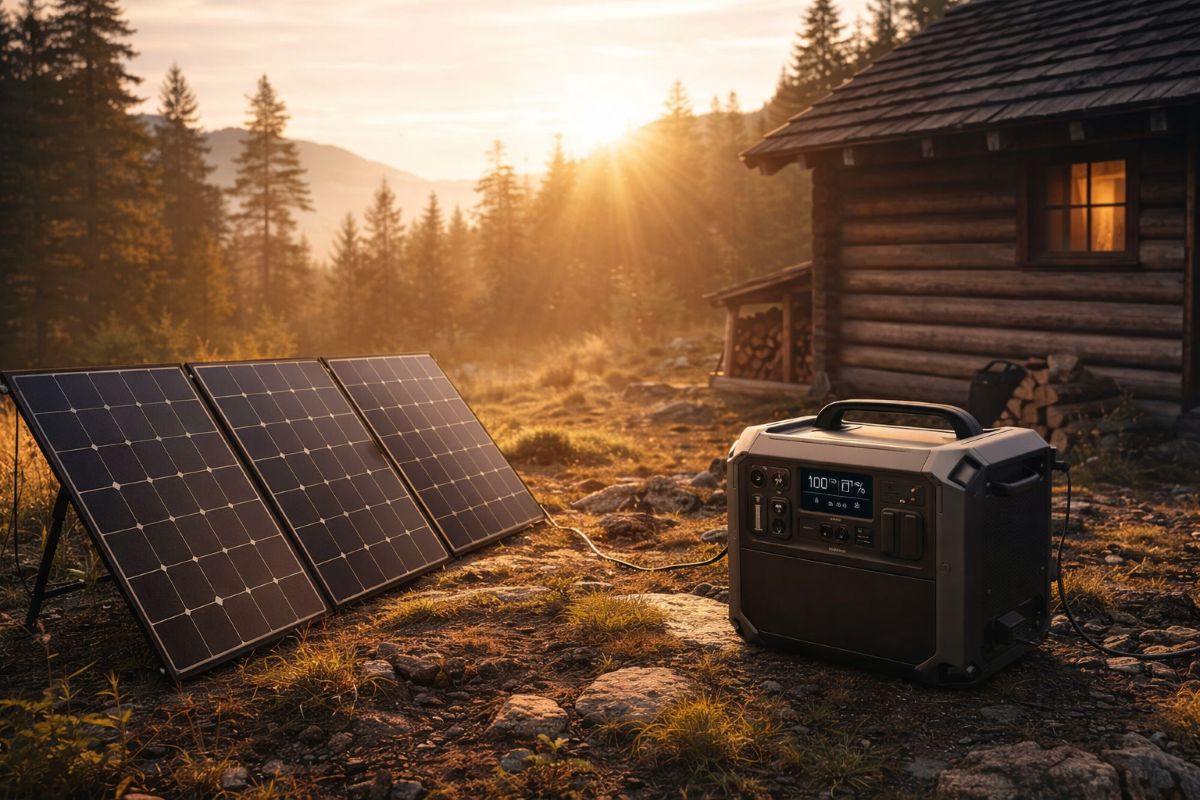
This guide uses “solar generator” in the common sense: a portable power station paired with compatible solar panels. The battery, inverter, charge controller, and outlets are built into the station. Panels are usually sold separately or as a bundle. That convenience is valuable, though it does not remove the need to size the system honestly.
Best Solar Generators by Use Case
| Use Case | Best Pick | Why It Stands Out |
|---|---|---|
| Serious home backup or cabin loads | EcoFlow DELTA Pro 3 | 4,096Wh base capacity, 120V/240V output, and a large expansion path |
| Scalable off-grid system | BLUETTI Apex 300 | High output, strong solar capability, and unusually broad system expansion |
| Simple modular backup | Jackery Explorer 2000 Plus | Straightforward controls, 2,042Wh base capacity, and established expansion options |
| Balanced 2kWh class | BLUETTI AC200L | Solid output, useful ports, and a practical capacity range for many users |
| Value-focused home backup | EcoFlow DELTA 2 Max | 2,048Wh, 2,400W output, and expansion without moving into whole-home pricing |
| Compact emergency power | Anker SOLIX C1000 Gen 2 | A 1,024Wh unit with 2,000W output and unusually fast AC charging |
Use-case selection is more useful than chasing one headline specification. A large station that cannot accept enough solar to recover between cloudy days is a poor cabin system. A compact unit can be excellent for an apartment outage even if it would be inadequate for a refrigerator, pump, and workshop.
Who These Systems Are For
Cabin owners need to think in daily energy, weather, and recharge windows. A station can run a light overnight load easily, then still fail the larger job if its panels cannot restore the battery after a gray day. Expansion batteries and solar-input limits matter more here than a long list of USB ports.
Van and RV users tend to value manageable weight, a clean 12V plan, and fast recovery while driving or parked. A portable station is often a sensible first system, but it must fit the vehicle’s storage, ventilation, and tie-down plan. A 90-pound unit is portable in the technical sense, not necessarily convenient to move alone every day.
See Related: https://offgridatlas.com/battery-storage/portable-battery-systems/
For home emergency backup, simplicity matters. The best station is usually one that can keep communications, lights, medical equipment, refrigeration, and device charging running without a complex installation. If you intend to power a home circuit through a transfer switch, consult a qualified electrician and follow local electrical rules.
Hybrid off-grid homes and workshops need more caution. Portable stations can support important loads, but a large, permanent electrical system may be better served by a purpose-built inverter, battery bank, disconnects, and code-compliant distribution equipment. Do not treat a power station’s marketing claim as permission to improvise household wiring.
What to Look For in a Solar Generator
A power station combines energy storage, AC inversion, DC charging, and output ports in one enclosure. It saves time and reduces wiring complexity, but its limits are still real. Assess the system as a whole: stored energy in watt-hours, continuous inverter output in watts, solar-input ceiling, compatible voltage range, usable outlets, and ability to expand.
Start with the loads you genuinely need. A phone and LED lights require very little energy. Refrigeration, induction cooking, well pumps, space heating, air conditioning, and power tools are different categories entirely. Their running draw, startup surge, and hours of use must all be considered.
Pay close attention to charging limits. Solar-panel wattage printed on a box is not the energy you will necessarily harvest. Sun angle, shade, temperature, panel orientation, wire losses, and the station’s own maximum PV input all affect production. The panel array must remain within the station’s published voltage and current limits.
Battery Capacity (Wh) — Your Real Fuel Tank
Watt-hours measure stored energy. They are the most useful first comparison, but they are not a direct promise of AC runtime. The inverter consumes some energy, batteries have protective reserve, and an appliance such as a refrigerator cycles rather than drawing its nameplate wattage constantly.
For planning, begin with the energy each essential load uses in a day. A compact refrigerator might consume roughly 800 to 1,500Wh per day depending on ambient temperature and efficiency. A router, a few LED lamps, phones, and a laptop may add another 400 to 900Wh. The exact figures come from your equipment, not a generic list.
In a simple emergency setup, a 1,000Wh-class station can be a useful communications-and-lights reserve. A 2,000Wh-class station is a more comfortable starting point for a refrigerator plus smaller essentials. Daily cabin use commonly pushes beyond that, particularly once a pressure pump, cooking appliance, or work equipment enters the picture.
Add reserve capacity before buying. A 25 percent buffer can be reasonable for short, predictable outages with alternate charging available. For off-grid use or winter conditions, a 50 percent buffer is a safer starting point. The reserve is not wasted capacity. It is what prevents normal variation from becoming a dead battery.
Most current stations in this class use lithium iron phosphate, often written LiFePO4 or LFP. It generally offers a longer cycle life and better thermal stability than older lithium-ion chemistries. That does not eliminate the need to follow the manufacturer’s temperature, storage, charging, and transport guidance.
See Related: https://offgridatlas.com/battery-storage/battery-runtime-calculator-off-grid/
Inverter Output (W) — What You Can Actually Run
Capacity tells you how long a load may run. Inverter output tells you whether the station can start and operate it at all. A 2,000Wh battery connected to a 1,000W inverter still cannot continuously power a 1,500W kettle or a heavy shop tool.
Check continuous output first, then look at surge capability. Motors and compressors can draw a brief startup surge that is far above their normal running draw. Some stations include load-management modes that can run certain resistive appliances above the nominal rating, but those modes are not a substitute for properly rated output and are unsuitable for every device.
A 1,800W to 2,400W inverter covers many emergency and mobile loads, including refrigerators, small microwave ovens, coffee makers, common power tools, and electronics. Larger cabin or home-backup ambitions may justify 3,000W or more, especially when several loads could overlap. Do not plan to run a high-draw appliance simply because it has started successfully once.
If you need 240V power, verify it explicitly. Some large stations provide 120V and 240V from one unit; others require two compatible units or an accessory. The outlet, cable, and transfer equipment all need to match the intended use. A station with a 240V claim is not automatically a whole-home solution.
Solar Input (W): How Fast You Recover
Solar input determines how quickly sunlight can replace what you used. It is one of the most important differences between a short-term backup station and a workable off-grid system. A large battery is useful only until it needs to be recharged.
For a 2kWh station, 500W to 800W of compatible solar input can be useful in good conditions, but the actual daily harvest depends on the site. A large station that can accept 1,200W to 2,400W has more room to recover from a deep discharge, provided you can deploy an array large enough to use that capability.
The station’s PV input window matters as much as the wattage ceiling. Series wiring raises voltage; parallel wiring raises current. Exceeding the published open-circuit-voltage limit can damage equipment. Under-sizing voltage can prevent the MPPT controller from starting efficiently. Use the panel and power-station manuals together before choosing cables or wiring arrangements.
Do not design around perfect summer sun. Estimate from the poorer seasons and less-than-ideal weather that matter to your use case. If a system supports critical loads only on the clearest day of the year, it is undersized for resilience.
Build Quality and Longevity
Portable power stations experience more handling than fixed batteries. Look beyond capacity to enclosure strength, handle design, outlet protection, display legibility, cable strain relief, fan behavior, and how well the unit can be secured during transport. The best capacity on paper is of little value if the system is awkward to deploy or poorly protected from damage.
Firmware and app features can be helpful for monitoring input, output, and charge limits. They should never be the only way to understand or operate essential functions. During an outage, physical controls and a clear display are more valuable than a phone-dependent feature list.
Warranty terms deserve a careful read. Check the coverage period, whether it applies in your country, the process for battery service, and the availability of expansion batteries after the initial purchase. Avoid assuming that a brand’s older accessories will work with a newer product family.
How to Actually Size Your System (Without Guessing Wrong)
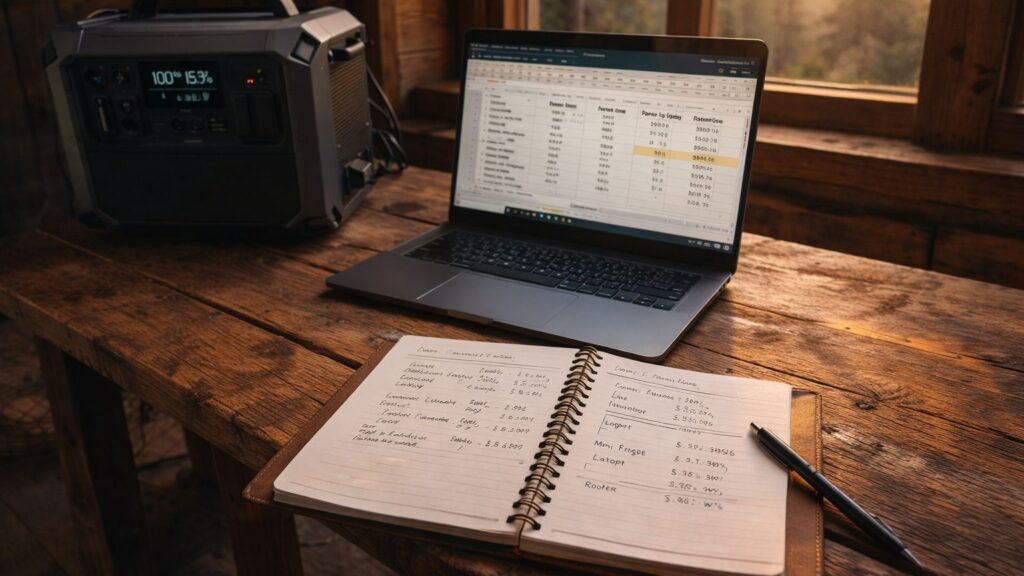
The practical sizing process is simple, though it requires honest numbers. Build the system around essential loads, the duration of the outage or trip, and the recharge sources you can realistically use. Do this before comparing product photos or sale prices.
Step 1: Start With Daily Energy Use
List each load, its average wattage, and the hours it runs in a day. Multiply watts by hours to estimate watt-hours. For cycling appliances, use a plug-in energy meter over a normal day whenever possible. A refrigerator’s nameplate wattage does not reveal its daily energy use.
For example, a router using 12W for 24 hours consumes about 288Wh. A 60W laptop used for five hours consumes about 300Wh. Four 10W lights used for five hours consume about 200Wh. Add the actual refrigerator measurement rather than guessing, then include phone charging, CPAP equipment, or other non-negotiable loads.
Step 2: Add a Realistic Buffer
Once you have a daily estimate, add a reserve for inverter losses, changing habits, weather, and imperfect battery conditions. A 1,600Wh daily essential-load plan becomes roughly 2,000Wh with a 25 percent buffer, or 2,400Wh with a 50 percent buffer.
The buffer should be larger when the station must carry medical equipment, keep food safe, or bridge several days of uncertain weather. It can be smaller for a short planned trip with reliable vehicle or wall charging. The goal is a useful margin, not a misleadingly precise number.
Step 3: Match Battery Size to Lifestyle
Weekend use can often work with one day of capacity and a plan to recharge the following day. A 1kWh to 2kWh unit may be enough for lights, electronics, and modest refrigeration if the load has been measured.
Part-time off-grid use benefits from one to two days of usable reserve and a solar array capable of ordinary recovery. This frequently points toward a 2kWh to 4kWh base station, often with an expansion option.
Full-time cabin loads require a more conservative approach. Two or three days of autonomy, significant solar production, and a backup charging plan are more realistic goals. At that point, compare a portable station with a fixed system rather than assuming the more convenient product is automatically the better value.
Step 4: Don’t Ignore Inverter Limits
Make a separate list of the largest load you might run and the combinations that may overlap. A microwave, coffee maker, and refrigerator may each be manageable alone while exceeding the inverter’s continuous rating together. Pumps and compressors require extra attention because of startup demand.
Step 5: Solar Input Is What Keeps You Alive
The array should be sized to replace average daily consumption under realistic conditions, not merely to meet the station’s maximum input figure. A station with a 1,200W solar limit does not require 1,200W of panels, but a larger compatible array may improve recovery in weak sun if the voltage and current remain within specification.
Calculate expected production conservatively, then confirm it at the actual site. Trees, rooftop shading, a poor parking orientation, and winter sun angles can reduce harvest far more than product photography suggests. Keep an alternate recharge option for essential loads where possible.
Step 6: Think in Systems, Not Devices
Choose panels and accessories with clear compatibility. Confirm connector type, voltage limits, input current limits, cable polarity, and whether the solar bundle includes the cable you actually need. Never force connectors or rely on an unverified adapter for a high-current setup.
Step 7: Plan for Expansion Early
Expansion is valuable only if it solves the next likely constraint. Adding battery capacity helps if runtime is the problem. Adding panels helps if recovery is the problem. Adding neither will fix a station whose inverter cannot run the intended load.
Check the maximum supported battery count, whether expansion batteries can be purchased separately, and whether a future upgrade locks you into a proprietary accessory family. A modest, well-supported system is often a better first purchase than an oversized unit with an uncertain expansion path.
The Simple Rule Most People Miss
A dependable system can cover the essential daily load, operate the largest intended appliance without overload, and recover a meaningful share of its use during an ordinary solar day. If one of those pieces is missing, the station will feel restrictive regardless of its advertised capacity.
Real-World Setup Examples
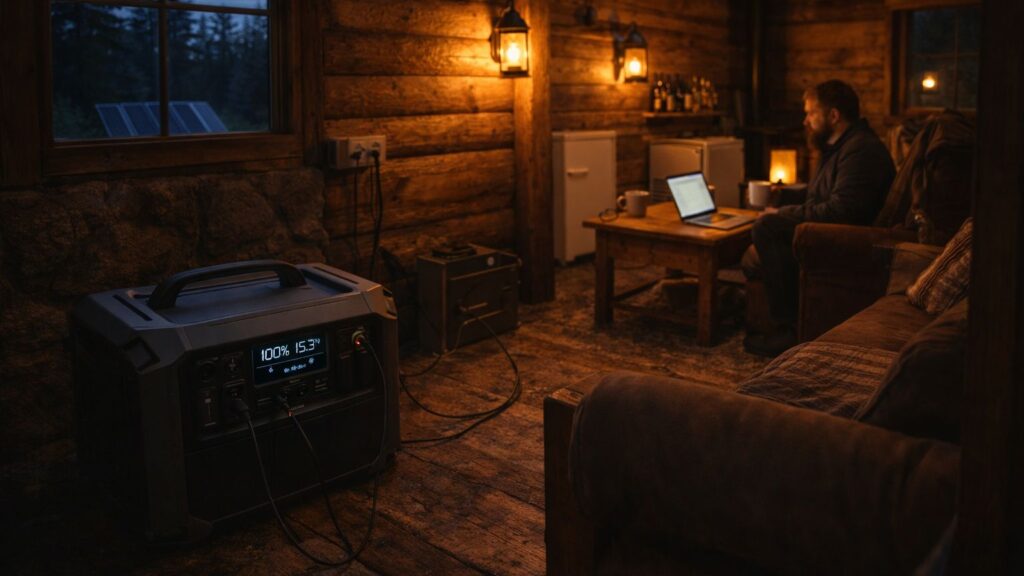
Minimal apartment or outage setup: A 1,000Wh-class station can support communications, lighting, device charging, a CPAP machine, and selected small loads. It is not a refrigerator-and-kitchen system unless the actual energy budget proves otherwise. The Anker SOLIX C1000 Gen 2 is a capable example of this class, with 1,024Wh capacity and 2,000W output.
Expanded cabin setup: A 4kWh-class base station with 120V/240V capability, expansion batteries, and substantial panel capacity can support a disciplined cabin load plan. EcoFlow DELTA Pro 3 fits this role, but its size and cost mean it should be treated as a system purchase rather than a casual portable device.
High-demand or future system setup: The BLUETTI Apex 300 is designed to scale beyond a normal power station. Its base unit has 2,764.8Wh capacity and 3,840W output, with expansion options that can take the system far beyond a weekend backup role. That flexibility is meaningful only when paired with deliberate electrical planning.
Example Power Usage
| Device | Typical Energy Use | Planning Note |
|---|---|---|
| Laptop | 200–500Wh/day | Depends on model, charging losses, and work hours |
| Router | 200–400Wh/day | Small but continuous load |
| LED lighting | 50–300Wh/day | Depends on number of lights and hours used |
| CPAP machine | 250–700Wh/night | Verify humidifier and heated-hose use separately |
| Compact refrigerator | 800–1,500Wh/day | Measure in the intended ambient conditions |
| Microwave or kettle | 100–300Wh/use | High power draw, short runtime; check inverter capacity |
These figures are planning ranges, not promises. Measure the devices you own before depending on any system for food preservation, medical needs, or a long outage.
The 10 Best Portable Solar Generators of 2026
1. EcoFlow DELTA Pro 3 — Best for Serious Home Backup
Key specifications: 4,096Wh LiFePO4 battery, 4,000W output, 120V/240V capability, and manufacturer-stated expansion from 4kWh to 48kWh.
The DELTA Pro 3 is a strong choice for buyers whose needs exceed a normal 2kWh station. Its base capacity gives meaningful breathing room for refrigeration, communications, lighting, and carefully managed appliance loads. The 120V/240V capability and expansion ecosystem make it relevant for cabins and more serious backup plans.
It is heavy and expensive enough that portability should be evaluated honestly. This is a wheeled system to position deliberately, not a unit most people will want to lift repeatedly. Buyers should also determine whether they need an electrician-installed transfer solution, a simple extension-cord backup plan, or neither.
Verdict: The best option here for a buyer building toward high-demand backup or a disciplined cabin system.
2. BLUETTI Apex 300 — Best Scalable Off-Grid Platform
Key specifications: 2,764.8Wh LiFePO4 base capacity, 3,840W AC output, 120V/240V capability, up to 2,400W solar input in the base configuration, and a manufacturer-stated expansion path up to 58kWh.
The Apex 300 occupies the space between a conventional portable station and a modular energy platform. Its high output, substantial solar input, and expansion architecture make it compelling for a workshop, RV, or cabin owner who expects needs to grow.
The tradeoff is complexity and weight. It is a poor choice for someone who only wants a compact outage box for phones and lamps. It becomes attractive when the buyer has identified real loads, has room for panels and batteries, and will use the system’s greater capability.
Verdict: A serious long-term platform for readers who need more than a sealed 2kWh box.
3. Jackery Explorer 2000 Plus — Best Straightforward Modular System
Key specifications: 2,042Wh LiFePO4 battery, 3,000W continuous output, 6,000W peak output, solar input up to 1,200W, and a published expansion path to 24kWh with compatible units and batteries.
The Explorer 2000 Plus remains a sensible option for buyers who value a relatively uncomplicated interface and a well-defined upgrade path. Its 3,000W output gives it more headroom than many 2kWh stations, which matters for short-duration kitchen appliances and tools.
It is still a substantial piece of equipment, so review its dimensions, weight, and the cost of proprietary expansion hardware before committing. The solar-input ceiling is useful but should be paired with a realistic panel plan rather than assumed to deliver full output all day.
Verdict: A good fit for home backup or mobile users who want modular capacity without a highly technical system.
4. BLUETTI AC200L — Best All-Rounder
Key specifications: 2,048Wh LiFePO4 battery, 2,400W AC output, 1,200W maximum solar input, and expansion options using compatible BLUETTI batteries.
The AC200L is one of the more practical middle-ground choices. It has enough inverter output for many household and RV appliances, a useful solar-input ceiling, and a 2kWh starting capacity that suits a measured emergency or mobile load plan.
The integrated RV-oriented output options may be particularly useful for trailer and van owners. For a house, the appeal is simpler: it can carry core loads and recharge from a meaningful panel array without requiring the scale of a whole-home backup platform.
Verdict: The most balanced choice for readers who need a capable 2kWh system without committing to a much larger platform.
5. Anker SOLIX F2000 — Best for Durable 2kWh Backup
Key specifications: 2,048Wh LiFePO4 battery, 2,400W AC output, solar input up to 1,000W, app monitoring, and compatible expansion batteries.
Its 1,000W solar-input ceiling is adequate for a lot of emergency and weekend use, though less ambitious than the largest systems in this guide. Confirm current availability and compatible expansion-battery options in your market, as product bundles change.
Verdict: A durable, capable 2kWh option for buyers who value a proven format and strong output.
6. EcoFlow DELTA 2 Max — Best Value for Fridge-and-Essentials Backup
Key specifications: 2,048Wh LiFePO4 battery, 2,400W output, and expansion to 6,144Wh with two compatible smart extra batteries.
The DELTA 2 Max provides a useful blend of capacity, output, and expandability for a home that needs to protect essential loads during an outage. It is large enough to be meaningful for a refrigerator-and-communications plan, yet less intimidating than a 4kWh platform.
It is best used with a disciplined load list. Adding a refrigerator, coffee maker, space heater, and cooking appliance to the same plan will drain even a 2kWh station quickly. Pair it with measured loads and enough compatible solar to make recovery possible.
Verdict: A strong value candidate for practical backup, RV use, and buyers who may add capacity later.
7. BLUETTI Elite 200 V2 — Best Simple 2kWh Power Station
Key specifications: 2,073.6Wh capacity, 2,600W output, and up to 1,000W solar input according to BLUETTI’s current product information.
The Elite 200 V2 appeals to users who want substantial output and capacity in a more self-contained station. Its 2,600W output gives useful overhead for common appliances, while the 2kWh-class battery remains appropriate for a refrigerator, lighting, electronics, and selected loads.
It is not a replacement for a multi-day cabin battery bank. Its strongest role is a capable, plug-and-play backup or mobile power source where the user has measured the critical load and can recharge from solar, AC, or a vehicle as appropriate.
Verdict: A capable alternative in the 2kWh class for readers who want strong output without building a large modular system.
8. Anker SOLIX C1000 Gen 2 — Best Compact Emergency Pick
Key specifications: 1,024Wh LiFePO4 battery, 2,000W output, 3,000W peak output, and manufacturer-stated full AC recharge in as little as 49 minutes when its supported fast-charge mode is used.
The C1000 Gen 2 is for people who need a genuinely manageable station but do not want to give up useful inverter output. Its capacity is not sufficient for carefree, multi-day refrigerator backup, yet it can be excellent for lights, communications, electronics, CPAP use, and short, selective appliance loads.
Fast wall charging is valuable when an outage warning gives you little time to prepare. For solar use, check its current input specifications and build a compatible panel setup rather than relying on a generic panel bundle.
Verdict: The best compact choice in this list for apartment backup, short outages, and mobile essentials.
9. EcoFlow DELTA 3 Max Series — Best New Mid-to-Large Upgrade Path
Key specifications: Current DELTA 3 Max models are specified by EcoFlow with 3,000W output, 2kWh to 10kWh capacity options, rapid AC charging, and a 10ms backup switchover claim. Exact capacity and input specifications vary by configuration.
Because it is a series rather than a single fixed configuration, verify the exact model, battery size, solar-input specifications, outlets, and expansion limits before purchase. Treat comparison tables with caution whenever a product family contains several variants.
Verdict: A strong option for buyers who need a flexible current platform and will compare the exact configuration carefully.
10. Anker SOLIX F3800 Plus — Best for 240V-Ready Expansion
Key specifications: 3,840Wh LiFePO4 battery, 6,000W AC output, 120V/240V capability, and up to 3,200W solar input according to Anker’s current support information.
The F3800 Plus is a high-capacity platform intended for serious backup, RV, and off-grid applications. The output and solar-input figures place it far beyond a small portable station, and its 240V capability can matter for appropriate loads and properly designed connection hardware.
That scale also changes the buying decision. It is expensive, heavy, and best evaluated alongside a transfer-switch plan, panel deployment plan, and physical location. For simple emergency use, a smaller station may be more practical and easier to keep charged.
Verdict: Best reserved for buyers with genuine high-demand or 240V requirements and a deliberate system plan.
What Actually Changes When You Own Your Power
Owning backup power makes energy visible. You begin to notice what runs continuously, which appliances are genuinely essential, and how much a cloudy day changes the plan. That awareness is useful because it turns resilience from a vague idea into a set of manageable choices.
Energy Becomes Something You Manage, Not Consume
Good portable-power habits are simple: charge small devices while solar production is strong, avoid running several heating appliances together, and check the battery before nightfall. These are not sacrifices. They are the normal operating habits that let a modest system deliver more value.
Reliability Feels Different
A properly sized station reduces the chaos of a short outage. Communications remain available, food has a better chance of staying cold, and lights do not depend on disposable batteries. Reliability comes from preparation, measured loads, charged batteries, and a known charging plan, not from the logo on the enclosure.
Independence Builds Gradually
The Goal Isn’t Unlimited Power
Trying to recreate unlimited grid electricity with portable equipment is expensive and often unnecessary. The better goal is to keep essential loads operating safely and comfortably for the time you need. A smaller, familiar system that is ready to use is more valuable than a larger plan that is never completed.
Common Mistakes to Avoid
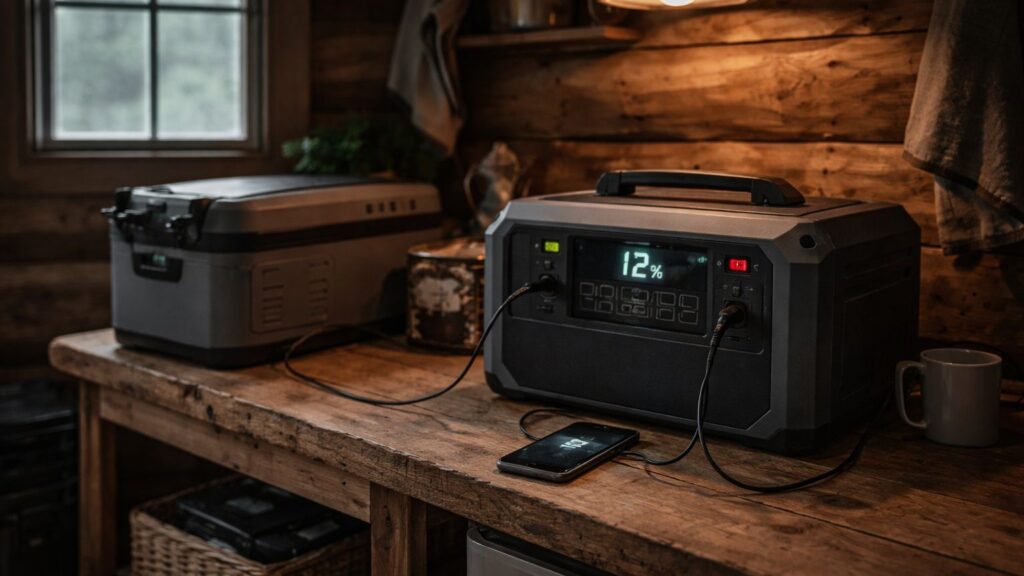
- Buying by wattage alone and ignoring daily watt-hour consumption.
- Assuming a refrigerator’s nameplate watts equal its daily energy use.
- Forgetting startup surge and overlapping appliance loads.
- Treating panel wattage as guaranteed daily harvest.
- Exceeding a station’s PV voltage or current limits.
- Using thin, damaged, or unverified extension and solar cables.
- Expecting a 1kWh station to deliver multi-day, whole-home backup.
- Connecting a station to household wiring without correctly designed transfer equipment and qualified electrical guidance.
- Storing a battery discharged for long periods or charging it outside the manufacturer’s permitted temperature range.
Field Verdict
The right portable solar generator is the one that matches a measured load plan and a realistic recharge plan. For most readers, a good 2kWh-class system is the useful middle ground: large enough to protect core loads, compact enough to deploy, and expandable enough to learn from before committing to a larger system.
Choose the EcoFlow DELTA Pro 3, BLUETTI Apex 300, or Anker SOLIX F3800 Plus when your needs genuinely justify a larger 120V/240V-capable platform. Choose the Jackery Explorer 2000 Plus, BLUETTI AC200L, Anker SOLIX F2000, EcoFlow DELTA 2 Max, or BLUETTI Elite 200 V2 for the broadly useful 2kWh class. Choose the Anker SOLIX C1000 Gen 2 when compact emergency readiness is the priority.
Before ordering, measure your essentials, confirm the exact product specifications in your region, and decide how the station will recharge after the first battery cycle. Those three steps will matter more than any single comparison-chart number.
See Related: https://offgridatlas.com/battery-storage/best-off-grid-battery-setups/