Top 10 Water Filtration & Purification Units

Water is the one system you can’t fake.
You can run low on power or wood and still survive, but go 72 hours without clean water, and the rest of your setup won’t matter.
Off-grid living demands trustworthy, redundant water purification that works with no grid, no pressurized line, and no luck.
Below are the ten most reliable, field-tested systems, from small filters to whole-home rigs — used by preppers, homesteaders, and explorers worldwide.
Filtration vs. Purification — Know the Difference
Before you buy a filter, understand what it’s actually doing.
- Filtration: Removes dirt, sediment, metals, and protozoa.
- Purification: Destroys or neutralizes microbes (bacteria, viruses, cysts).
Most off-grid failures come from relying on one without the other.
Always filter first and purify second.
A muddy puddle that’s UV-treated is still mud.
A clear stream filtered through carbon may still hold viruses.
Your system should handle both.
[See Related: Top 10 Emergency Water Sources (and How to Make Them Safe)]
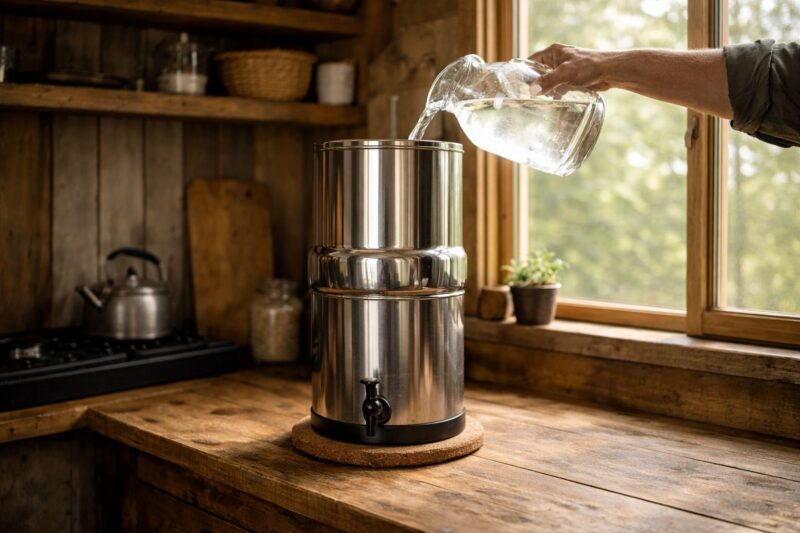
#1 — Berkey Gravity Systems (The Gold Standard)
Ask anyone who’s lived off-grid for more than a year — odds are they own a Berkey.
Stainless steel, gravity-fed, no power, and filters that last for years.
Why it’s unbeatable:
- Black Berkey elements remove bacteria, heavy metals, and some viruses.
- Holds multiple gallons, serves families or small communities.
- No pressurization or power needed. Just fill and wait.
- Up to 6,000 gallons per element set.
Top picks:
- Big Berkey (2–4 people)
- Royal Berkey (4–6 people)
- Travel Berkey (portable)
Downside: Slow flow rate, but you’re trading speed for safety.
“If it’s safe enough for disaster relief camps, it’s safe enough for your cabin.”
#2 — Sawyer Squeeze / Sawyer Mini
Tiny, cheap, and astonishingly effective.
A 0.1-micron hollow fiber filter that screws directly onto a water bottle or gravity bag.
Why it works:
- Removes 99.99999% of bacteria (E. coli, cholera) and protozoa.
- Backflush to clean — lifespan basically unlimited.
- Weighs 2 ounces; fits in a pocket.
Use for: Backup kit, field trips, bug-out bags, or ultralight setups.
Pro tip: Pair with a collapsible bottle or a gravity bag for hands-free use.
#3 — Katadyn Pocket Filter (The Tank)
This one’s for lifers. Machined aluminum body, ceramic core, and designed for decades of use.
Strengths:
- Filters down to 0.2 microns.
- 50,000-liter lifespan (roughly 13,000 gallons).
- Handles silt and muddy sources with ease.
- Field-serviceable: scrub the ceramic and keep going.
Cons: Slower flow rate. But if you want a filter you can pass to your grandkids, this is it.
Best for: Permanent cabins, global travel, or mission-grade durability.
#4 — Survivor Filter PRO X (Manual + Powered Hybrid)
Bridges the gap between hand-pump and high-tech.
Can run manually or via USB power — ideal for cabins with solar setups.
Features:
- 0.01-micron filtration — finer than most filters on earth.
- Three-stage: prefilter, carbon, and internal membrane.
- Pumps about 500 ml/minute.
- Taste improvement from post-carbon filter.
Great for: Off-grid tiny homes, overlanders, and backup filtration redundancy.
#5 — Lifestraw Family 1.0 & Community 2.0
Designed for rural Africa, perfect for off-grid homesteads.
Gravity-fed, virus-removing, and built for volume.
Highlights:
- Treats 18,000–26,000 liters before replacement.
- Removes bacteria, protozoa, and viruses — rare for a non-electric system.
- Field-maintainable; cleans easily with included backflush hose.
Best for: Group living, family cabins, community bunkers.
“When you need to hydrate ten people on one filter — this is the one.”
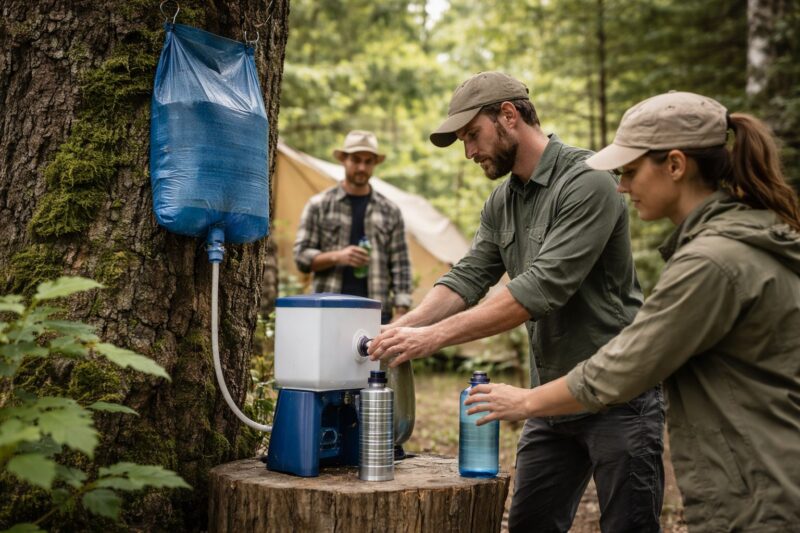
#6 — Platypus GravityWorks 4L System
Think of this as the ultralight cousin to Berkey.
Two collapsible bags, a hose, and a hollow-fiber cartridge — gravity does the rest.
Advantages:
- Fast — filters a liter in 40 seconds.
- Packs flat for portability.
- Easy to clean and replace parts.
Weak spot: Not rated for viruses — use with UV or chlorine backup.
Perfect for: Campers, vanlifers, or short-term off-grid expeditions.
#7 — MSR Guardian Purifier Pump (Military-Grade)
The top-tier pump purifier — built to meet U.S. military standards.
Performance:
- Eliminates viruses, bacteria, protozoa, and particulates.
- Pumps ~2.5 L/minute, even in freezing conditions.
- Self-cleans every stroke — no backflushing needed.
Built for: Harsh conditions, extreme travelers, or those who never want to think twice about water safety.
Downside: $350+, but it’s the best on the planet.
“The MSR Guardian forces even questionable water through a serious purification process.”
#8 — AquaRain Natural Drip Filter (Made in USA)
A handmade stainless gravity filter with ceramic + carbon elements.
A close rival to Berkey — but smaller batch and a slightly different taste profile.
Why it stands out:
- Pure mechanical filtration — no chemicals or electricity.
- Up to 10,000 gallons lifespan per element.
- Easy-to-clean ceramic candles.
Best for: Families, off-grid homes, or long-term domestic setups.
#9 — SteriPEN Ultra UV Purifier
Compact and futuristic. Kills what filters can’t — viruses, bacteria, and protozoa — using ultraviolet light.
How it works:
- Insert wand into clear water, stir for 90 seconds.
- UV disrupts microbial DNA — no regrowth.
- Rechargeable via USB or solar panel.
Note: Use after filtering to remove sediment first.
Great backup for any filtration system.
#10 — DIY Rainwater + Multi-Stage Whole-House Systems
For long-term homesteads, this is the pinnacle. Build a system that does everything automatically.
Typical setup:
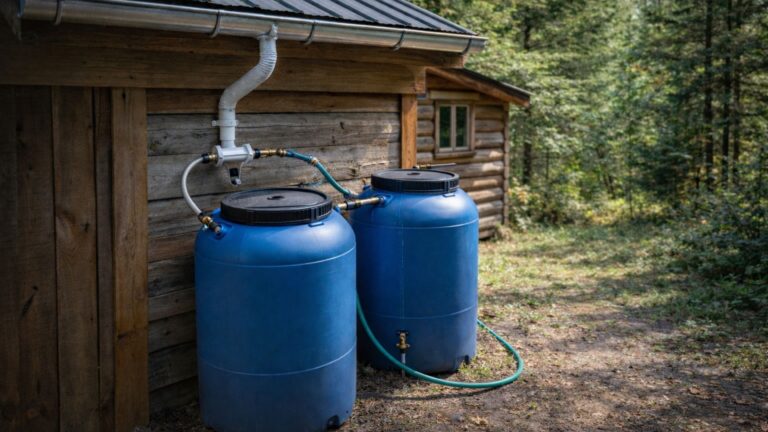
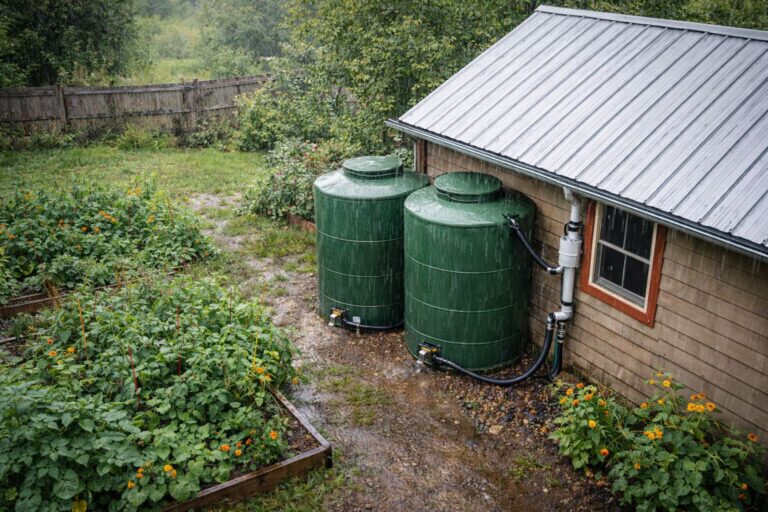
- Collection: Gutter-fed storage tanks.
- Sediment Filter: 5-micron prefilter.
- Carbon Block: Removes chlorine, pesticides, and taste.
- UV Sterilizer: Final microbial kill step.
Recommended brands: VIQUA, iSpring, Home Master, Aquasana Rhino.
Why it matters: This setup provides reliable clean water year-round without depending on bottled supplies.
[See Related: Rain to Reservoir: Complete Guide to Off Grid Rainwater Harvesting Systems]
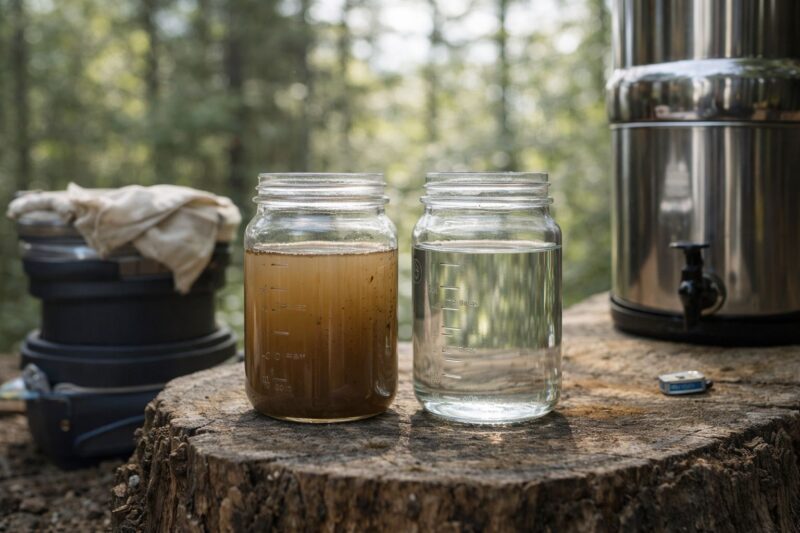
Real-World Water Sources: What You’re Actually Filtering
Most guides talk about filters in isolation. That’s not how this plays out in the field.
Your filter doesn’t exist on its own. It reacts to the water you give it.
A slow-moving forest stream behaves very differently from rooftop rainwater. A muddy river after a storm will clog systems that normally run clean for months. Even something that looks perfectly clear can carry viruses or agricultural runoff.
Let’s break down what you’re really dealing with.
Rainwater (Roof Collection)
This is often your cleanest starting point — but only if your system is built right. First-flush diverters matter. Without them, you’re pulling bird droppings, dust, and debris straight into your tanks.
Rainwater still needs filtration. Always. A simple sediment filter followed by carbon and UV is usually enough. Gravity systems like Berkey or AquaRain handle it well if pre-filtered properly.
Lakes and Ponds
Still water is deceptive. It often looks calm and usable, but it’s where bacteria and protozoa thrive. Algae blooms, especially in warmer months, can overwhelm filters quickly.
This is where multi-stage systems earn their place. Pre-filtering through cloth or a coarse filter reduces load. Then your main filter handles particulates. Finally, purification — UV, chemical, or high-grade membrane — finishes the job.
Skip that last step, and you’re rolling the dice.
Rivers and Streams
Flowing water is usually safer than stagnant sources, but it’s not guaranteed. Upstream contamination is invisible. Farms, wildlife, or even a dead animal miles away can affect your intake.
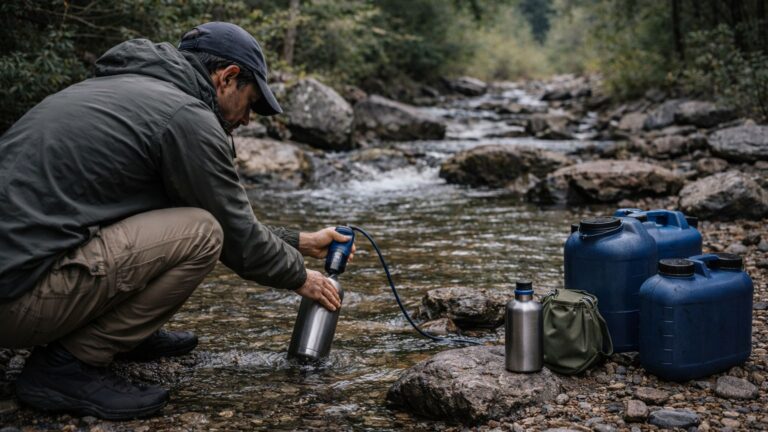
These sources are ideal for pump systems like the MSR Guardian or Katadyn Pocket. They handle silt better and keep flow consistent.
But again — don’t assume safety just because it’s moving.
Urban Water (Emergency Use)
In a grid-down scenario, people turn to whatever they can find. Decorative fountains. Building runoff. Stored water in pipes.
This is high-risk water.
You need both filtration and purification here. Systems that remove viruses become critical. That’s where units like the MSR Guardian or a filter + UV combo step in.
Snow and Ice
It seems clean. It’s not.
Snow traps airborne particles and pollutants. Ice concentrates impurities over time. Melt it, filter it, then purify it.
Always.
The takeaway is simple:
Your filter is only as effective as your understanding of the source. Clean-looking water isn’t safe water. Dirty-looking water isn’t always dangerous — but it will stress your system.
Match your setup to your reality. Not the ideal version of it.
Bonus: Emergency Methods That Still Work
- Boiling: One minute at a full boil kills all pathogens (3 minutes above 6,500 ft).
- Bleach: 2 drops per liter, mix and wait 30 minutes.
- Solar Disinfection (SODIS): Fill clear bottles, lay in sun 6 hours.
Always keep a fallback method. Technology breaks. Fire doesn’t.
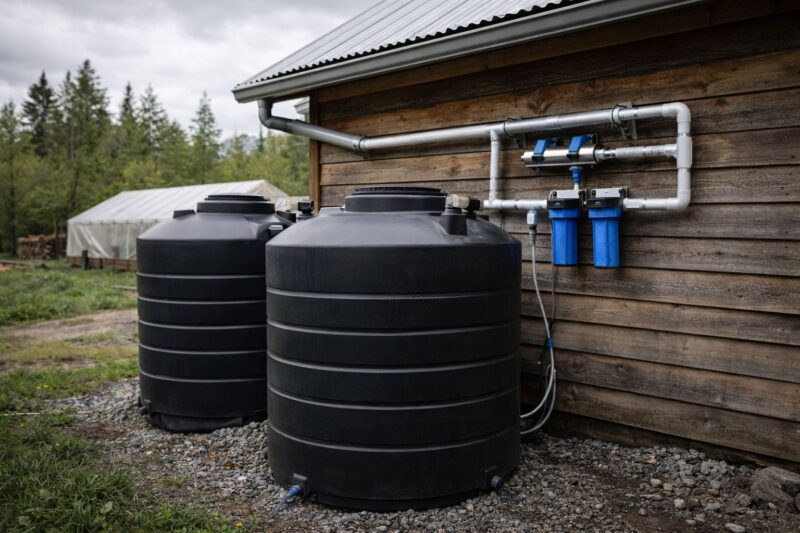
Building a Layered Water System (Step-by-Step Setup)
A single filter is not a system.
A system has layers. Each one solves a different problem.
Here’s what a reliable off-grid setup actually looks like when built from scratch.
Step 1: Collection
Start with the cleanest source you can control.
For homesteads, that’s usually rainwater. Use food-grade tanks. Install a first-flush diverter. Add mesh screens to block debris.
For mobile setups, collection might mean filling from a stream or public source. In that case, your system starts downstream — but the principle stays the same.
Clean input reduces stress on everything that follows.
Step 2: Pre-Filtration
This step gets ignored — and it shouldn’t.
A simple sediment filter or even a cloth layer removes large particles. That protects your main filter and extends its lifespan.
Think of it as a buffer. Cheap. Effective. Easy to replace.
Step 3: Primary Filtration
Now your main unit does the heavy lifting.
This could be a gravity system like Berkey, a pump like Katadyn, or a hollow fiber setup like Sawyer. This stage removes bacteria, protozoa, and visible contaminants.
Flow rate matters here. So does capacity.
Choose based on your daily use, not your ideal scenario.
Step 4: Purification
This is where you handle what filtration can’t.
UV systems, chemical treatment, or high-grade purifiers remove viruses and microscopic threats. If your source is questionable, this step is not optional.
Even in “clean” environments, it’s your safety net.
Step 5: Storage
Filtered water needs a place to go.
Use sealed, food-grade containers. Keep them out of sunlight. Rotate your supply. Clean them regularly.
Storage is where many systems quietly fail.
Step 6: Redundancy
You need a backup.
Not a duplicate. A different method.
If your main system is gravity-based, your backup might be chemical or UV. If your main system is a pump, your backup might be a simple gravity filter.
Different methods cover different failure points.
What this looks like in practice:
A rainwater tank feeding into a sediment filter, then a gravity system, followed by a UV purifier, stored in sealed containers — with a Sawyer Mini in a drawer as backup.
That’s a system.
Complete systems don’t need to be complicated or expensive.
[See Related: How to Build a Simple Reliable Off-Grid Water System 2026]
💡 How to Choose the Right Filter
| Use Case | Recommended Filter | Why It Works |
|---|---|---|
| Daily Off-Grid Home | Berkey / AquaRain | Large capacity, no power |
| Cabin / Tiny House | Survivor Filter PRO X | Small, dual-power |
| Bug-Out / Mobile | Sawyer Mini / Platypus | Lightweight, fast |
| Contaminated Water | MSR Guardian | Removes viruses |
| Family / Group | Lifestraw Family | High output |
Pick two systems, one for daily use and one for emergencies.
Failure Points: How Water Systems Break (and Why Most People Miss It)
Most setups don’t fail all at once. They degrade.
Quietly.
You’ll still get water. It’ll still look clean. That’s what makes it dangerous.
Let’s walk through the common failure points that take systems down.
Clogging and Flow Loss
Hollow fiber filters like Sawyer or Platypus slow down over time. It’s gradual. You barely notice it day to day.
Until one day, it’s barely dripping.
People assume the filter is still working. It is — but barely. Reduced flow often means reduced effectiveness, especially if internal channels are blocked unevenly.
Backflushing helps. But eventually, replacement is the only real fix.
Carbon Saturation
Carbon filters don’t last forever. They don’t “break” — they fill up.
Once saturated, they stop removing chemicals, taste, and odor. Water may still look clean, but contaminants pass straight through.
This is one of the most overlooked issues in off-grid setups.
Set a schedule. Replace them even if they seem fine.
UV Misuse
UV systems only work under specific conditions. Clear water. Proper exposure time. Clean bulbs.
If your water has sediment, UV effectiveness drops fast. Particles block the light. Microbes survive in the shadows.
That’s why filtration must come first. No exceptions.
Seal and Storage Contamination
You filtered it. You purified it. Then you poured it into a dirty container.
Game over.
Storage is part of the system. Biofilm builds up inside tanks and bottles over time. If you’re not cleaning them regularly, you’re reintroducing contamination every single use.
Cold Weather Failures
Freezing damages hollow fiber filters permanently. Once frozen, internal structures crack.
You won’t see it. You won’t taste it. But the filter is compromised.
Keep filters warm in winter. Sleep with them if you have to. It’s not optional.
User Error
This is the big one.
Wrong assembly. Skipped steps. Using a filter past its lifespan. Assuming one system does everything.
Water systems don’t tolerate shortcuts.
What actually works:
Redundancy. Awareness. Routine checks.
Test your flow rate. Track your usage. Replace parts before they fail.
Maintenance Tips for Longevity
- Clean ceramic and carbon filters monthly.
- Backflush hollow fiber filters after every trip.
- Replace carbon cores yearly or after heavy use.
- Disinfect storage tanks every 3–6 months.
- Label filters by date installed and flow tested.
Maintenance isn’t busywork. It protects the reliability of the system.
Long-Term Cost vs. Short-Term Convenience (What Actually Saves Money)
Upfront cost is easy to see. Long-term cost isn’t.
That’s where most people make the wrong call.
A cheap filter looks like a win. Low price. Easy entry. But if it needs constant replacement, the math changes fast.
Let’s break it down.
Disposable Systems
Small filters and cartridges often have lower upfront cost. But they rely on frequent replacements.
Carbon filters, for example, may need changing every few months depending on use. That adds up.
Over a year or two, you’ve spent more than a durable system would have cost.
Long-Life Filters
Systems like Berkey or Katadyn have higher initial cost. But their lifespan stretches into years.
You’re paying for durability. For fewer replacements. For consistency.
That matters when supply chains are unreliable or you’re far from resupply.
Maintenance Costs
Every system has them.
Replacement parts. Cleaning supplies. Occasional upgrades.
The key is predictability. Systems with known, scheduled maintenance are easier to manage than ones that fail unexpectedly.
Energy Costs
Powered systems introduce another variable.
UV purifiers and electric pumps need energy. In a solar setup, that may not be a problem — but it’s still a factor.
Manual systems remove that dependency.
Failure Cost
This is the one nobody calculates.
What happens when your system fails at the wrong time?
If your setup relies on a single filter with no backup, the cost isn’t money. It’s risk.
That’s why redundancy isn’t optional.
The better approach:
Spend once. Maintain consistently. Back it up.
A solid system feels expensive upfront. Then it disappears into the background. It just works.
That’s the value you’re paying for.
Water Testing: Knowing When Your System Is Actually Working
Most people assume their system is working.
Clear water. No smell. No obvious issues.
That’s not proof.
If you’re serious about off-grid water, you need a way to verify what’s coming out of your system. Not guess. Not assume. Actually know.
Why testing matters
Filters don’t fail loudly. They drift. Performance drops. Contaminants start slipping through without any visible warning.
You won’t taste bacteria. You won’t see viruses.
Testing is the only way to catch that.
What you should be testing for
You don’t need a lab setup. But you do need coverage.
- Bacteria (E. coli / coliform): Indicates biological contamination
- pH levels: Helps identify chemical imbalance
- TDS (Total Dissolved Solids): Measures dissolved minerals and possible contaminants
- Chlorine (if using treatment): Ensures proper dosing
These aren’t advanced metrics. They’re baseline indicators.
If something’s off here, your system needs attention.
Simple field testing tools
You don’t need complexity. You need reliability.
- Test strips (cheap, fast, good for routine checks)
- Digital TDS meter (instant readings, very useful for trend tracking)
- Bacteria test kits (slower, but critical for validation)
Keep them stored with your system. Use them regularly, not just when something feels wrong.
When to test
Set a rhythm.
- After installing a new system
- After replacing filters
- After heavy use periods
- When switching water sources
- Every 1–2 months as routine
Consistency matters more than frequency.
What failure actually looks like
You won’t always get a dramatic result.
Sometimes it’s subtle.
TDS slowly creeping up. pH drifting. A bacteria test that suddenly shows presence after months of clean results.
That’s your warning.
Ignore it, and you’re trusting a system that’s already slipping.
Real-world scenario
You’re running a gravity filter off rainwater. Everything seems fine.
Months go by.
Then a test shows elevated bacteria levels.
What happened?
Maybe your storage tank developed biofilm. Maybe your first-flush system failed. Maybe your filter elements are overdue for cleaning.
Without testing, you’d never know.
The goal isn’t perfection
It’s awareness.
You need safe, consistent output rather than sterile lab-grade water.
It tells you when to act, before your system becomes a liability.
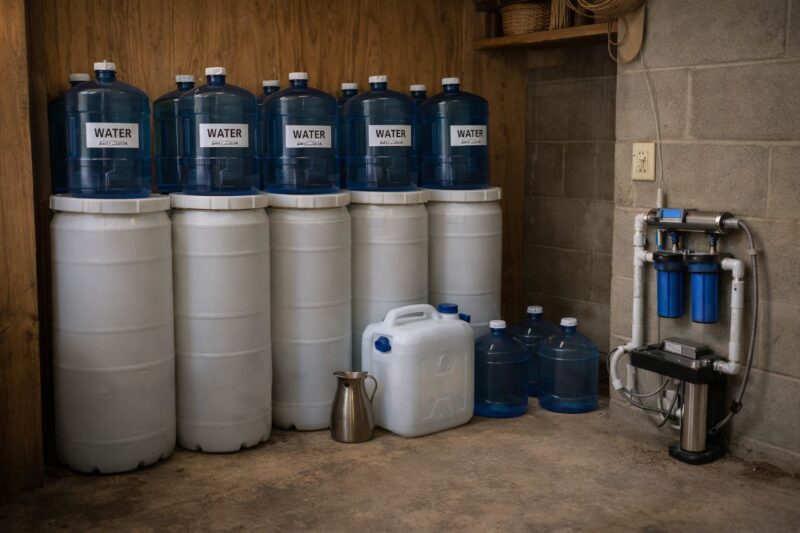
The Off-Grid Proven Water Hierarchy
- Collect cleanly. Use food-grade tanks, first-flush diverters, and mesh screens.
- Filter physically. Remove all visible contaminants.
- Purify biologically. Kill the invisible ones.
- Store safely. Keep water shaded, sealed, and rotated.
“Water is the first infrastructure, the last teacher, and the truest mirror of how you live.”