The 8 Best Off Grid Battery Systems for Reliable Solar Power in 2026
Introduction: Storage Is the True Heart of Any Off Grid System
Harvesting sunlight is easy.
Keeping it overnight, and through long winters, cloudy weeks, or extended outages, is the real challenge.
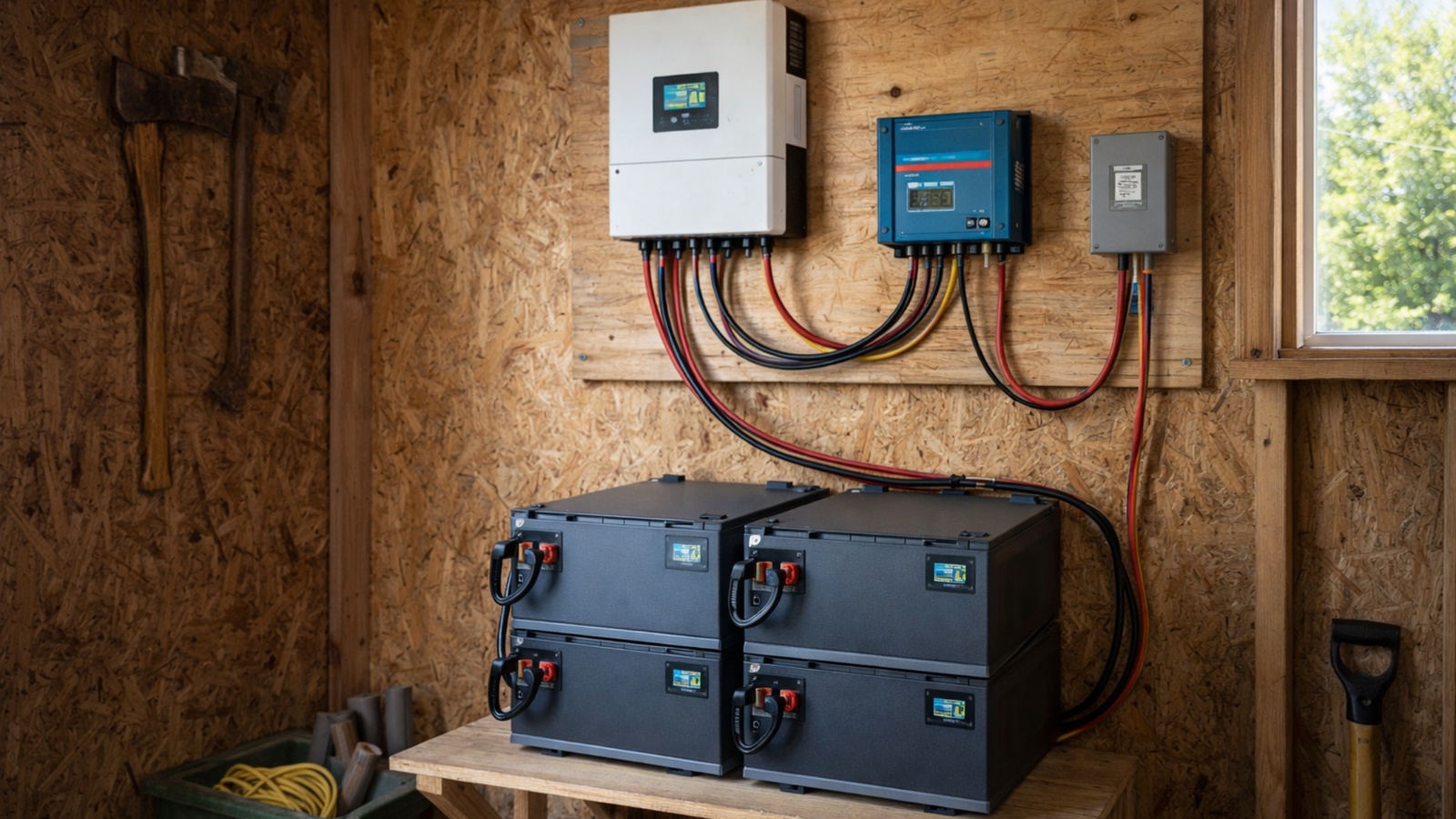
Your battery bank is the heart of an off grid system: quiet, invisible, and unforgiving if you get it wrong. Choose poorly and you will spend evenings rationing power. Choose well and you will barely think about energy again.
Modern LiFePO4 battery technology has transformed off grid storage. Safer chemistry, advanced battery management systems, and modular expansion now make it possible to build battery banks that operate reliably for more than a decade.
This guide examines the best off grid battery systems available in 2026: from modular expansion packs to full scale storage solutions for cabins, RVs, and homesteads.
Quick Ratings Overview
| Rank | Model | Chemistry | Capacity | Expandable | Value | Overall |
|---|---|---|---|---|---|---|
| 1 | EG4 LiFePower4 48V 100Ah | LiFePO4 | 5.12 kWh | Yes | 9.5 | 9.4 / 10 |
| 2 | Battle Born BBGC2 12V 100Ah | LiFePO4 | 1.2 kWh | Parallel | 9.0 | 9.2 / 10 |
| 3 | Bluetti B300S | LiFePO4 | 3.1 kWh | Yes | 8.8 | 9.0 / 10 |
| 4 | EcoFlow Delta Pro Extra Battery | LiFePO4 | 3.6 kWh | Yes | 8.6 | 9.0 / 10 |
| 5 | SOK 200Ah | LiFePO4 | 2.56 kWh | Yes | 9.4 | 9.1 / 10 |
| 6 | Victron Energy Smart 200Ah | LiFePO4 | 2.56 kWh | Yes | 8.8 | 9.0 / 10 |
| 7 | Renogy Smart Lithium 48V 100Ah | LiFePO4 | 4.8 kWh | Yes | 8.7 | 8.9 / 10 |
| 8 | Ampere Time 12V 300Ah | LiFePO4 | 3.6 kWh | Parallel | 9.1 | 8.8 / 10 |
Who This Is For
This guide is built for:
- Cabin owners transitioning from generator-only setups
- Homesteaders building full-time off grid systems
- RV and van users upgrading from lead acid
- Homeowners creating blackout-resilient backup systems
If you’re still unsure what size system you need:
Understanding Battery Basics
Battery Chemistry: LiFePO4 vs Lead Acid
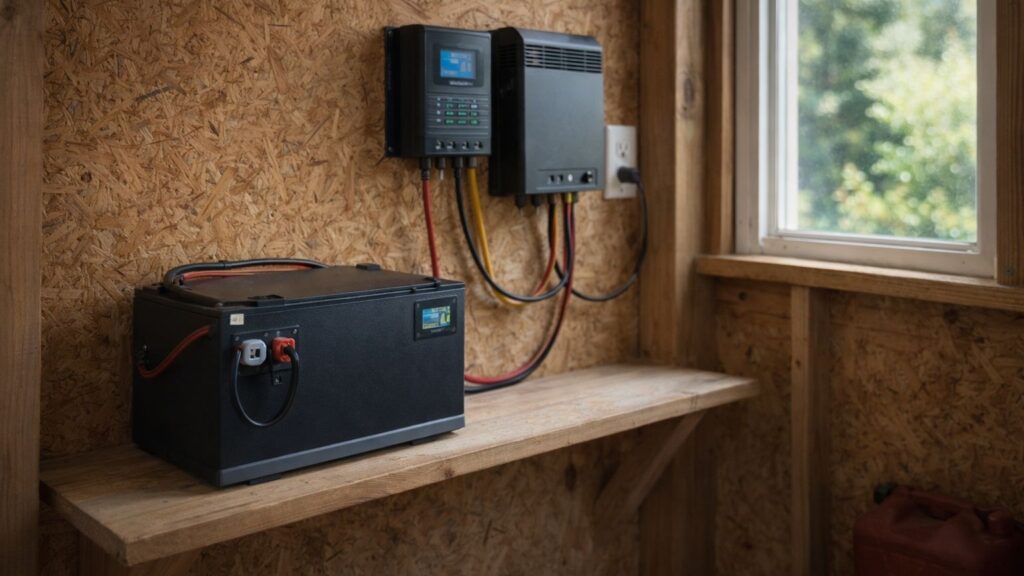
Lithium Iron Phosphate (LiFePO4) has become the dominant chemistry for off grid power systems. It offers excellent safety characteristics, extremely long cycle life, and the ability to use nearly the entire stored capacity.
Lead acid batteries still exist in backup roles, but their shorter lifespan and limited usable capacity make them difficult to justify for modern off grid systems.
Typical usable capacity comparison:
- Lead Acid: ~50 percent usable
- Lithium (LiFePO4): 90 to 95 percent usable
What this means in practice:
A “200Ah” lead acid bank often behaves like a 100Ah system. A lithium bank actually delivers close to its full rating, which changes how you size everything.
For most installations, lithium batteries now deliver better long term value despite the higher upfront cost.
Capacity and Depth of Discharge
Depth of Discharge (DoD) determines how much energy you can safely pull from a battery before recharge.
Lithium batteries tolerate deep discharge extremely well, while lead acid batteries degrade quickly when repeatedly drained below half capacity.
For example:
Daily power consumption: 4 kWh
Recommended battery bank: 8 to 10 kWh minimum
Real-world insight:
Most systems fail not during average days, but during 3–5 day cloudy stretches. That’s where undersized battery banks become painfully obvious.
Cycle Life and Warranty
Modern LiFePO4 batteries typically deliver:
- 3,000 to 6,000 charge cycles
- 10 to 15 years of daily use
A battery rated for 5,000 cycles at one cycle per day can realistically operate for well over a decade.
What to look for:
- Warranty length (5–10 years is standard now)
- Cycle rating at realistic conditions (not lab-only numbers)
- Temperature performance specs
Any lithium battery rated below 2,000 cycles should be considered outdated technology.
Expandability and Modularity
One of the biggest advantages of modern lithium battery systems is modular expansion.
You can begin with a modest battery bank and expand it over time by wiring additional batteries in series or parallel.
Many modern batteries include integrated Battery Management Systems (BMS) with communication ports that automatically balance expansion banks.
This allows a system to grow alongside your energy needs.
Important note:
Mixing old and new batteries can cause imbalance. This applies even to lithium systems. Try to expand in matched batches when possible.
How Battery Systems Actually Behave in the Real World
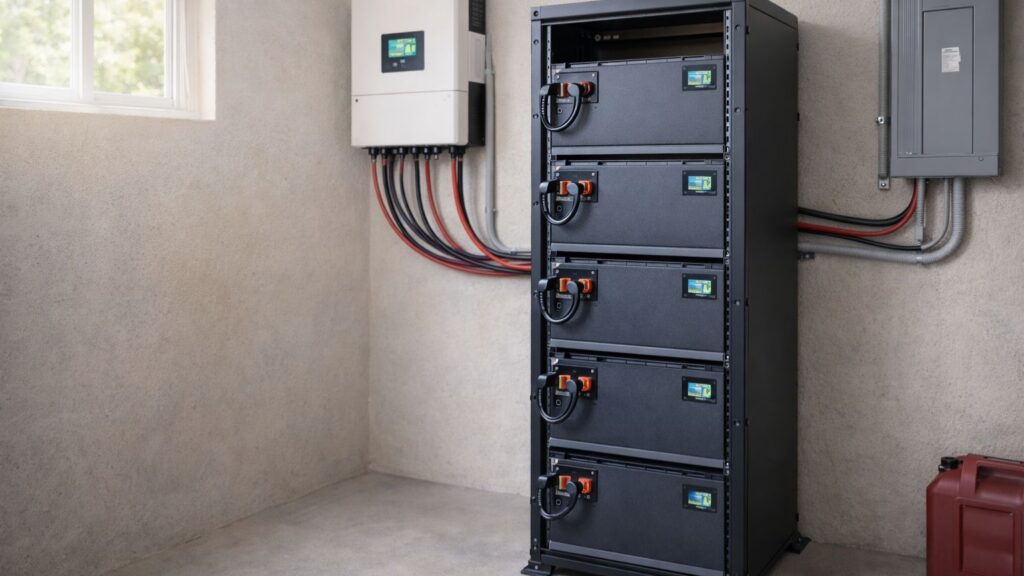
Battery specs are clean on paper.
Real-world performance is not.
Capacity matters, but real-world behavior matters just as much.
Not All Kilowatt Hours Feel the Same
Two battery systems can have the same rated capacity and perform very differently.
Why?
Because usable performance depends on:
- discharge rate
- temperature
- inverter efficiency
- system balance
A 5 kWh system powering steady loads will feel stable and predictable.
That same system running high-draw appliances repeatedly may feel like it drains far faster than expected.
This behavior is normal and catches many first-time users by surprise.
High Draw Loads Change Everything
Short bursts of high power demand can dramatically affect perceived battery life.
Common examples:
- kettles
- microwaves
- power tools
- space heaters
Even though these devices run for short periods, they pull large amounts of power quickly.
This creates two effects:
- faster voltage drop under load
- increased inverter losses
As a result, systems that seem large enough on paper can feel undersized in practice.
Temperature Has a Direct Impact
Battery performance changes with temperature more than most people expect.
In cold environments:
- capacity is temporarily reduced
- charge rates may be limited
- internal resistance increases
In extreme cases, lithium batteries may restrict charging entirely to protect themselves.
In hot environments:
- efficiency drops slightly
- long-term degradation increases
This is why proper installation matters as much as battery choice.
A well-insulated, temperature-controlled battery space can significantly improve performance and lifespan.
Charging Speed Defines System Recovery
Discharge capacity gets most of the attention, but recharge capability matters just as much over the long run.
If your system cannot recharge fully during a normal day of sunlight, it slowly falls behind.
After a few cloudy days, even a large battery bank can be depleted.
Strong systems are defined by balance:
- battery capacity matches usage
- solar input matches recharge needs
If either side is weak, the system struggles.
Voltage Matters More Than Most People Realize
One of the biggest differences between entry-level and advanced systems is system voltage.
12V systems:
- simpler
- more accessible
- higher current, thicker cables required
48V systems:
- more efficient
- lower current for same power
- better suited for larger installations
As systems scale, higher voltage becomes increasingly important.
It reduces losses, improves efficiency, and allows for cleaner system design.
Expansion Changes System Behavior
Adding more batteries does more than increase capacity.
It changes how the system behaves:
- voltage remains more stable under load
- discharge rates are spread across more cells
- system stress decreases
This is why larger battery banks often feel “smoother” to use.
Lights don’t dim under load. Inverters operate more efficiently. The system feels less reactive.
The Gap Between Theory and Daily Use
On paper, battery sizing looks straightforward.
In practice, behavior matters more than numbers.
Two systems with identical specs can feel completely different depending on:
- how they are installed
- how they are used
- how they are charged
Experienced off-grid users usually size their systems with stability and recovery in mind, not just total capacity.
They size for stability.
They want a system that:
- absorbs daily usage without stress
- recovers quickly
- handles unexpected loads without issue
The Real Goal
The best battery systems don’t demand much attention once they’re dialed in.
A well-sized system handles normal daily loads, recovers reliably, and leaves enough reserve for poor weather and unexpected usage.
The 8 Best Off Grid Battery Systems of 2026
1. EG4 LiFePower4 48V 100Ah — Best Overall Value
Capacity: 5.12 kWh
System Voltage: 48 V
Communication: CANBus and RS485
EG4 has quietly become one of the most respected battery systems in the off grid community. Its rack mount design, integrated communication ports, and strong price to performance ratio make it ideal for both DIY builders and professional installers.
Field users report excellent efficiency and reliable operation even in colder climates when paired with heated enclosures.
Why it stands out:
- Designed for full system integration
- Excellent scalability (stackable rack systems)
- Strong real-world track record
Verdict: Industrial grade design at a surprisingly reasonable price.
2. Battle Born BBGC2 12V 100Ah — Proven Durability
Capacity: 1.2 kWh
System Voltage: 12 V
Expandable: Parallel configuration
Battle Born remains one of the most trusted lithium battery manufacturers in North America. Their batteries are built in Nevada and supported by excellent customer service.
RV owners, boat builders, and off grid cabin users consistently report many years of reliable performance.
Where it shines:
- Cold weather resilience
- Customer support
- Proven longevity
Verdict: Expensive per kilowatt hour but extremely dependable.
3. Bluetti B300S — Ideal for Bluetti Power Stations
Capacity: 3.1 kWh
Compatible Systems: Bluetti AC500 and AC200 series
The Bluetti B300S expansion battery integrates seamlessly with Bluetti power stations. It automatically communicates with the inverter system and allows simple expansion without complex wiring.
Bluetooth monitoring and plug and play configuration make it especially attractive for beginners.
Verdict: The best expansion battery for Bluetti ecosystems.
4. EcoFlow Delta Pro Extra Battery — Modular Powerhouse
Capacity: 3.6 kWh
System Voltage: 51.2 V
EcoFlow’s modular battery design allows expansion to large home backup systems. When paired with the Delta Pro inverter and Smart Home Panel, it can operate as a partial home energy storage system.
The design emphasizes portability while still offering serious capacity.
Verdict: A strong option for hybrid home backup and off grid systems.
5. SOK 200Ah — The DIY Favorite
Capacity: 2.56 kWh
Voltage: 12.8 V
SOK batteries have earned a strong reputation among DIY builders. Their metal case design allows owners to open the battery for inspection or repair, something rarely possible with sealed lithium packs.
This transparency has created a loyal following in the off grid community.
Verdict: Affordable, repairable, and extremely popular among DIY builders.
6. Victron Energy Smart 200Ah — Professional Grade Control
Capacity: 2.56 kWh
Connectivity: Bluetooth and Victron ecosystem integration
Victron equipment is widely considered the gold standard in professional off grid power systems. Their Smart Lithium batteries integrate seamlessly with Victron inverters, solar charge controllers, and monitoring systems.
Detailed telemetry allows users to track temperature, voltage, and cycle data in real time.
Verdict: Premium performance for serious system builders.
7. Renogy Smart Lithium 48V 100Ah — Mid Size System Workhorse
Capacity: 4.8 kWh
System Voltage: 48 V
Renogy has significantly improved the reliability of its lithium battery line over the past several years. The Smart Lithium series integrates with Renogy inverters and solar controllers to form a complete ecosystem.
It performs particularly well in small cabin and workshop installations.
Verdict: A solid mid tier battery bank with good expansion potential.
8. Ampere Time 12V 300Ah — Budget Long Cycle Option
Capacity: 3.6 kWh
System Voltage: 12 V
Ampere Time offers one of the most affordable lithium batteries per kilowatt hour currently available. While the casing is lighter than premium brands, the internal cells provide excellent cycle life.
It is often used for weekend cabins or secondary battery banks.
Verdict: Outstanding value for budget conscious off grid systems.
Real World Setup Example
A practical off grid cabin system might look like:
- 2 × EG4 48V batteries (≈10 kWh total)
- 3–5 kW solar array
- 48V inverter (Victron or EG4 hybrid)
What this setup handles comfortably:
- Fridge + freezer
- Lighting
- Laptop / workstation
- Water pump
- Occasional microwave use
What it struggles with:
- Electric heating
- Full-time air conditioning
- High draw appliances without load management
This is where many off grid systems fail, not from lack of power, but from unrealistic expectations of what battery storage should support.
Installation and Maintenance Essentials
Proper installation dramatically improves battery lifespan and system safety.
Key installation practices include:
- Fuse each battery string to prevent catastrophic current flow
- Torque all terminal connections correctly
- Use equal length cables when connecting parallel batteries
- Protect batteries from freezing temperatures
- Label wiring and installation dates clearly
- Allow airflow around batteries to reduce heat buildup
Adding a smart battery monitor or shunt greatly improves system awareness. Voltage alone rarely tells the full story of battery charge state.
(Related: https://offgridatlas.com/solar-systems/series-vs-parallel-solar-panels/)
Common Mistakes to Avoid
Most battery failures are not product failures. They are system design mistakes.
Avoid these:
- Choosing capacity based on price instead of power needs
- Ignoring inverter losses when calculating runtime
- Forgetting standby loads (these add up fast)
- Building systems with no expansion capability
- Mixing voltage systems incorrectly
- Using undersized wiring that creates resistance and heat
- Installing batteries in freezing environments without protection
Big one:
People consistently underestimate how much power they actually use, especially once they get comfortable.
Field Verdict

Lithium iron phosphate batteries have fundamentally changed off grid power.
They are quiet, efficient, and capable of thousands of cycles when installed correctly.
For most users:
- EG4 offers the best balance of cost and performance
- Battle Born provides exceptional reliability and customer support
- SOK delivers transparency and repairability for DIY systems
- EcoFlow and Bluetti excel in modular plug and play setups
A properly sized battery bank turns solar power into something you can rely on day after day. Good storage gives the rest of the system room to perform well and makes off-grid living much easier to manage.