How to Build a Simple Reliable Off-Grid Water System 2026
Power keeps the lights on.
Water keeps you alive.
Every lasting off-grid homestead begins with a water system that works in drought, frost, and power outages. The strongest systems are not complicated. They are simple, redundant, and easy to maintain.
This guide breaks down what actually works in the field: collection, storage, pressure, filtration, and backup. When these five elements are designed properly, your water system can run reliably for decades.
Understanding the Basics
Before buying tanks or pumps, you need to understand how water moves through a system.
Every off-grid setup follows the same basic logic:
Source → Storage → Pressure → Filtration → Distribution
Once you understand that flow, building a reliable system becomes straightforward.
A mistake many people make early is focusing too heavily on one part of the system, usually pumps or filtration, while neglecting storage and redundancy. In reality, reliability comes from how well each stage supports the next.
Water Sources
Your water source determines everything else in the system.
Choosing the right source is less about convenience and more about long-term consistency. A system that works 80% of the time will fail you exactly when you need it most… during droughts, freezes, or power outages.
Wells
A well is the most reliable option for long-term off-grid living.
Deep groundwater is stable, clean, and available year-round. The downside is that wells require power to lift water to the surface.
Most off-grid homes use:
- DC submersible pumps
- solar-powered shallow jet pumps
- backup hand pumps
Oversizing the pressure tank reduces pump cycles and extends pump life.
Field insight:
If your system depends entirely on an electric well pump, you don’t have true redundancy. A manual backup, even a simple hand pump, changes everything.
Rain Catchment
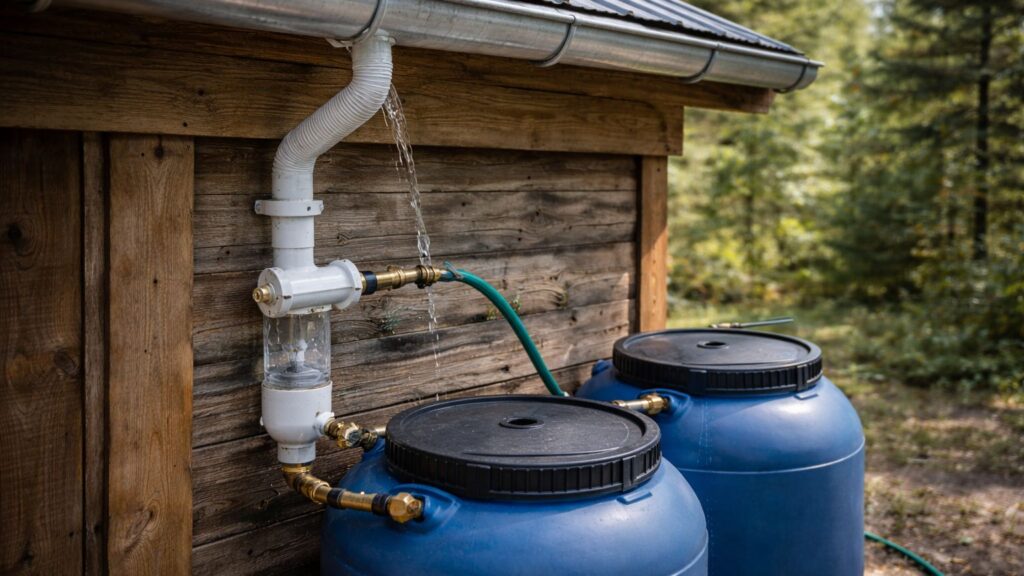
Rainwater collection is simple and scalable.
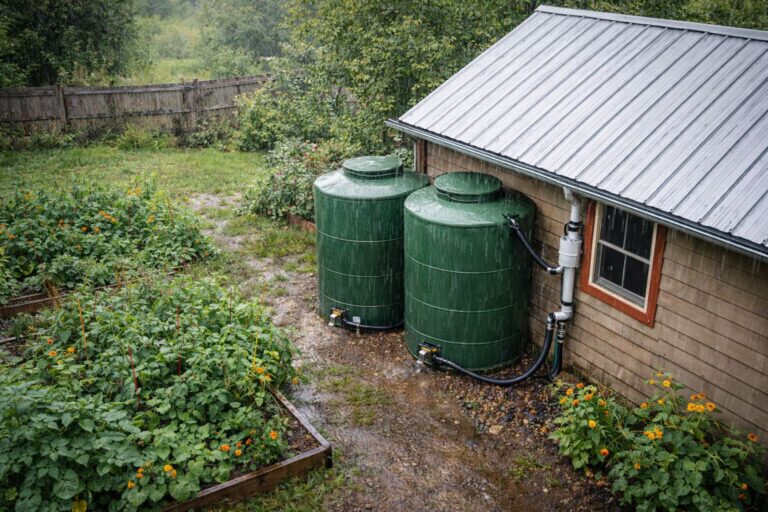
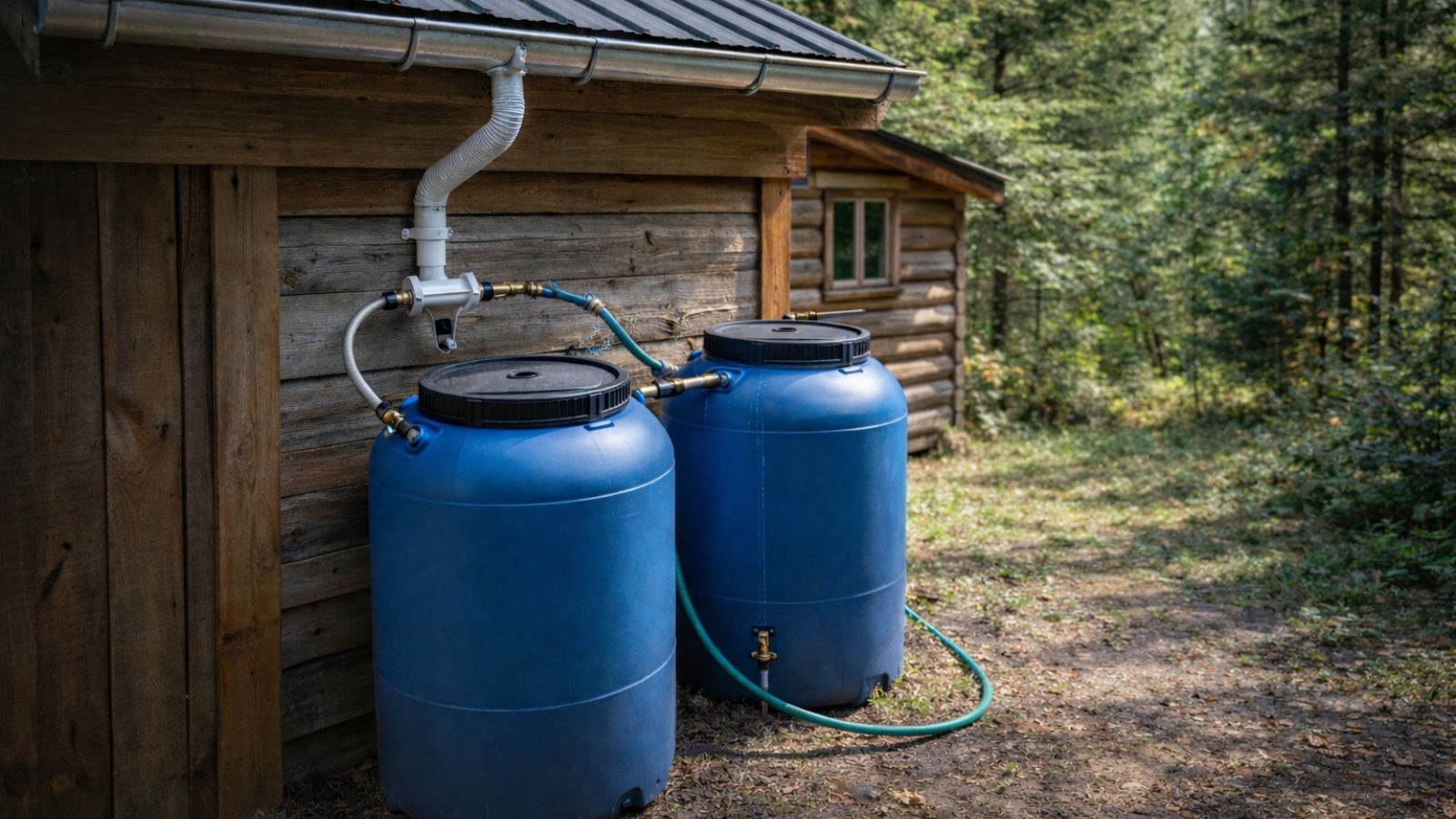
A basic system includes:
- roof catchment surface
- gutter system
- first-flush diverter
- storage tank
Rain systems work extremely well in regions with consistent precipitation, but they require large storage tanks to handle dry periods.
Real-world tip:
Metal roofing dramatically improves water quality compared to asphalt shingles, reducing contamination and extending filter life.
For deeper planning:
[Related: Rain to Reservoir: Complete Guide to Off Grid Rainwater Harvesting Systems]
Surface Water
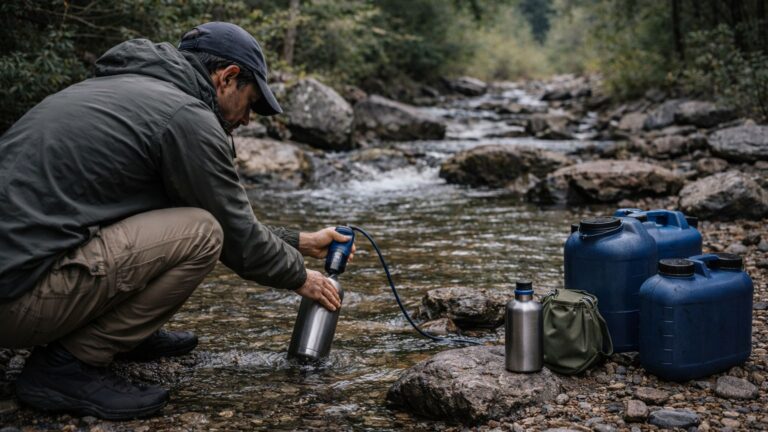
Lakes, creeks, and rivers provide abundant water but require strong filtration.
Typical intake setups include:
- screened intake hose
- foot valve to maintain pump prime
- sediment pre-filter
Seasonal maintenance is critical because debris, algae, and sediment loads change throughout the year.
Important:
Surface water systems should always include multiple filtration stages. Not optional.
Springs
Natural springs are often the most ideal off-grid source.
Many springs allow gravity-fed systems, eliminating the need for pumps. Even so, water quality should still be tested regularly and backup sources should exist.
A good rule for resilience is to design two independent water sources whenever possible.
How to Size a Water System That Actually Holds Up
Most off-grid water systems don’t fail because of bad equipment.
They fail because they were sized for ideal conditions instead of real ones.
A system that works perfectly on a good week can fall apart quickly during drought, heavy use, or equipment failure.
Sizing your system properly is what turns it from functional into reliable.
Step 1: Understand Daily Water Use
Before choosing tanks or pumps, you need a realistic picture of how much water you actually use.
Typical daily usage:
- Minimal cabin living: 10–20 gallons per person
- Moderate off-grid home: 30–50 gallons per person
- Full homestead (laundry, animals, gardens): 50–100+ gallons per person
These numbers vary widely depending on lifestyle.
A small cabin using compost toilets and minimal washing will consume far less than a full household with livestock and irrigation.
Field insight:
Most people underestimate their usage. Especially once they become comfortable and stop conserving.
Step 2: Plan for Storage, Not Just Supply
Your water source might be strong. But supply is rarely consistent.
Rain comes in cycles. Wells can fluctuate. Surface water changes seasonally.
Storage smooths all of that out.
A reliable system should store at least:
- 3–7 days of water for small cabins
- 7–14 days for full-time off-grid homes
- longer in drought-prone regions
Example:
Daily use: 40 gallons × 2 people = 80 gallons
7-day storage = 560 gallons minimum
This is why 250 gallon tanks often feel too small in real use.
Step 3: Account for System Losses
Water systems are not perfectly efficient.
Losses come from:
- leaks and fittings
- flushing filters
- first-flush diverters in rain systems
- evaporation (in open systems)
Even small losses add up over time.
Adding a 10–20% buffer to your storage calculations prevents slow shortages.
Step 4: Plan for the Worst Week, Not the Average Day
The biggest mistake in water system design is planning for normal conditions.
Instead, design for the worst realistic scenario:
- several days of no rain
- frozen pipes or reduced flow
- pump failure or power loss
If your system can survive that period, it will feel effortless the rest of the time.
This is where redundancy matters.
[See Related: Top 10 Emergency Water Sources (and How to Make Them Safe)]
Step 5: Build Redundancy Into the System
Reliable systems don’t depend on a single point of failure.
Strong designs include:
- two water sources when possible
- manual water access (hand pump or gravity tap)
- backup storage separate from main tank
- simple bypass lines around filters or pumps
These additions don’t need to be complex. They just need to exist.
Step 6: Match System Complexity to Your Lifestyle
The more complex a system becomes, the more maintenance it requires.
For part-time cabins:
- simpler systems are better
- fewer components = fewer failure points
For full-time homesteads:
- more robust systems are necessary
- but still prioritize serviceability
The goal is not to build the most advanced system.
It’s to build one that you can understand, maintain, and repair.
Step 7: Think in Systems, Not Components
A pump alone doesn’t solve pressure.
A tank alone doesn’t solve storage.
A filter alone doesn’t solve water quality.
Everything works together.
The strongest systems are balanced across:
- source reliability
- storage capacity
- pressure delivery
- filtration layers
- backup access
If one part is weak, the entire system feels unstable.
The Simple Rule Most Systems Miss
If your system can:
- meet your daily usage
- store multiple days of water
- continue operating during failure conditions
…it will feel reliable.
If it can’t, you’ll constantly be managing around its limitations.
Water systems don’t need to be complicated.
They need to be sized correctly.
That’s what turns a system from “working” into something you can trust.
Designing for Freeze, Drought, and System Failure
A water system that works in ideal conditions is easy to build.
A water system that works when everything goes wrong. That’s what defines a true off-grid setup.
Most failures don’t come from bad equipment. They come from environmental stress that the system wasn’t designed to handle.
If you design for three conditions: freezing temperatures, extended dry periods, and equipment failure — your system will hold up long-term.
Freeze Protection (Cold Climate Reality)
Cold weather is one of the fastest ways to destroy a water system.
Pipes freeze. Tanks crack. Pumps fail. And it often happens overnight.
The key is not just insulation. It’s designing the system so water doesn’t sit where it can freeze.
Critical Freeze Protection Strategies
- bury water lines below frost depth
- use insulated pipe runs for exposed sections
- install drain valves at low points
- slope pipes so water can drain out when not in use
Standing water is the enemy in cold climates.
Tank Placement Matters
Above-ground tanks are convenient — but vulnerable.
In cold regions:
- bury tanks when possible
- or insulate heavily and keep them partially enclosed
- avoid placing tanks in fully exposed wind zones
Even partial wind protection can dramatically reduce freezing risk.
Pump and Filter Protection
Pumps and filters are often the first components to fail in freezing conditions.
Best practices:
- install pumps indoors or in insulated enclosures
- use heat tape where necessary (as a backup, not a primary solution)
- avoid rigid pipe connections that can crack under expansion
Field Insight
Most freeze damage happens in systems that “almost” accounted for winter.
One uninsulated section, one low spot holding water. That’s all it takes.
Drought Resilience (When Supply Drops)
Water systems don’t fail when they run out. They fail slowly as supply tightens.
Drought exposes weaknesses in storage, planning, and consumption habits.
Signs Your System Isn’t Sized for Drought
- tanks drop faster than expected
- pump runs more frequently
- pressure becomes inconsistent
- water usage becomes restrictive
These are warning signs, not sudden failures.
Designing for Dry Periods
To handle drought:
- increase storage beyond minimum calculations
- reduce dependence on a single source
- design for lower daily usage when needed
Rain systems benefit most from larger tanks.
Well systems benefit from reduced pump cycling and backup access.
Backup Water Strategies
Strong systems include secondary options:
- hauled water fill ports
- auxiliary tanks
- nearby surface water intake (with filtration)
Even if rarely used, backup sources change the system from fragile to resilient.
Designing for Equipment Failure
Every system will experience failure at some point.
The difference between inconvenience and crisis is how the system responds when something stops working.
The Most Common Failure Points
In real systems, failures usually occur in:
- pumps
- fittings and connectors
- filtration components
- electrical connections
Rarely the tank. Rarely the source.
Build Around Failure, Not Perfection
Instead of trying to prevent failure entirely:
Design so the system still works when something breaks.
Practical Redundancy That Works
You don’t need a duplicate system, just fallback paths.
Examples:
- gravity-fed tap from storage tank
- manual hand pump on well
- bypass line around filters
- spare pump stored on-site
These are simple additions that prevent total system shutdown.
Serviceability Matters More Than Complexity
If you can’t fix your system quickly, it’s not resilient.
Design choices should favor:
- accessible components
- standard fittings
- easy-to-replace parts
Avoid burying critical components without access points.
The Real Goal of a Reliable Water System
A strong off-grid system doesn’t have to be perfect.
What matters is that it:
• degrades slowly
• gives warning signs
• and continues operating in reduced capacity
The Rule That Changes Everything
If your system can:
- survive a freeze
- handle a dry period
- continue operating through a failure
You’ll have a system you can depend on.
Most off-grid systems don’t fail all at once.
They fail at their weakest point.
Design around that weak point, and your system will hold up much better.
Storage and Pressure
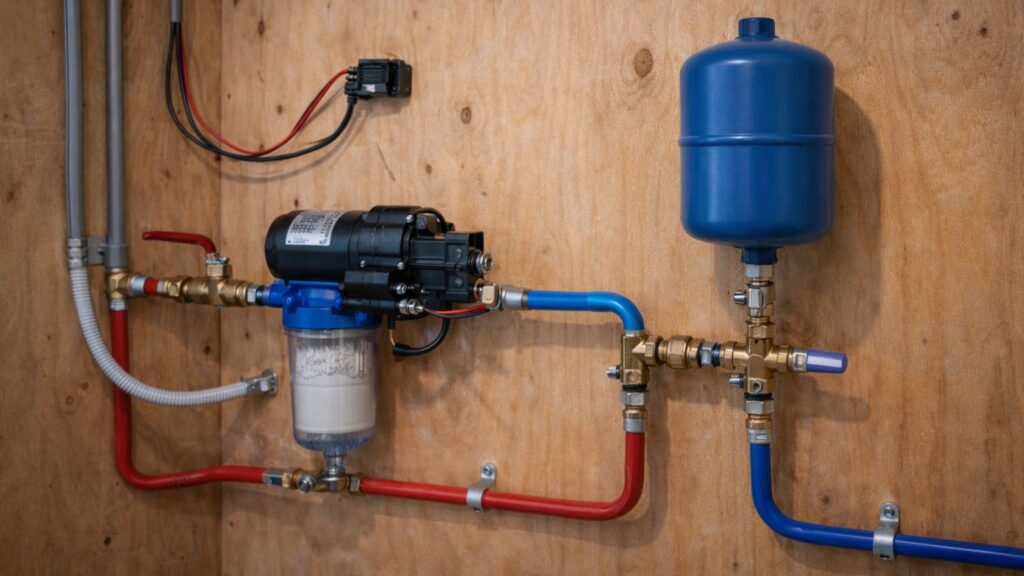
Storage tanks balance the difference between water collection and daily use.
Without adequate storage, even a strong water source becomes unreliable.
Typical capacity guidelines:
- Small cabin: 250–500 gallons
- Full homestead: 1,000–2,500 gallons
- Farm systems: 5,000+ gallons
Larger tanks provide a buffer during droughts, equipment failures, or seasonal supply fluctuations.
Field insight:
If you’re unsure, oversize your tank. Storage is one of the cheapest ways to increase system reliability.
Gravity Systems
Gravity-fed water systems are extremely reliable.
When a tank sits above the house, water pressure is created naturally by elevation.
Pressure is determined by height:
0.43 psi per foot of elevation
A tank positioned 20 feet above the house produces roughly 8–9 psi. This is enough for basic water use even without electricity.
Gravity systems are the ultimate backup because they require no pumps and no power.
Where they shine:
- emergency backup supply
- low-maintenance cabins
- cold climate reliability
Pump Pressurized Systems
Most off-grid homes combine gravity storage with a pressure pump.
Common setups include:
- 12-volt diaphragm pumps
- 24-volt pressure pumps
- accumulator pressure tanks
These systems deliver 40–60 psi, similar to city plumbing.
The accumulator tank reduces pump cycling and stabilizes pressure throughout the system.
Pro tip:
Mount pumps on vibration-dampening pads. This reduces noise significantly inside cabins.
Filtration and Purification
Clean water comes from layered filtration, not a single device.
A typical filtration sequence includes:
- Sediment filter
- Carbon filter
- UV sterilizer
- Optional reverse osmosis
Each stage performs a specific role.
Sediment filters remove sand, rust, and particles.
Carbon filters remove taste, odor, and chemicals.
UV systems neutralize bacteria and viruses.
UV sterilizers only work when water is already clear, which is why pre-filtration is essential.
Water should be tested several times per year, especially with rain or surface water systems.
Important insight:
Skipping one layer often overloads the next. Systems fail not from lack of filtration, but from imbalance.
[See Related: Top 10 Water Filtration & Purification Units]
The Five Core Components of Every System
Reliable off-grid water systems all share the same five elements.
Collection
Water enters from well, rain catchment, spring, or surface intake.
Storage
Food-grade tanks or cisterns store water for consistent supply.
Pressurization
Pumps or gravity create usable pressure in the system.
Filtration and Treatment
Multiple layers remove particles, chemicals, and pathogens.
Distribution
PEX or HDPE piping delivers water throughout the property.
These components form the backbone of systems ranging from small cabins to large homesteads.
If one fails, the system weakens. If two fail, the system stops.
Recommended Gear Field Picks 2026
| Category | Model | Key Specs | Field Rating |
|---|---|---|---|
| Pump | Shurflo 2088-554-144 | 12V · 3.5 GPM · 45 PSI | 9.3 |
| Pump | SEAFLO 33-Series | 12V · 3 GPM | 9.0 |
| Filter | Big Berkey System | Gravity · 0.2 micron filtration | 9.4 |
| UV Purifier | Acuva ArrowMAX 2.0 | 12V UV sterilizer | 9.5 |
| Storage Tank | Norwesco 305 Gallon Vertical | Food-grade polyethylene | 9.2 |
These components are popular because they are durable, serviceable, and widely available in rural hardware stores.
Real-World Setup Example
A practical small homestead system might look like:
- rain catchment feeding a 1,000 gallon tank
- elevated tank for partial gravity pressure
- 12V pump for full pressure inside
- sediment + carbon + UV filtration
- backup manual water access
What this setup handles well:
- daily household use
- cooking and cleaning
- basic irrigation
Where it needs planning:
- extended drought periods
- winter freeze protection
- heavy water use (livestock, gardens)
Common Mistakes to Avoid
Undersized Tanks
Small tanks create constant shortages. Oversizing storage from the beginning prevents system stress.
Wrong Pump Voltage
Match pumps to your power system.
- Small solar systems: 12V
- Larger off-grid homes: 24V
Mixing voltages leads to inefficiency and electrical problems.
Skipping Sediment Filtration
Sediment damages pumps, clogs filters, and shortens UV bulb life. A simple sediment filter prevents many system failures.
Ignoring Winterization
Frozen pipes can destroy a water system in hours.
Install:
- drain valves
- insulated pipe runs
- frost-proof hydrants
Cold climates require thoughtful pipe routing and insulation.
No Redundancy
Every system should have a manual backup.
Options include:
- hand pumps
- gravity bypass lines
- secondary water sources
When the main pump fails, your household should still have drinking water.
Example Off-Grid Water Systems
Cabin Simplicity
- 300 gallon raised storage tank
- rain catchment system
- 12V Shurflo pump
- sediment, carbon, and UV filtration
This setup provides several days of water storage with reliable pressure.
RV or Van System
- 30–50 gallon tank
- SEAFLO pump
- inline carbon filter
- optional UV purifier
Solar charging allows daily water use while traveling.
Full Homestead System
- deep well pump
- 1,000 gallon buried cistern
- pressure pump with accumulator
- UV and carbon filtration
- manual hand pump backup
These systems are capable of operating for years with minimal intervention.
Maintenance and Longevity
Regular maintenance prevents most water system failures.
Recommended routine:
- inspect filters monthly
- replace carbon annually
- replace UV bulbs every 12 months
- clean tanks each spring
- inspect piping for leaks
Keeping spare pump parts and fittings on-site prevents small failures from becoming major problems.
Labeling valves and pipes also makes future maintenance far easier.
Field habit:
If something fails once, keep a spare on-site. Downtime off-grid is never convenient.
Field Notes from Off-Grid Atlas
The most reliable systems are rarely the most complicated.
Across many real-world installations, a consistent pattern appears:
Gravity first. Pressure second. Filtration third. Backup always.
Simple systems tolerate neglect, power outages, and seasonal stress far better than complex ones.
Field Verdict
Reliable water is one of the foundations of off-grid living.
A well-designed system does not depend on perfect weather or perfect power. It relies on good planning, proper storage, and simple equipment that can be serviced easily.
When your water system is stable, everything else about off-grid life becomes easier.
Reliable water doesn’t have to be complicated. Most dependable systems are simply well designed.
That’s what makes a system truly dependable.