Top 10 Off-Grid Refrigerators & Freezers That Sip Power (2026 Edition)
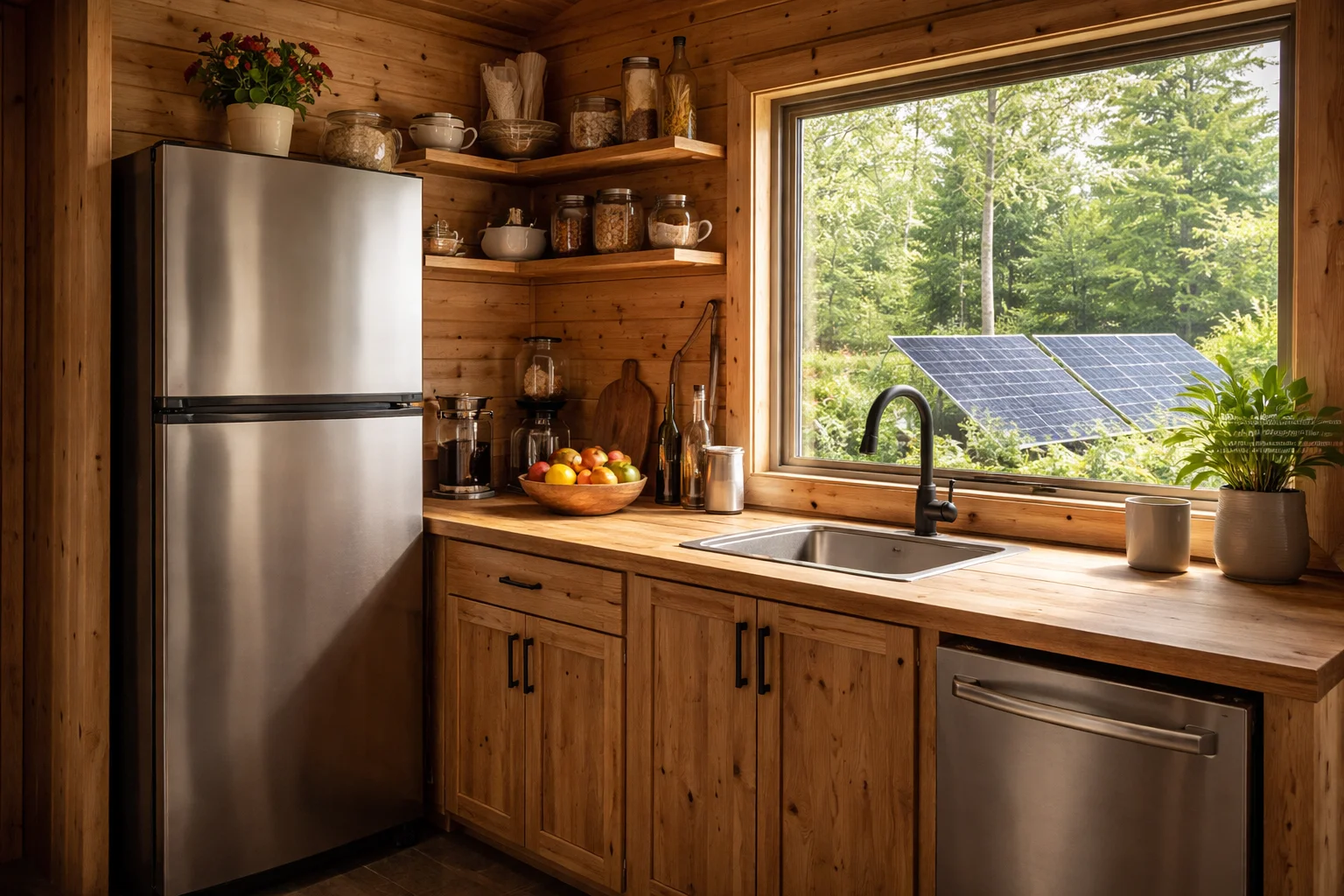
Why Cold Storage Is the Silent Power Killer
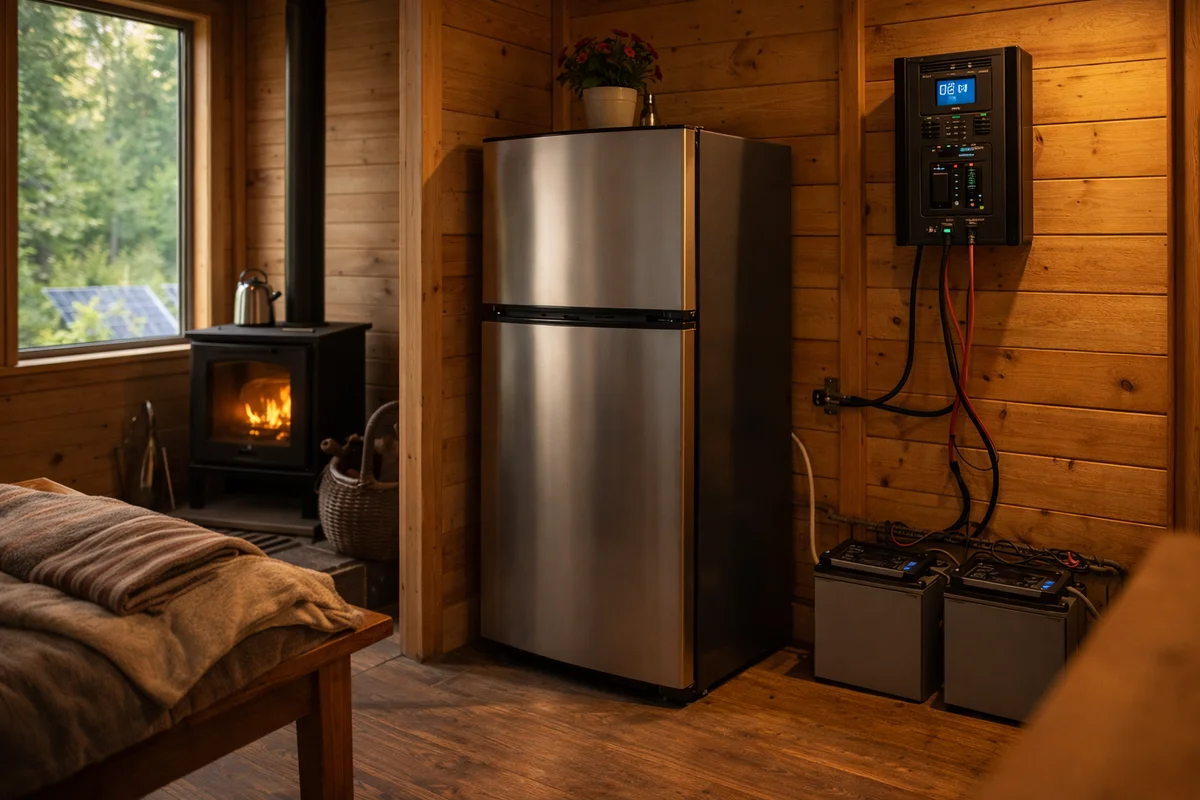
Refrigeration protects food twenty-four hours a day through heat, clouds, travel days, and maintenance problems. That steady demand makes cold storage one of the first loads to include when designing an off-grid power system. Daily energy use over a full day determines the system demand. A compressor may draw a fairly small amount while running, then cycle for longer periods in hot weather, during frequent door openings, or when the cabinet sits in direct sun. A unit that seems easy to power during a mild weekend can become the appliance that dictates winter battery reserve or generator run time.
Efficient compressor refrigerators suit solar power, while absorption refrigerators remain useful where propane is dependable. Capacity, ambient conditions, door openings, fuel availability, and the power system determine the right choice. This guide compares ten credible options, then explains energy budgeting, poor-weather planning, and system integration. Use a measured twenty-four-hour consumption test at the temperatures and loading patterns the appliance will actually experience.
1. EcoFlow Glacier Portable Freezer — Dual-Zone, Solar-Capable, Built for Movement
The EcoFlow Glacier is designed for mobile cold storage and short-to-medium-duration backup use. Its core appeal is flexibility: it can operate from AC or DC power, accepts solar through EcoFlow’s ecosystem, and certain configurations use a removable battery. It can move with the owner between a vehicle, small cabin, and emergency kit. Its most useful capability is divided temperature control on the dual-zone version. One compartment can hold refrigerated food while the other freezes supplies, which removes the need to carry separate coolers on a trip or during a temporary outage. The integrated ice-making feature is convenient for recreation, though it raises the practical load and deserves to be treated as an occasional feature when battery reserve is limited. Capacity and price deserve an honest look. The Glacier suits vehicle travel, hunting camps, seasonal cabins, medical backup, and temporary cold-storage needs; a year-round family home calls for a larger primary refrigerator and a properly sized cabin battery bank.
2. Dometic CFX3 55IM — Premium 12V Compressor Fridge-Freezer
The Dometic CFX3 55IM is a 53-litre portable compressor fridge-freezer built for regular mobile use. Its range extends from 20°C down to -22°C, with a Rapid Ice Plate and silicone trays for ice production while the main compartment remains at its set temperature. It runs from 12/24-volt DC or household AC. Dometic’s three-stage battery protection is valuable in vehicle installations because it helps avoid drawing a starter battery down too far. Wi-Fi and Bluetooth monitoring can also help owners see temperature status without opening the lid, although an app should be treated as a convenience layer. A clear physical display, a protected DC connection, adequate cable size, and a manual temperature check remain more important during a serious outage. The CFX3 suits a couple, a vehicle-based traveler, or a cabin that needs high-quality portable freezer capacity. Its single main chamber operates as a refrigerator or freezer, so simultaneous chilled and frozen storage calls for a dual-zone unit.
3. ICECO VL60 Dual Zone — Budget-Friendly Heavy-Duty DC Fridge
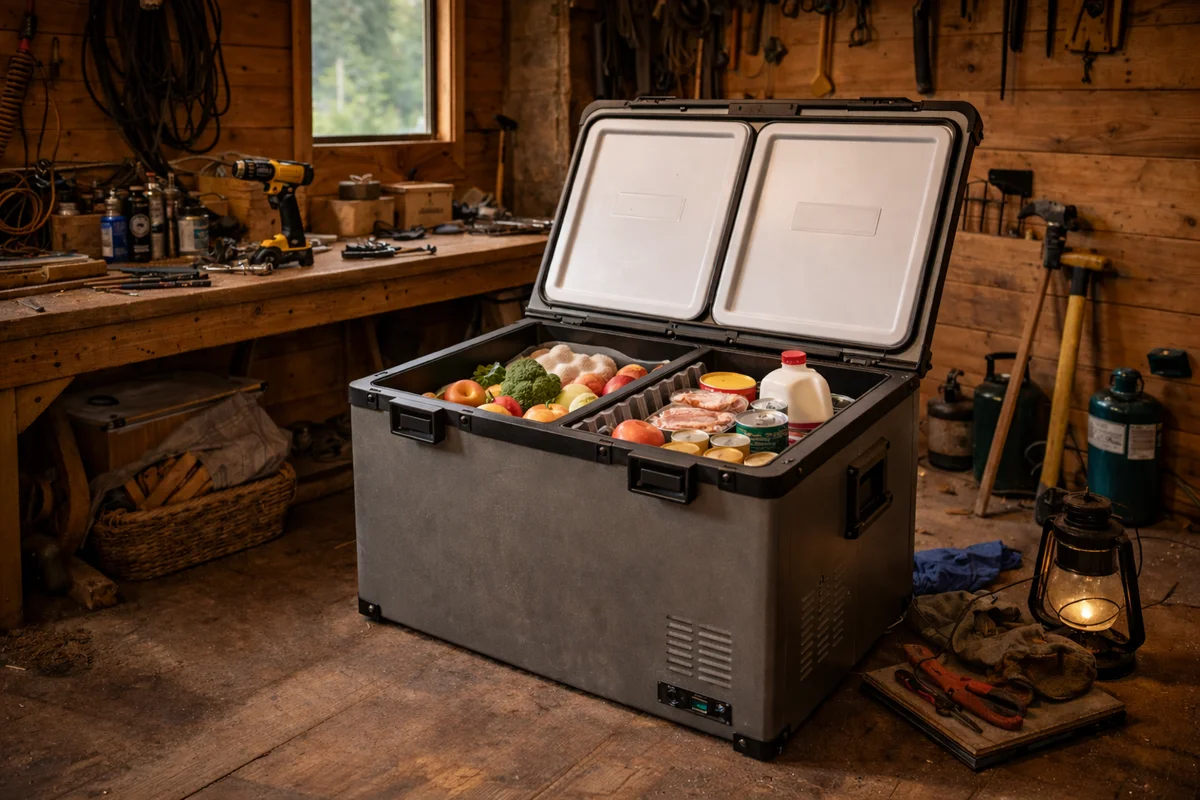
The ICECO VL60 Dual Zone provides roughly 60 litres of portable cold storage in a metal-bodied format for trucks, vans, work sites, and extended camping. Its divided compartments allow refrigerator and freezer operation at the same time, and it supports AC and DC power. The metal shell, substantial handles, latches, and corner protection suit gear that will be loaded, unloaded, and exposed to vibration. It needs a secured mounting position and compressor-side ventilation. A small household can use it for supplementary cold storage or carefully managed primary storage; measure its draw with the actual divider position, temperature settings, and food load before designing around it.
4. Unique UGP-275L1 — Full-Size Propane/AC Hybrid Refrigerator
The Unique UGP-275L1 represents the fixed-cabin end of this list. It is a full-size propane refrigerator with electric capability, intended for places where propane delivery or a large on-site supply is already part of the household energy plan. Absorption cooling moves refrigeration demand away from the electrical system, which can free substantial solar and battery capacity for pumps, communications, lighting, and tools. That independence comes with installation responsibilities. An absorption refrigerator needs a level, well-ventilated location, careful adherence to the manufacturer’s clearances, and a correctly installed propane system. Combustion appliances also require appropriate venting, leak testing, carbon-monoxide alarms, and regular inspection by a qualified technician where required. Never use a propane refrigerator in an unvented interior space or improvise gas fittings.
Propane refrigeration suits a remote cabin with dependable fuel logistics and a limited electrical system. Its slower response and fuel use are balanced by operational separation during poor solar weather. Fuel delivery schedules and installation oversight belong in that decision.
5. SMETA 3-Way Fridge — Classic Absorption for Total Flexibility
SMETA’s three-way absorption refrigerators are commonly sold in compact sizes that can operate from propane, 120-volt AC, or 12-volt DC. The appeal is source flexibility. A unit can be powered from shore power at home, cooled while traveling according to its manufacturer-approved instructions, then operated from propane at a destination with no reliable electricity. Three-way operation deserves careful interpretation. The 12-volt mode on many absorption appliances is a high continuous draw intended mainly for use while a vehicle is running. Check the specific manual for the model being considered, including its 12-volt current draw, required ventilation, level requirements, and any restrictions on operation in transit. Those details vary enough that a generic rule is unsafe.
For a small seasonal cabin, guest bunkie, or backup cold-storage role, a three-way unit can provide useful redundancy. A dedicated DC compressor chest refrigerator remains the strongest option where low solar-electric demand is the priority. The model-specific manual determines whether its DC mode fits the itinerary.
6. Sundanzer DCR165 — Solar-Ready DC Chest Fridge/Freezer
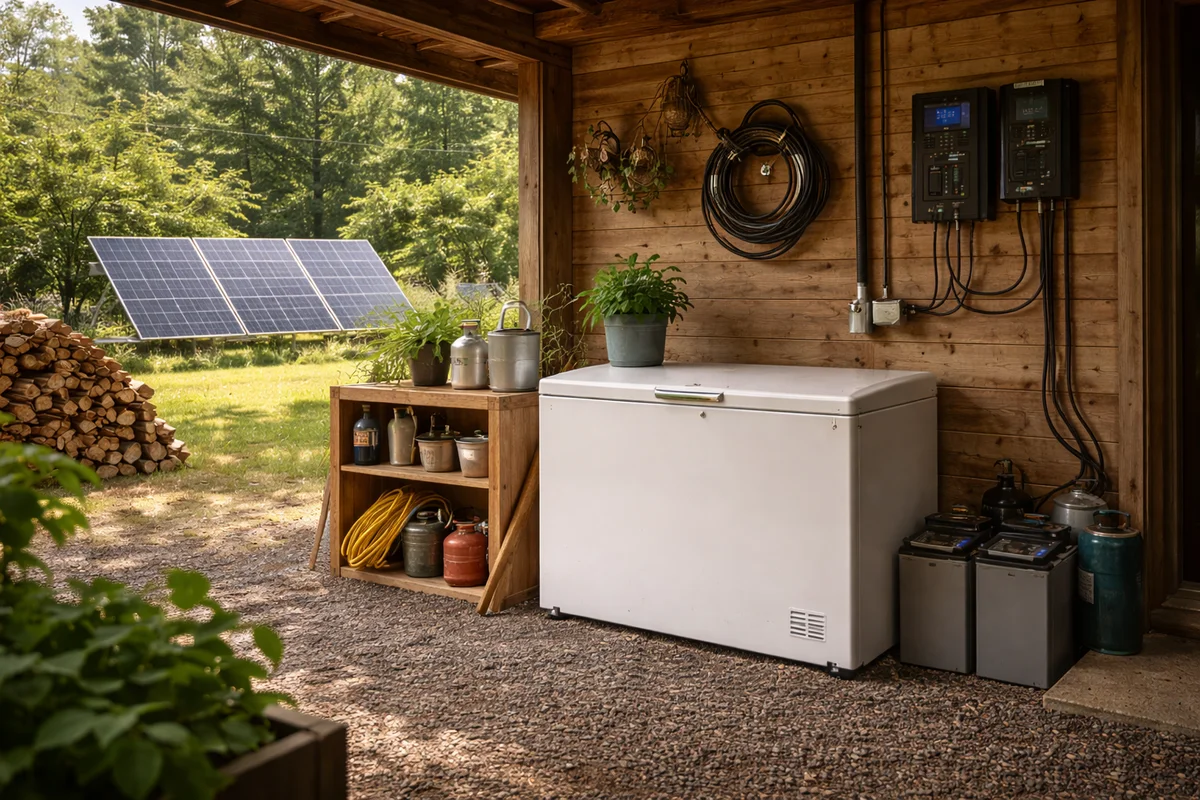
The SunDanzer DCR165 is a purpose-built 12/24-volt DC chest refrigerator with about 165 litres, or 5.8 cubic feet, of capacity. Its published specification identifies a brushless DC compressor, thick polyurethane insulation, and an average 7-watt draw at 38°F in a 90°F ambient test condition. Field use changes with temperature, loading, ventilation, and lid openings. The chest layout holds cold air in place when opened, and the cabinet’s insulation gives it substantial thermal stability. It is a very sensible option for solar-only homesteads, remote clinics or supply storage, and cabins where every watt-hour matters. The large chest form also makes it closer to a stationary appliance than a portable cooler; plan its location, access path, floor support, and basket organization before delivery. Food is stacked, so families need baskets, labelled bins, and a rotation routine. That organization protects the chest refrigerator’s low energy demand and useful margin during poor weather.
7. Bodega TWW75 — Dual Zone Capacity Without the Price Spike
The Bodega TWW75 is a large portable dual-zone cooler with 75 litres, or about 80 quarts, of capacity. Current product information lists 12/24-volt DC and 100–240-volt AC operation, separate zones, and freezer-capable temperatures. It suits families, long road trips, vehicle-supported work, and movable cabin storage. Its roughly 67-pound empty weight suits a slide, secure tie-down points, or a planned shelf. Energy use depends heavily on zone configuration, ambient heat, cable length, and ventilation, so buyers should confirm the manual and run a watt-hour test before assigning it a permanent place in a small solar budget.
8. Alpicool C40 — Compact 12V Classic That Just Works
The Alpicool C40 is a roughly 40-litre portable-compressor cooler for a car, van, boat, or small backup system. Its size suits a hatchback, a bunkside position, or a small power station, with enough storage for one person, a couple, or a dedicated medical and food backup. Compact compressor fridges earn their keep through simplicity. A small cabinet presents less volume to cool and can be an efficient choice when the owner has realistic storage needs. It still needs the same fundamentals as any DC appliance: a fused connection close to the battery, cable sized for the run, ventilation around the compressor, protection from rain, and a stable platform that prevents damage to the cord and cabinet. Choose this size after measuring the food you genuinely need to store. Verify the current model, warranty support, temperature range, and input requirements before purchase because portable-cooler lines change frequently.
9. Whynter FM-85G — Rugged Steel Build for Heavy Use
The Whynter FM-85G is a large single-zone portable refrigerator/freezer with an 85-quart capacity. Whynter lists an adjustable -8°F to 50°F range, 12/24-volt DC and 115-volt AC operation, two removable baskets, two lid locks, and a tough outer casing. Its published maximum draw is 80 watts on AC and 5.5 amps at 12 volts or 2.75 amps at 24 volts on DC; use a full-day meter test for a practical consumption figure. Its strength is volume. The FM-85G can handle a serious supply of frozen food, game, meal preparation, or group-cabin provisions, and the removable baskets make access easier than a deep unorganized chest. Its single-zone design means the owner chooses refrigerator or freezer duty, so it works especially well as a dedicated freezer beside a smaller daily-use refrigerator. Keep it freestanding with clear air circulation and protection from direct sun. A large portable freezer deserves its own measured energy profile before it is paired with a small battery system.
10. Engel MT45 — Proven Longevity Above All Else
The Engel MT45 has long been a respected portable refrigerator-freezer platform for people who prioritize service life and robust cooling over a feature-heavy interface. Its characteristic swing-motor compressor is well known in marine, overland, and remote-work settings, and the insulated cabinet is sized for a practical amount of food without becoming as unwieldy as a large chest freezer. The key benefit is the ownership model: a simple, durable portable fridge can be worth more in a remote setting than a cheaper unit with limited parts support. Buyers should confirm the exact MT45 variant, power lead, warranty coverage, and local service options, since names and specifications can differ by market. A protective cover, secure mounting, clean condenser ventilation, and a sound DC connection do more for longevity than adding accessory electronics. Engel is a strong fit for long deployments, boats, emergency kits, and overland travel. Select it after comparing measured draw with the required temperature and ambient conditions, then provide enough battery reserve for reliable continuous operation.
Comparison Table
| Model | Format and power | Approximate capacity | Best use | |:–|:–|:–|:–| | EcoFlow Glacier | Portable compressor, AC/DC and optional battery ecosystem | Varies by version | Mobile backup and travel | | Dometic CFX3 55IM | Single-zone portable compressor, AC/DC | 53 L | Premium vehicle or cabin portability | | ICECO VL60 Dual Zone | Dual-zone portable compressor, AC/DC | About 60 L | Vehicle, work site, or compact cabin | | Unique UGP-275L1 | Fixed absorption refrigerator, propane/AC | Full-size cabinet | Propane-equipped remote cabin | | SMETA 3-Way | Compact absorption refrigerator, propane/AC/DC | Varies by model | Seasonal use and fuel-source flexibility | | SunDanzer DCR165 | Stationary DC chest refrigerator, 12/24 V | 165 L / 5.8 cu. ft. | Solar-only homestead or cabin | | Bodega TWW75 | Dual-zone portable compressor, AC/DC | 75 L | Family travel and secondary cold storage | | Alpicool C40 | Compact portable compressor, DC/AC by version | About 40 L | One- or two-person storage | | Whynter FM-85G | Single-zone portable compressor, AC/DC | 85 qt | Large dedicated fridge or freezer duty | | Engel MT45 | Portable compressor refrigerator/freezer | About 40 L | Long-term mobile reliability |
Published capacity, power input, and temperature ranges differ by revision and market. Confirm the exact model number and manual before purchasing. Daily energy use is intentionally excluded from this table because it depends on ambient temperature, cabinet setpoint, food load, ventilation, and door-opening behavior; a single advertised figure often creates false precision.
Real-World Energy Budgeting for Continuous Refrigeration
Budget refrigeration in watt-hours per day. A 60-watt label describes running draw; the full daily figure includes compressor run time. A unit averaging 35 watts across a day consumes about 840 watt-hours; a cabinet averaging 55 watts consumes about 1.32 kWh. Begin with a plug-in energy meter for AC operation or a DC battery monitor that records amp-hours and watt-hours. Fill the cabinet as it will normally be used, set the target temperature, let it stabilize for at least a day, and record a full twenty-four-hour cycle. Repeat the test during warm weather if possible. The resulting number is more useful than an estimate because it includes the actual cabinet, location, food load, and habits of the household.
Battery capacity needs an autonomy allowance. Two days of refrigerator autonomy at 900 Wh per day calls for 1.8 kWh of usable battery energy before other loads, inverter losses, cold-weather effects, and battery longevity limits are included. Solar production must cover the refrigerator’s average daily use and generate enough surplus to recharge the bank after poor weather. Panel output varies with season, snow cover, shading, orientation, and local weather. A solar array that only equals a refrigerator’s ideal daily consumption will struggle to recover after a cloudy period. Build a measured energy budget, then include a realistic production margin and a backup charging plan.
Record the test date, outdoor temperature, refrigerator setting, food load, and measured daily watt-hours in the system log. Those simple notes turn a one-time test into a useful seasonal baseline and make a change in performance easier to identify later. They also support accurate future upgrades.
Run the test after loading warm groceries as well as during normal steady operation. Pull-down periods add a temporary demand that matters when the system has little charging margin. It also reveals whether solar recovery restores the battery before sunset.
Surviving Extended Cloud Cover Without Losing Your Food
Poor solar weather calls for a deliberate cold-storage plan before the batteries reach a critical level. Start by keeping the refrigerator in its most favorable environment: shaded, dry, ventilated, and away from cooking heat. A cabinet in a hot shed or sunlit vehicle can require dramatically more run time than the same appliance under cover with free airflow around its condenser. Keep the cabinet reasonably full, use water containers as thermal mass, and organize food for quick access. Maintain 37–40°F for perishable food and use a separate thermometer to check actual food-space temperature.
When the forecast calls for several low-production days, reduce discretionary electrical loads early and decide which cold-storage function matters most. A freezer full of frozen food can tolerate a short interruption better than a refrigerator full of fresh meat and dairy, provided the door remains closed. The U.S. Department of Agriculture advises that an unopened refrigerator keeps food cold for about four hours during an outage, while a full freezer can maintain temperature for about forty-eight hours if unopened. Conditions vary, so use a thermometer and food-safety guidance instead of guesswork. A generator, vehicle charging source, or propane appliance can bridge a poor-weather period. Prepare fuel, cords, transfer procedures, and safety checks before the weather event begins.
Startup Surge and Why It Matters More Than You Think
Compressor loads have a starting characteristic beyond the daily-energy figure. Many AC compressor appliances draw a brief inrush current as the motor starts, and an undersized inverter may shut down even though its continuous rating looks adequate on paper. Cable resistance, low battery voltage, and cold batteries can make that start harder by creating a voltage drop exactly when the appliance asks for the most current. Modern DC compressor refrigerators often manage start-up more gently than conventional AC equipment, which is one reason they work well directly from a battery bank. The DC circuit still needs proper protection and conductor size. A thin vehicle-style plug lead may be adequate for a short run, then become a source of nuisance low-voltage cutouts when the fridge is several metres from the battery.
Use the appliance manual to identify its input range, maximum current, start requirements if supplied, and recommended fuse. Then size the inverter, DC disconnect, fuse, wiring, and battery discharge capability as one system. An electrician or qualified off-grid installer is a worthwhile resource for a fixed installation, especially where multiple high-current loads share a battery bank.
Off-Grid Fridge Buying Guide
Start with the job the appliance must perform. Portable refrigerators suit travel and backup; stationary DC chests suit efficient long-term storage; propane uprights suit cabins with reliable fuel delivery. Choosing the format first makes the product shortlist more useful. Next, calculate the food volume. Count the groceries, frozen meals, produce, medicine, and seasonal harvest you will actually keep cold. Leave working space for airflow and baskets. Large empty cabinets waste space and can encourage inefficient placement; a cabinet that is too small forces frequent shopping, overpacking, and long door openings. A dedicated freezer beside a smaller everyday refrigerator can be a practical arrangement for a household that stores bulk food.
Check the appliance’s input options, low-voltage cutoff behavior, compressor ventilation requirements, temperature range, warranty coverage, and availability of replacement parts. In a mobile setup, also check its empty weight, tie-down points, lid opening clearance, and cable route. In a cabin, measure the delivery path and service access. Cold storage is a long-term appliance decision, so repairability and local support deserve real weight.
Chest vs Upright Refrigerators: Efficiency vs Usability
Chest refrigerators and freezers protect efficiency through basic physics. Cold air is dense and tends to remain in the box when a lid opens. An upright refrigerator releases much of that cold air when its door is opened, then has to cool the incoming warm air. The difference becomes meaningful in a busy household or a hot climate, especially when the appliance is opened repeatedly. The upright format offers superior visibility and easier daily access. Shelves make it easier to find food, rotate produce, and avoid forgotten leftovers. That convenience can reduce the time the door stays open, which partly offsets the format’s inherent cold-air loss. Good door gaskets, orderly shelves, and a shaded location improve the result further.
Chest units ask for organization. Use baskets for categories, label containers, keep frequently used food near the top, and maintain an inventory of deeper frozen items. The effort pays off through lower energy demand, higher thermal stability, and useful capacity. A hybrid setup can combine a small upright refrigerator for daily items with a chest freezer or chest refrigerator for bulk storage, giving the household access where it matters and efficiency where it matters most.
Long-Term Failure Points Most People Ignore
Heat rejection is central to compressor life. Dust, pet hair, insects, and cramped cabinetry can restrict airflow across coils and condenser fans, causing longer run times and hotter components. Inspect ventilation regularly and clean it with the appliance disconnected from power, following the manufacturer’s instructions. An appliance that suddenly runs more often may be signaling a dirty condenser, failed fan, poor clearance, or hotter ambient conditions. Door and lid gaskets deserve the same attention. A damaged seal lets warm, moist air enter continuously, creating frost, extra compressor cycling, and food-temperature instability. Clean seals with mild soap and water, inspect for tears or deformation, and test the closing pressure according to the appliance manual. Poor levelling can also interfere with a seal on some cabinets.
Electrical connections fail quietly in vehicles and outbuildings. Vibration, corrosion, loose plugs, undersized wire, and improvised extensions can cause voltage drop and intermittent shutdowns. Use appropriately rated marine or automotive-grade connectors where exposure demands it, secure cables against abrasion, and keep a spare fuse and the correct power lead on hand. Propane systems add burner, flue, and ignition maintenance that should follow the appliance manual and local safety requirements.
Thermal Mass Strategy: Using Stored Cold to Reduce Energy Demand
Thermal mass gives the refrigerator more stored cold to work with. Food, drinks, and sealed containers of water cool down slowly and warm up slowly, so the cabinet temperature changes less when the door opens or the compressor pauses. A mostly empty refrigerator contains a lot of air, which warms quickly and forces more recovery cycling. Water containers are an inexpensive way to stabilize unused space. Use clean, sealed containers that fit securely without blocking internal vents or preventing the door from closing. In a freezer, frozen water containers also become emergency ice packs and help maintain a safe temperature during a brief outage. Leave room for air circulation and for food packages to cool evenly.
Thermal mass supports a well-designed system as a stability measure. It buys time during a short interruption, reduces temperature swings, and can make daily cycling gentler. Pair it with a reliable thermometer, orderly storage, and an energy plan that keeps the appliance operating within its intended temperature range.
Maintenance & Longevity Tips
Keep the compressor area, exterior vents, and surrounding clearance clean so heat can leave the appliance efficiently. Inspect the power lead and fuse holder regularly, especially in vehicles or damp outbuildings. Defrost freezer compartments before ice buildup begins to reduce usable space and maintain normal airflow. Check door or lid seals, hinges, latches, baskets, and mounting hardware as part of seasonal maintenance. A portable appliance should be secured against travel movement, and a fixed appliance should remain level where the manufacturer requires it. Record the usual daily energy use and cabinet temperature so a change in performance becomes visible early.
For propane models, have the gas system and appliance maintained according to the manual and applicable code. Keep combustion air and vent paths clear, test carbon-monoxide alarms, and replace damaged components with approved parts. Routine attention protects food, equipment, and the rest of the power system.
Propane vs Electric Refrigeration: Choosing the Right Backbone
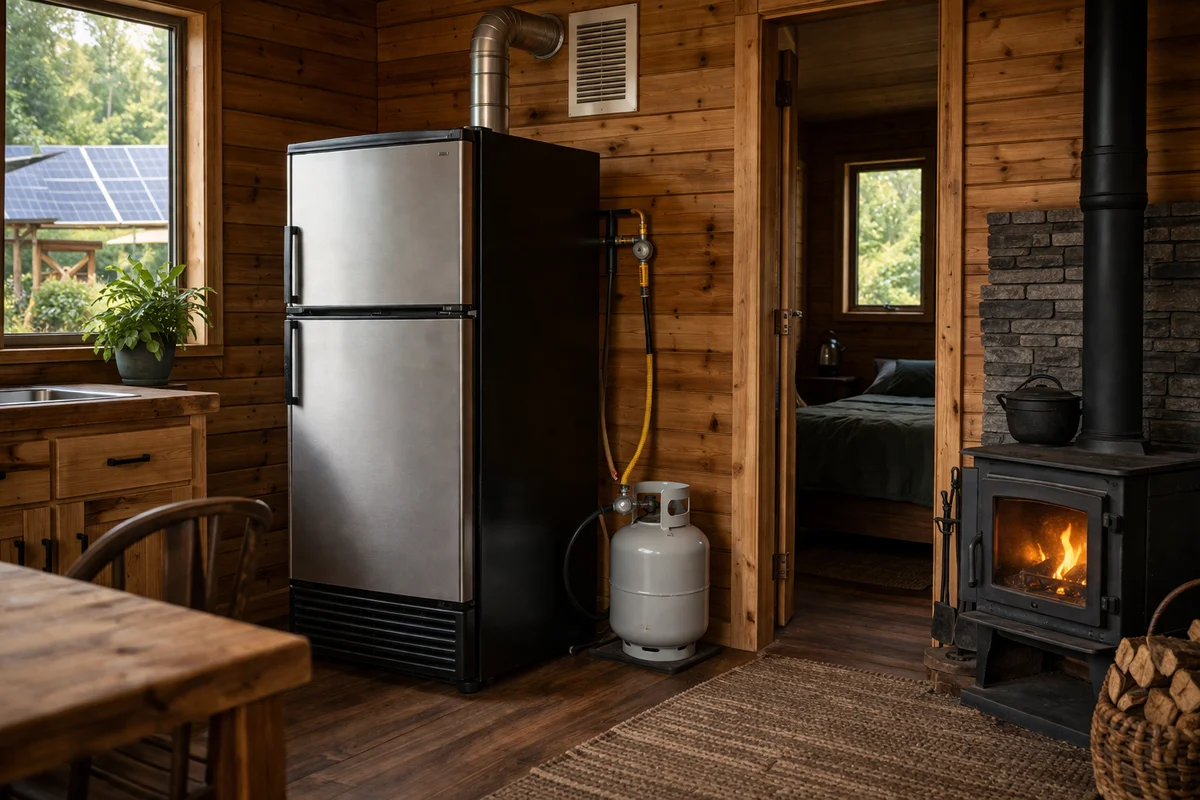
Electric DC compressor refrigeration pairs naturally with solar and batteries. It offers precise temperature control, efficient operation, and no combustion inside the building. A well-insulated DC chest refrigerator can make a remote solar system far easier to live with because its daily electrical demand stays within a predictable range once the actual installation has been tested. Propane absorption refrigeration shifts the refrigerator’s primary energy source to fuel. That can be valuable in a small electrical system, a heavily shaded cabin, or a location where fuel is already stored for cooking and heat. It also creates a fuel-management, venting, and inspection obligation that should be considered part of the appliance’s operating cost.
The most resilient choice depends on the site. A year-round solar home with strong battery storage may be best served by DC compression. A seasonal cabin with regular propane delivery may value a propane refrigerator’s separation from electrical loads. Some properties use a primary electric unit and keep propane, generator, or portable cold storage as contingency capacity. Choose the arrangement that your household can operate and maintain confidently through its worst weather period.
Integrating Refrigeration Into Your Overall System Design
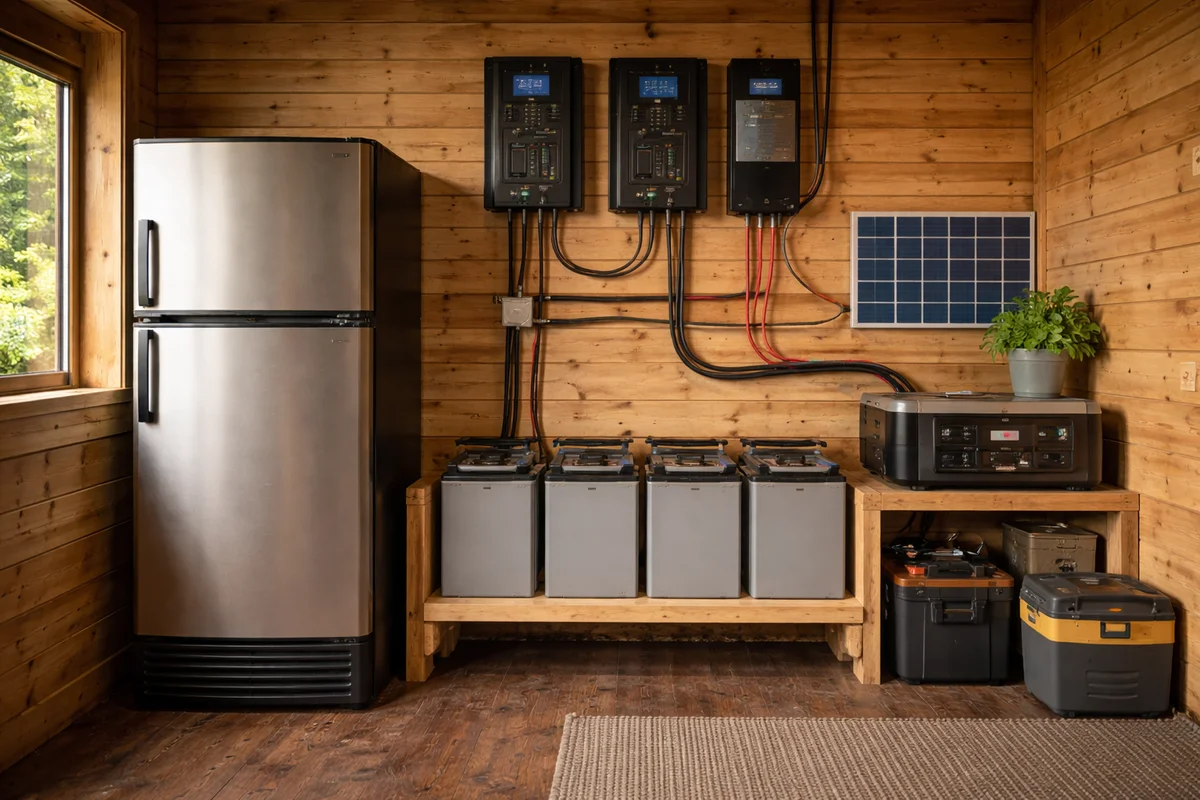
Put refrigeration near the top of the essential-load list. Measure its daily watt-hours, add its maximum current and start behavior to the electrical design, then calculate the battery reserve required for the number of low-production days you want to withstand. This approach creates a power system sized for consistent refrigeration.
Location changes the energy budget. Place the appliance in shade with a dry, ventilated air path around the compressor or condenser. Keep it away from ovens, direct sun, and tightly enclosed cabinetry. For DC appliances, keep the cable run short where possible and size conductors for the actual length and current. For AC appliances, account for inverter efficiency and idle consumption if the inverter must remain on solely for the refrigerator.
Monitoring turns a theoretical design into an operating system. A battery monitor, solar controller data, a refrigerator thermometer, and periodic energy readings show how weather and behavior affect the load. Those records make it easier to catch a failing gasket, blocked vent, weak battery, or declining solar production before food safety is at risk.
Final Thoughts
An off-grid refrigerator earns its place by fitting the energy system, food-storage habits, and site conditions around it. Portable DC units provide flexible cold storage for travel and backup. Deeply insulated DC chests provide excellent efficiency for fixed solar installations. Propane absorption models offer a distinct path for cabins with a mature fuel system.
Measure real daily consumption, plan enough autonomy for poor weather, and give the appliance a cool, ventilated location. Those foundations make cold storage a reliable part of off-grid life. Seasonal measurements keep that reliability sustainable.