
Solar Snow and Ice Management: Keeping Off-Grid Panels Producing Through Winter
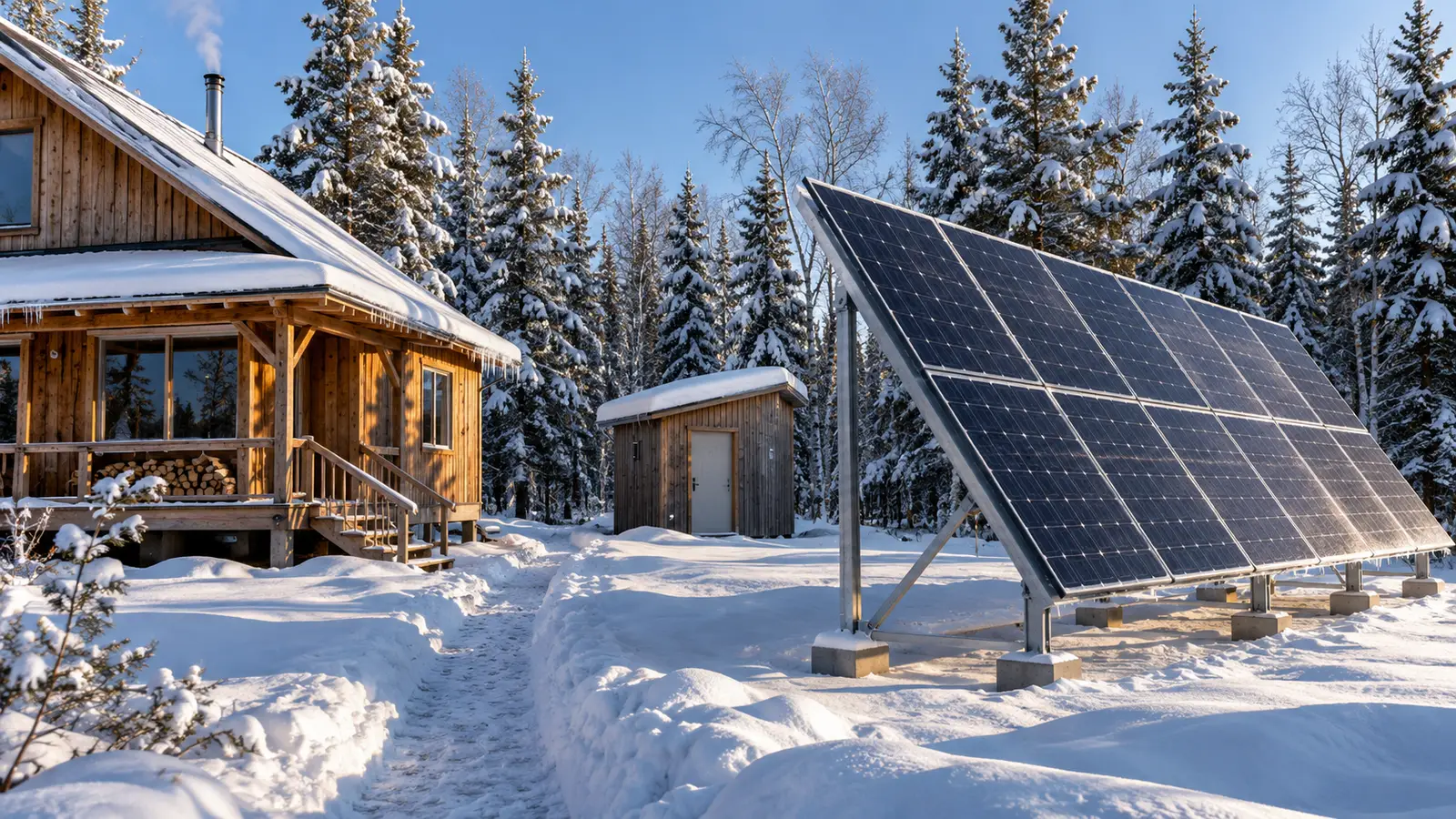
Winter is the season that tests an off-grid solar system’s real margin. Daylight is brief, the sun stays low, storms can arrive in sequence, and household demand often rises as lighting, pumps, ventilation, communications, and freeze protection work harder. A snow-covered array can turn an already lean charging day into a negligible one. The result is rarely a panel problem alone. It is a system-planning problem involving array geometry, access, storage, backup charging, and how the property handles snow.
Cold air itself usually helps photovoltaic modules. Solar cells commonly produce power more efficiently at low temperatures than they do in summer heat, provided sunlight can reach them. Snow, frost, ice, shading, and low winter irradiance limit output. A well-sited array with enough tilt and clear space beneath it can shed fresh snow with very little help. An array with a shallow angle, winter shade, drifting at its lower edge, or poor access can remain impaired long after the sky has cleared.
This guide explains how to plan for those conditions before installation, how to decide when manual clearing is worthwhile, and how to protect the rest of an off-grid power system when weather interrupts production. Electrical work, structural design, roof work, and code compliance belong with qualified professionals where required. Local snow loads, wind exposure, roof geometry, and the equipment manufacturer’s installation instructions set the final design requirements.
Why Winter Solar Performance Matters
Annual production figures can conceal the difficult part of off-grid ownership. A system may make abundant energy from April through September and still run short in December. The winter solar window is narrower, cloud cover can persist, and the sun reaches a lower angle across the array. Electrical consumption may also rise: lights run longer, pressure pumps and furnace blowers remain essential, fans manage moisture, and some properties use heat trace or well-house protection. A battery bank must absorb the gap between those loads and intermittent generation.
Snow coverage compounds that seasonal deficit. A small uncovered strip can sometimes allow a module to produce through its bypass diodes, yet output from a broadly covered array is severely constrained. Partial coverage can also make string behavior uneven when exposed cells are poorly distributed. Monitoring data matters here; a clear-looking day with poor charging current deserves a visual inspection when access is safe.
The practical winter objective is dependable energy through the full season. Dependability comes from an array that clears quickly, battery capacity sized for realistic weather gaps, a charging backup for exceptional periods, and a household load plan that protects essentials. That approach keeps maintenance proportional to the value of the recovered energy.
Understanding How Snow and Ice Behave on Solar Panels
Snow behavior changes with moisture content, temperature, sun, wind, surface condition, and tilt. Dry powder often releases once direct sun warms the glass or a light breeze moves across the array. Wet snow carries more weight and adheres much more strongly. When daytime melt is followed by a hard overnight freeze, the remaining layer can bind to the glass and hold later snowfall in place.
Freezing rain is a separate condition. It forms a thin continuous coating that scatters light and creates a rough surface for later snow to catch. Frost can look minor from a distance while still limiting morning output. Repeated freeze-thaw cycles can also build ice at the bottom edge of an array, in rail channels, or in the snowpack below a ground mount. Those locations deserve attention during design because they affect drainage and snow shedding throughout the season.
Wind can be useful or troublesome. Moderate wind often clears loose snow from an exposed ground array. Strong prevailing winds can deposit a deep drift beneath the lower edge, blocking the route that shed snow needs to take. Two arrays in the same community can therefore behave very differently because of terrain, tree lines, nearby roofs, and the direction of common storms.
Designing Arrays That Shed Snow Naturally
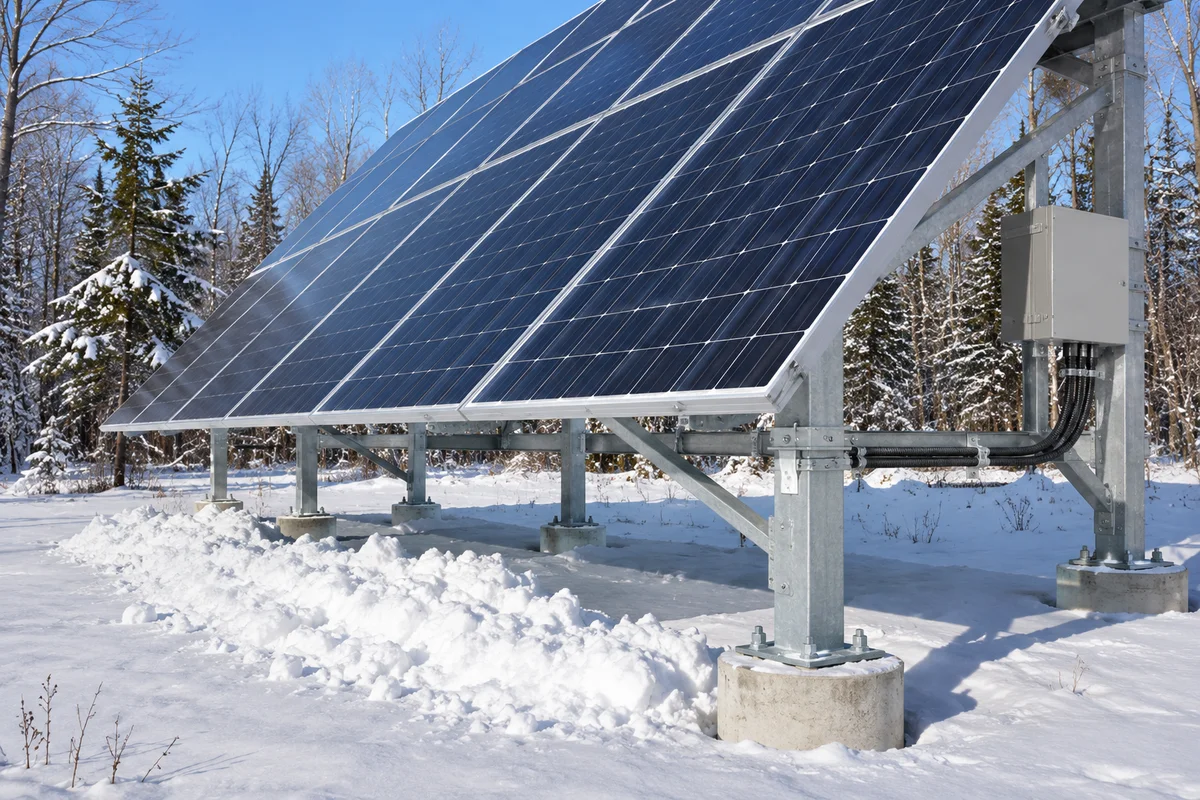
The most reliable snow-management feature is an array that releases fresh snow on its own. Thoughtful mounting decisions made during design establish that result before the first difficult winter.
Array Tilt
Tilt strongly affects both winter solar incidence and the likelihood that snow will slide. Roof pitch often reflects architecture, annual production targets, and construction convenience. An off-grid system in a snowy climate may benefit from a steeper winter-optimized angle, subject to structural design, wind loading, and the racking manufacturer’s approved range. Steeper angles also present the module more directly to the low winter sun in many northern locations.
Adjustable ground mounts can be valuable where seasonal access is practical. A lower setting may suit summer production and wind conditions, while a steeper approved setting can improve winter collection and shedding. The adjustment mechanism must remain safe to operate, secure under local wind loads, and accessible when the ground is icy. A fixed mount designed around the hardest season can be the simpler and more durable choice for many cabins.
Tilt alone cannot guarantee clearing. Wet snow and freezing rain can cling to even a steep array, and an array needs open space below its lower edge for shed snow to fall. Treat tilt as one part of a full winter design.
Mounting Height and Clearance
Ground mounts need clearance for the full winter snowpack, drifting, and the snow that slides off the panels. Designing around a single typical snowfall creates trouble in a long winter. As snow rises beneath the array, the bottom edge loses its drop zone and accumulated snow can bridge back onto the glass. Access paths, conduit runs, posts, and combiner boxes also need to remain reachable for inspection.
Local experience is useful here. Ask what a severe season looks like on the property, including plowed snow placement and wind-driven accumulation. A structural professional can account for site-specific load and foundation needs. Avoid locating a ground array where roof runoff, plow berms, or naturally drifting snow will pile against it.
Module Layout, Drainage, and Airflow
Use the panel and racking manufacturer’s specified module clamps, spans, rail spacing, and gaps. Those details protect the warranty and allow water to drain as designed. A clean layout with adequate air space behind the modules supports drying, lets meltwater escape, and gives snow fewer places to form persistent bridges between modules.
Drainage deserves an inspection after the first freeze-thaw events. Water should leave the array area without pooling around posts, electrical enclosures, or walking routes. Ice around supports makes future maintenance harder and can hide hazards. Grading, gravel, drainage swales, and carefully chosen access paths often solve issues that would otherwise return every winter.
Choosing a Site for Winter Sun and Safe Access
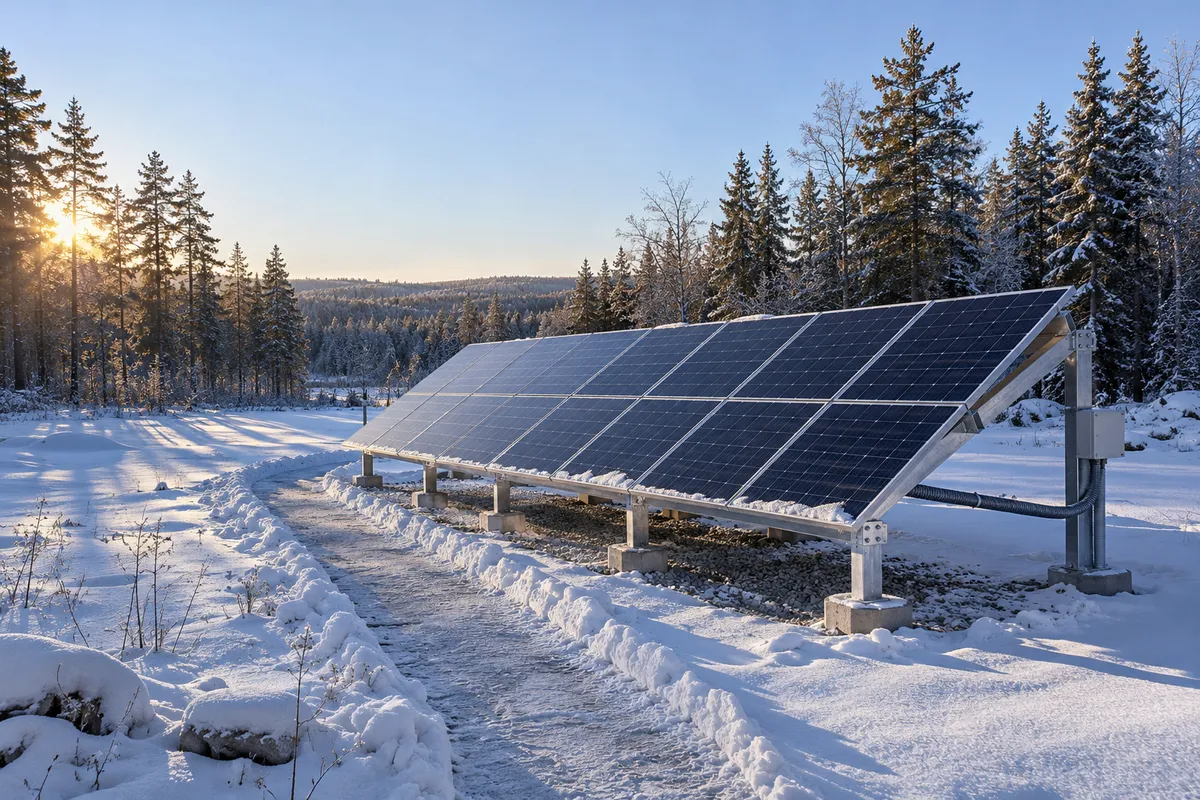
Winter shade must be evaluated separately from summer shade. Trees, ridges, neighboring buildings, and roof features cast much longer shadows when the sun is low. A branch that seems harmless in July may remove a significant portion of a January charging window. Use a solar-path assessment or site analysis during the winter season whenever possible, and account for tree growth over the expected life of the array.
Early sun has special value. Morning light can warm the glass, loosen fresh snow, and begin restoring charge before household loads consume more of the battery bank. An array that stays shaded until midday may remain colder and snow-covered longer, losing useful time during the shortest days.
Choose a location that can be observed and accessed safely. A ground array beside a maintained walkway can be inspected without climbing. A roof-mounted array may be appropriate for the site, yet its maintenance plan must reflect real roof pitch, ladder placement, snow depth, overhead hazards, and fall protection. Do not create a routine that depends on walking a snow-covered roof. If a panel cannot be safely reached from the ground or a properly planned work position, natural clearing and the system’s energy reserve should carry the event.
Avoid low pockets where wind deposits snow. Consider where snow from driveways and roofs is moved, where spring melt flows, and whether vegetation will block access. These choices affect maintenance for decades, while a panel rack is difficult to relocate once the electrical and structural work is complete.
Safe Snow Removal Techniques
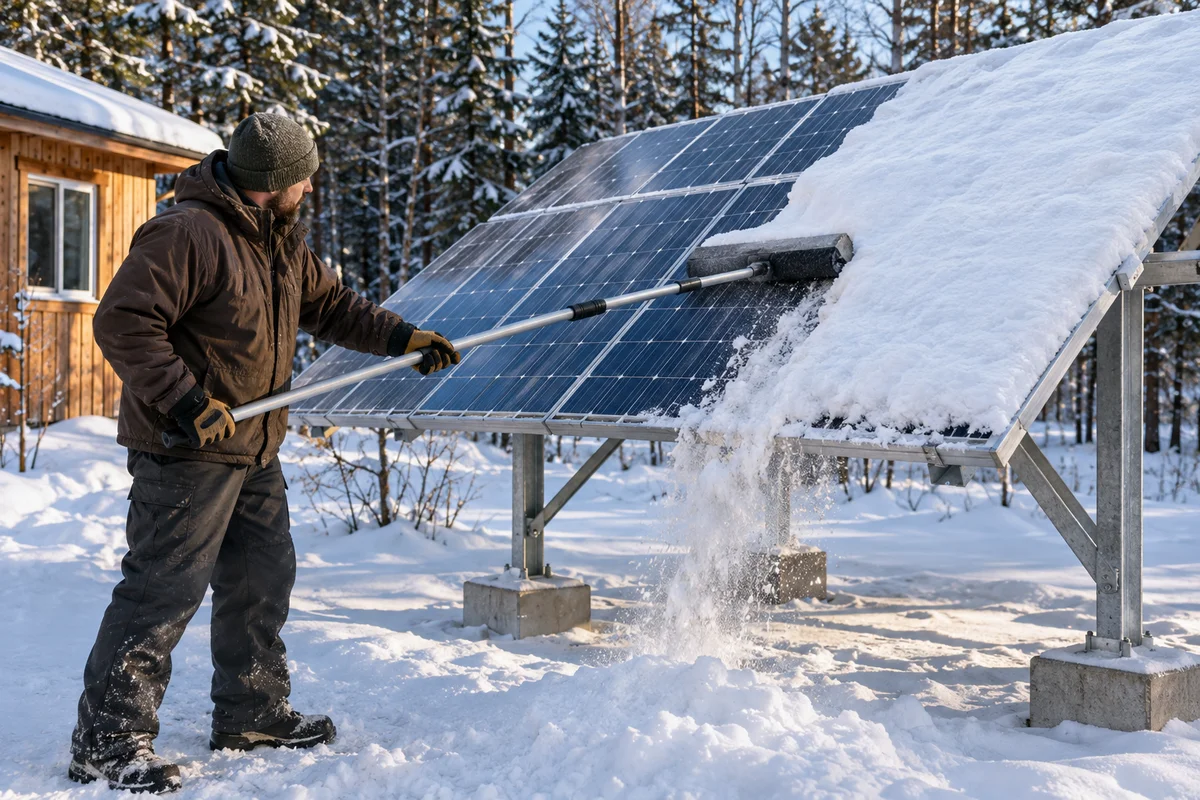
Manual clearing earns its place when the array remains covered after a storm, a clear weather window is available, battery state of charge is falling, and the work can be done safely. The aim is to start a release with as little contact as possible. Often a gentle pass at the bottom edge lets the upper snow sheet slide under its own weight.
Use a telescoping tool designed for solar panels or delicate roof surfaces, with a soft foam, fabric, or non-abrasive polyethylene head. Work from a stable position on the ground whenever possible. Keep the tool clear of junction boxes, wiring, module frames, and racking hardware. Follow the panel manufacturer’s cleaning and maintenance instructions, especially if the warranty specifies allowable tools or methods.
Metal shovels, steel ice scrapers, abrasive pads, stiff roof tools, and powered brushes can scratch glass, damage coatings, compromise seals, or strike wiring. Panel glass is durable under its designed environmental loads; it is still a precision surface. A scratch can retain dirt and moisture, and impact damage can be difficult to identify until later.
Establish a stop rule before beginning. Stop when footing is poor, wind is strong, snow is falling heavily, the work would require an unsafe ladder position, or the tool cannot reach without overextending. Never work under a loaded roof edge or stand in the path of sliding snow. For roof-mounted systems, a professional with proper access and fall-protection planning is the appropriate option when ground-based clearing is insufficient.
Managing Ice and Frost
Thin frost frequently disappears once the glass receives direct sun. Ice bonded to a module needs more patience. Mechanical force can damage the surface, while the short-term energy gain may be small in weak winter light. Use monitoring and battery state of charge to judge urgency, then let sun and a safe temperature change do most of the work where possible.
Never pour hot or boiling water onto frozen modules. Sudden temperature change can create thermal stress, and the resulting water may refreeze on the array, roof, or walking area. Never spread rock salt, calcium chloride, household de-icers, abrasive compounds, or chemicals onto photovoltaic modules. Residue can affect seals, frames, nearby hardware, drainage, and light transmission. Manufacturer-approved cleaning instructions should govern any cleaning product used on the system.
Persistent ice is diagnostic information. Inspect the location for shade, shallow tilt, trapped runoff, a blocked lower edge, damaged drainage, or inadequate space behind the modules. Correcting the cause usually produces a more reliable result than repeating a difficult maintenance task after every storm.
Hydrophobic Coatings and Heated-Panel Claims
Hydrophobic products can help liquid water bead and leave a smooth surface. Under some conditions, that may reduce water spotting and assist meltwater runoff. Their effect on heavy, wet, or frozen snow is modest because adhesion, weight, temperature, and array geometry remain the dominant factors. A coating cannot provide a drop zone below the array or create winter sunlight where shade blocks it.
Check panel documentation and warranty terms before applying any aftermarket coating. Products intended for windshields, vehicles, or household glass may leave residues or have no proven compatibility with photovoltaic module materials. A coating that reduces light transmission or complicates cleaning is a poor trade for a modest shedding benefit.
Heated panel systems deserve the same system-level calculation. Heating consumes energy when generation is already scarce, adds equipment and control complexity, and may offer limited benefit during dense cloud cover or severe storms. For a residential off-grid system, strong racking, suitable tilt, accessible maintenance, battery reserve, and backup charging usually provide greater winter resilience.
Monitoring Winter Production
Winter monitoring turns vague worry into useful decisions. Establish a baseline for clear days, overcast days, and ordinary storm recovery. Record battery state of charge, peak and total charging current, daily harvest, generator run time, and major loads. After one or two seasons, those patterns make it easier to recognize when an array is behaving differently from the weather.
A battery monitor with an accurate shunt gives a clearer picture than voltage alone. Compatible charge-controller and inverter data can show the charging curve, low-temperature protection events, and changes in production through the day. Remote monitoring is helpful for a periodically occupied cabin, alongside physical inspections of the array, wiring, enclosures, and snow conditions.
Investigate material deviations promptly. If neighboring roofs clear while the array remains covered, compare tilt, shade, lower-edge clearance, and drainage. If battery charging stays low through a sequence of clear days, inspect for snow, frost, tree shade, soiling, a fault indication, or a connection problem. Treat electrical faults as electrical work: isolate equipment according to its documented procedure and use a qualified technician when diagnosis goes beyond ordinary visual checks.
A simple daily winter check is usually sufficient: weather forecast, battery state of charge, charging current, and any alerts from the system. That small routine supports timely load decisions without turning the solar system into a constant chore.
Batteries, Loads, and Cold-Weather Charging
An uncovered array is only one part of winter power reliability. Battery capacity falls or becomes more restricted in the cold, depending on chemistry and battery-management controls. Lead-acid batteries deliver less available capacity at low temperature and require maintenance appropriate to their design. Lithium iron phosphate batteries commonly retain useful discharge performance, but many models prohibit charging below freezing unless their battery management system, internal heating, or an approved external solution allows it.
Read the exact battery manual. Charging a lithium battery outside its approved temperature range can cause permanent damage, and battery systems differ in their low-temperature sensors, heating logic, and charging limits. Place batteries in a dry, protected location that stays within the manufacturer’s operating range. A properly designed utility room may provide a more stable environment than an unheated shed, but batteries still require the required clearances, ventilation where applicable, fire safety measures, and service access.
Winter is also the time to identify essential and deferrable loads. Keep refrigeration, water, communication, safety systems, and critical heat-related controls at the top of the plan. Schedule workshop tools, laundry, water heating, and other heavy discretionary loads for periods of strong charging whenever possible. Clear priorities help a battery bank bridge a multi-day storm without requiring risky snow removal.
Calculate From Winter Loads
Start with a simple winter load ledger. List each essential appliance, its running watts, expected hours of use, and any surge requirement. Pumps, refrigeration compressors, power tools, and some heating equipment can draw a high starting current even when their daily energy use seems modest. Add realistic losses for inverter conversion, wiring, battery charging, and cold-temperature operation. The result gives a much better basis for storage and generator decisions than a summer electricity bill or a nameplate total.
Separate the ledger into critical, useful, and discretionary groups. Critical loads keep the property safe and habitable. Useful loads make the day workable but can often be scheduled. Discretionary loads can wait for a strong solar window or a generator run. Post the priorities near the power system so everyone using the cabin understands the plan during a storm. A clear load hierarchy turns conservation into a practical routine.
Protect the Battery Reserve
Set an operating reserve that triggers a response before the battery bank reaches its manufacturer-recommended lower limit. The response might include postponing discretionary use, starting the backup charger, or reducing overnight loads. The correct reserve depends on battery chemistry, available generator fuel, the forecast, and how long the property can safely operate at reduced consumption.
Review the battery monitor after major changes to the system. Additional appliances, a different refrigerator, a water-treatment system, or a new occupant can shift winter demand enough to make an older design assumption unreliable. Regular review helps the system retain its intended margin as the cabin evolves.
Building a Winter Energy Reserve
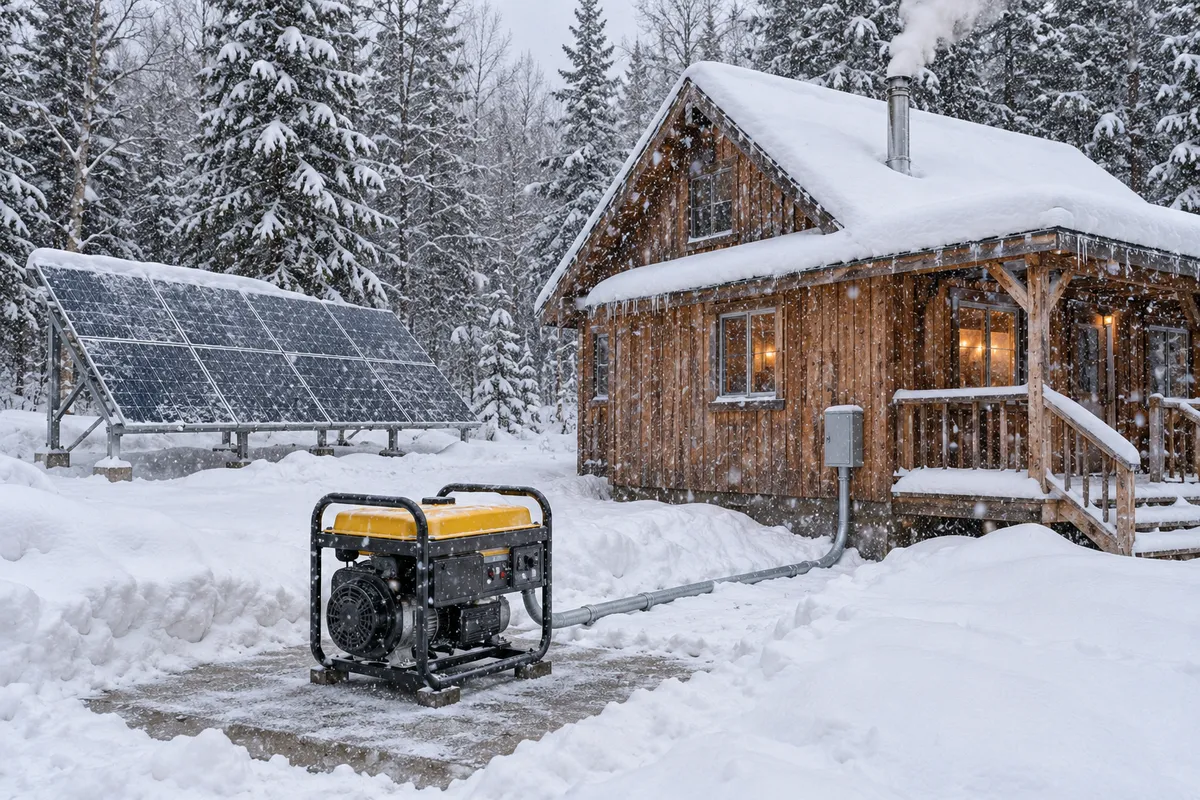
Every off-grid system needs a plan for the weather event that exceeds the normal model. Several dense-cloud days, an ice storm, or a large snowfall can suppress solar production regardless of array quality. Storage reserve and a backup charging source provide practical resilience during weather events that exceed the normal solar model.
Size battery capacity and solar generation through a real load analysis and local winter solar data. The plan should include average daily use, essential loads, surge demands, expected autonomous days, allowable depth of discharge for the battery chemistry, charging efficiency, and seasonal production. A qualified designer can combine those inputs with local code, snow and wind loads, and equipment requirements. The finished design should have enough margin to protect batteries from chronic deep discharge during the darkest part of the year.
A generator can restore battery capacity after extended bad weather. Select it, its fuel system, ventilation, transfer arrangement, and charging equipment according to manufacturer instructions and code. Test it before winter, maintain the fuel supply appropriately, and run it only outdoors or in a purpose-built, properly ventilated installation. Carbon-monoxide risk makes improvised indoor or attached-garage generator use unacceptable.
Conservation stretches every reserve. Delay nonessential work, reduce idle loads, use efficient lighting, and plan high-draw tasks around forecast sun. These habits may avoid both generator fuel use and unnecessary attempts to clear an array during dangerous conditions.
Selecting Equipment for Snowy Climates
Equipment selection begins with documented suitability. Review each module’s mechanical load rating and the racking system’s approved configuration. Local building requirements establish the snow and wind design loads for the site; a qualified installer or engineer should verify foundations, rails, clamps, fasteners, and attachment points. Install modules exactly as their manufacturer specifies, including clamping zones and frame orientation.
Choose corrosion-resistant racking and hardware suitable for repeated wetting, freezing, and thawing. Electrical enclosures, cable entries, conduit, and disconnects should remain protected from drifting snow, meltwater, and physical damage. Labels must stay visible and access to disconnects must remain clear. An autumn inspection is the best time to tighten up these practical details before snow conceals them.
Snow-load ratings require careful reading. A module rating, a rail rating, and a building-code design load each refer to defined conditions and installation assumptions. Their values cannot simply be compared as a single universal number. Rail span, clamp location, portrait or landscape orientation, array exposure, roof shape, drifting, and local ground-snow requirements can all change the required engineering. Treat the completed racking documentation and the approved structural plan as the authority for the installed system.
Consider the entire route of snow as well. Snow that slides from a steep roof array can land on a deck, walkway, lower roof, window well, or service area. Ground arrays need enough open space in front of them for repeated sheets to accumulate without blocking access. A site plan that identifies these zones protects people and prevents a successful snow-shedding design from creating a new maintenance issue elsewhere on the property.
For maintenance, a long-handled non-abrasive solar or roof rake is more useful than a collection of aggressive scraping tools. The Garant Yukon Telescoping Roof Rake is one example of a lightweight, ground-operated rake that may suit accessible arrays; confirm its head material and reach against the module manufacturer’s maintenance guidance before use. Keep it with a stable access plan, gloves, traction appropriate to the work area, and a clear understanding of where snow will fall.
Monitoring equipment should match the system architecture. Victron Energy’s SmartShunt and compatible temperature sensors are widely used examples for systems built around that ecosystem. Other inverter and battery manufacturers offer equivalent monitoring. The useful feature is reliable data for state of charge, charge current, temperature limits, and alerts, with installation performed according to the electrical design.
Battery heating needs to be integrated and approved for the specific battery. Many lithium batteries include internal heaters and low-temperature charging protection; manufacturer-approved heating accessories can be appropriate in a designed battery enclosure. Avoid improvised heating pads, unlisted wiring, or controls that bypass battery-management safeguards.
Common Winter Solar Mistakes
Several patterns repeatedly create winter trouble. The first is treating every snowfall as an emergency. Fresh powder on a well-angled accessible array may clear with sun and gravity, while a rushed roof climb creates a fall hazard for a small energy gain. Use battery state, weather, and safe access to decide whether a clearing effort is warranted.
Another pattern is optimizing only for high-sun summer output. Winter design needs attention to shade, low solar angle, snow shedding, and the property’s actual energy needs during long dark periods. A system that looks productive on an annual estimate can still leave too little resilience in the months that matter most to an off-grid home.
Poor maintenance access is costly. Arrays squeezed against a fence, installed over a steep roof section, or placed where snowplows bury them become difficult to inspect when the system is under stress. Build a clear route, usable working space, and safe observation points into the original site plan.
Finally, avoid treating accessories as a substitute for fundamentals. Coatings, specialty tools, and remote monitoring can each help in the right role. Sound siting, approved structural design, tilt, clearance, battery protection, and a backup plan determine whether the system remains reliable through a hard winter.
Reading Winter Weather Before It Becomes a Power Problem
Weather forecasting is an operational tool for an off-grid household. A forecast of one clear cold day followed by several storm days supports a different set of decisions than a gradual thaw with mixed cloud. Use the forecast alongside state of charge, expected solar harvest, and generator fuel level. Charge batteries fully while energy is available, move optional work into the clear window, and prepare essential loads to coast through the poorer period.
Snowfall totals alone tell only part of the story. Wet snow near freezing is heavier and more adhesive than dry powder. Freezing rain can create a durable light-blocking layer even when accumulation totals appear low. Wind direction can build a drift under a ground array, and a warm daytime melt followed by a hard freeze can turn a simple clearing decision into an ice-management problem. Reviewing temperature, precipitation type, wind, and cloud cover offers a far more useful expectation of how the array will recover.
For a seasonal cabin, include arrival planning. A property that has stood empty through a storm may have low battery state, covered modules, a buried access route, and fuel or water systems that need attention. Bring a safe access plan, inspect the area in daylight, and sequence tasks around safety and essential power. Remote monitoring can provide advance awareness, but the first on-site inspection remains important after severe weather.
A Practical Seasonal Maintenance Routine
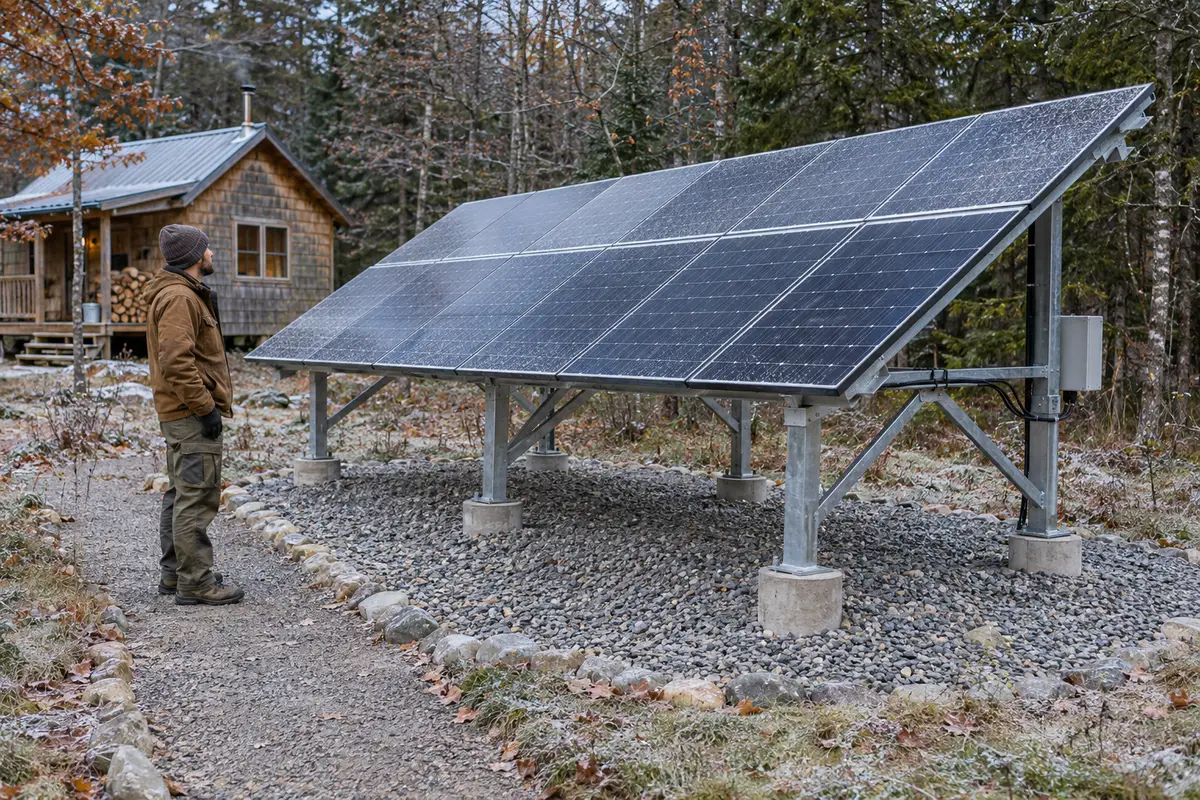
Prepare before the first persistent snow. In autumn, review monitoring alerts, confirm battery temperature protection, inspect racking and visible fasteners, verify that cable management is intact, clear drainage paths, trim winter-shading vegetation where permitted, and test the generator and battery charger. Check that snow-removal tools are reachable without digging through storage and that your access route remains clear when snow accumulates.
During winter, follow a light but consistent rhythm. Review the forecast and battery condition daily or whenever the property is occupied. After storms, inspect from a safe location for snow coverage, drift formation below the array, ice around access paths, damaged branches, and abnormal system alerts. Clear only when the energy benefit and safe conditions justify it. Keep notes on storm behavior; they are valuable evidence for improving the array next season.
Keep the maintenance log short and useful. Record storm type, depth, outside temperature, array condition, battery state of charge, any generator run time, and what action was taken. A few seasons of notes can reveal that a particular wind direction creates a drift, a tree shades the array in late afternoon, or the winter tilt setting begins clearing much faster. Those observations support focused improvements and help a future owner understand why the system is operated as it is.
After spring thaw, inspect for damage that was hidden by snow. Look for shifted racking, loose cable clips, water erosion, enclosure moisture, damaged conduit, and vegetation changes. Clean modules only with methods approved by the manufacturer. This is also a good time to compare winter production records with the design expectation and decide whether a change in tilt, access, storage, or load management would improve the next season.
Frequently Asked Questions
Should solar panels always be cleared after snowfall?
Clear panels when stored energy is becoming limited, a useful solar window is available, and the work can be performed safely. Light dry snow often releases naturally from a suitable array. Heavy wet snow and ice may persist longer, so system monitoring and weather conditions should guide the decision.
Can snow damage solar panels?
Modules installed within their documented mechanical-load limits are built for normal outdoor conditions. Damage risk rises when snow loads exceed the engineered system design, mounting hardware is inadequate, or aggressive tools strike the glass, frames, wiring, or racking. Local structural requirements and manufacturer instructions are essential.
Are heated solar panels worthwhile for an off-grid cabin?
They are a specialized solution with an energy and complexity cost. Most cabins gain more dependable winter performance from thoughtful array geometry, clear winter sun, accessible maintenance, adequate storage, and backup charging. Evaluate any heating system against the energy it consumes during the period it is meant to improve.
Do hydrophobic coatings eliminate snow buildup?
No coating can reliably prevent heavy wet snow or bonded ice. Some compatible products may assist water runoff in specific conditions. Confirm manufacturer approval before applying anything to module glass.
How should batteries be protected during winter?
Keep the battery system inside its manufacturer-approved temperature range, use the required temperature sensing and low-temperature charge protection, and maintain a realistic energy reserve. For lithium batteries, follow the documented limits for charging below freezing and use only approved heating provisions.
Off-Grid Atlas Verdict
Reliable winter solar begins with choices made before the first storm: a site with winter sun, a structurally sound array that can shed snow, enough clearance for the local snowpack, safe access, protected batteries, and a plan for long weather gaps. Once those foundations are in place, monitoring and occasional gentle clearing can preserve production without turning winter maintenance into a hazard.
Snow and ice will reduce solar availability in cold climates. A system designed around that reality remains calm under pressure. It protects essential loads, gives the battery bank time to recover, and uses backup charging when conditions exceed the forecast.