Cold-Climate Plumbing: Designing Water Systems That Survive Freezing Weather
Plumbing safety note: Freeze protection affects potable water, electrical heat trace, buried lines, pressure systems, and local plumbing requirements. Use qualified professionals for design, electrical connections, buried work, potable-water treatment, and repairs beyond your competence.
Compact Cold-Climate Plumbing Shortlist
| Product or system | Best use | Main benefit | Guardrail |
| Uponor AquaPEX | Interior cold-climate distribution | Flexible PEX tubing | Confirm approved fittings, pressure, and local code. |
| SharkBite PEX fittings | Accessible repairs and transitions | Serviceable connection path | Use only where approved and protect from freezing. |
| Frost King pipe insulation | Protected interior runs | Basic thermal protection | Insulation alone cannot prevent freezing indefinitely. |
| Heat-Line internal pipe heating | Vulnerable buried or exposed lines | Purpose-built freeze protection | Requires approved electrical design and monitoring. |
| EasyHeat heat cable | Selected exposed pipe protection | Supplemental heat trace | Follow listing, controls, and installation instructions exactly. |
| Woodford frost-free hydrant | Exterior draw-off points | Drain-back outdoor access | Correct burial, drainage, and installation are essential. |
| Watts boiler drain valve | Seasonal draining | Accessible drain-down point | Select potable-compatible components as required. |
| Rusco sediment filter | Protected mechanical-room filtration | Serviceable sediment control | Filter housings must remain protected from freezing. |
| Moen Flo leak monitor | Indoor leak detection | Early warning and shutoff planning | Confirm plumbing compatibility and power needs. |
| Temp Stick sensor | Remote temperature monitoring | Tracks vulnerable-space temperature | Monitoring does not replace freeze protection. |
Winter places demands on an off-grid plumbing system that many installations never encounter during the rest of the year. Water that flows reliably throughout the summer can become trapped inside pipes, freeze overnight, and expand with enough force to split fittings, crack valves, or burst entire sections of plumbing.
The damage is often discovered only after temperatures rise again.
A frozen pipe doesn't always fail while the water inside is still ice. Many systems rupture during thawing, when water begins flowing through damaged sections that remained hidden beneath insulation or inside walls throughout the coldest part of winter.
For off-grid homes, repairs can be particularly disruptive. Water systems often serve every part of the property, from household plumbing and livestock watering to irrigation and fire protection. Losing that infrastructure during freezing weather creates far more than an inconvenience.
Fortunately, freeze-resistant plumbing depends more on thoughtful design than expensive equipment.
Proper pipe routing, adequate burial depth, reliable drainage, careful material selection, and strategic insulation all contribute to a system that's capable of tolerating long periods of freezing weather with minimal intervention. Supplemental heating still has a place, but it should support good design rather than compensate for poor planning.
This guide explains how freezing damages plumbing systems, how to prevent those failures, and how to design water infrastructure that continues operating reliably throughout severe winter conditions.
Why Pipes Freeze
Water expands as it freezes.
Unlike most liquids, which contract when cooled, water increases in volume as it turns to ice. If that expansion occurs inside a completely filled pipe with nowhere else to go, tremendous internal pressure develops.
Contrary to popular belief, the ice itself doesn't always split the pipe exactly where it forms.
Instead, ice often blocks a section of plumbing while liquid water remains trapped elsewhere in the line. As freezing continues, expanding ice compresses that trapped water until the pressure exceeds the strength of the pipe, fitting, or valve.
The weakest component usually fails first.
Sometimes that's the pipe.
Sometimes it's a threaded fitting.
Sometimes it's a valve body or filter housing.
Understanding why this happens makes prevention much easier.
Successful cold-weather plumbing focuses on reducing the likelihood that water remains trapped in vulnerable locations while protecting sections that cannot be drained.
The Four Principles of Freeze-Resistant Plumbing
Although every property presents unique challenges, successful cold-climate plumbing systems generally follow the same four principles.
Water should remain below the local frost depth whenever practical.
Any section that cannot remain below frost depth should either be insulated, heated, or capable of draining completely.
Piping should be routed to eliminate unnecessary locations where water becomes trapped.
Every system should remain accessible enough that inspection, maintenance, and seasonal shutdown can be performed without dismantling finished walls or permanent structures.
These principles work together.
Insulation alone cannot prevent freezing indefinitely if water remains motionless inside an exposed pipe during prolonged cold weather.
Likewise, excellent drainage provides little benefit if plumbing is routed through poorly insulated crawl spaces exposed to sub-zero temperatures for months at a time.
The strongest designs consider the entire system rather than relying on one protective measure.
Planning Before Installation
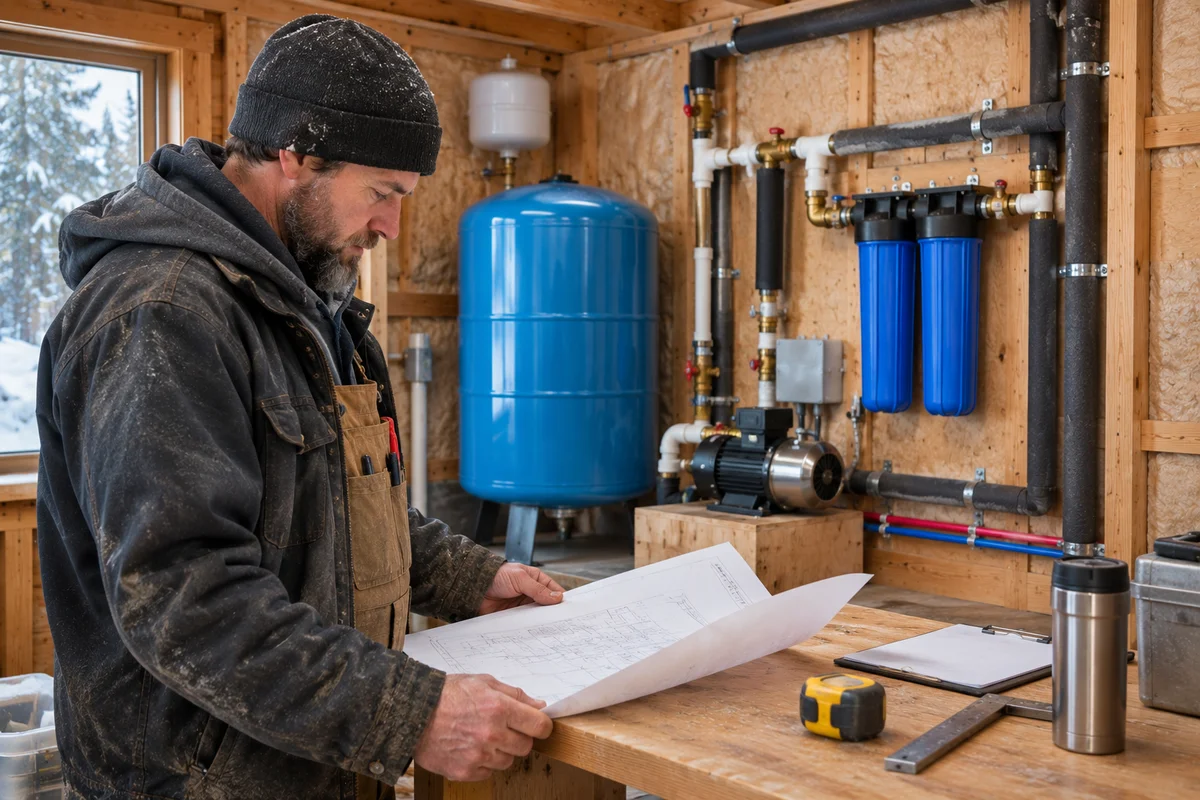
Preventing frozen plumbing begins long before the first section of pipe is installed.
Every water line should be planned with three questions in mind.
Where could water become trapped?
How will this section be serviced?
Can this section be drained if necessary?
Answering those questions during the design stage usually leads to a much simpler plumbing layout.
Long, direct pipe runs generally perform better than complicated routing filled with unnecessary bends and elevation changes. Every fitting introduces another potential leak point while every rise and dip creates another opportunity for trapped water.
Mechanical rooms also deserve careful planning.
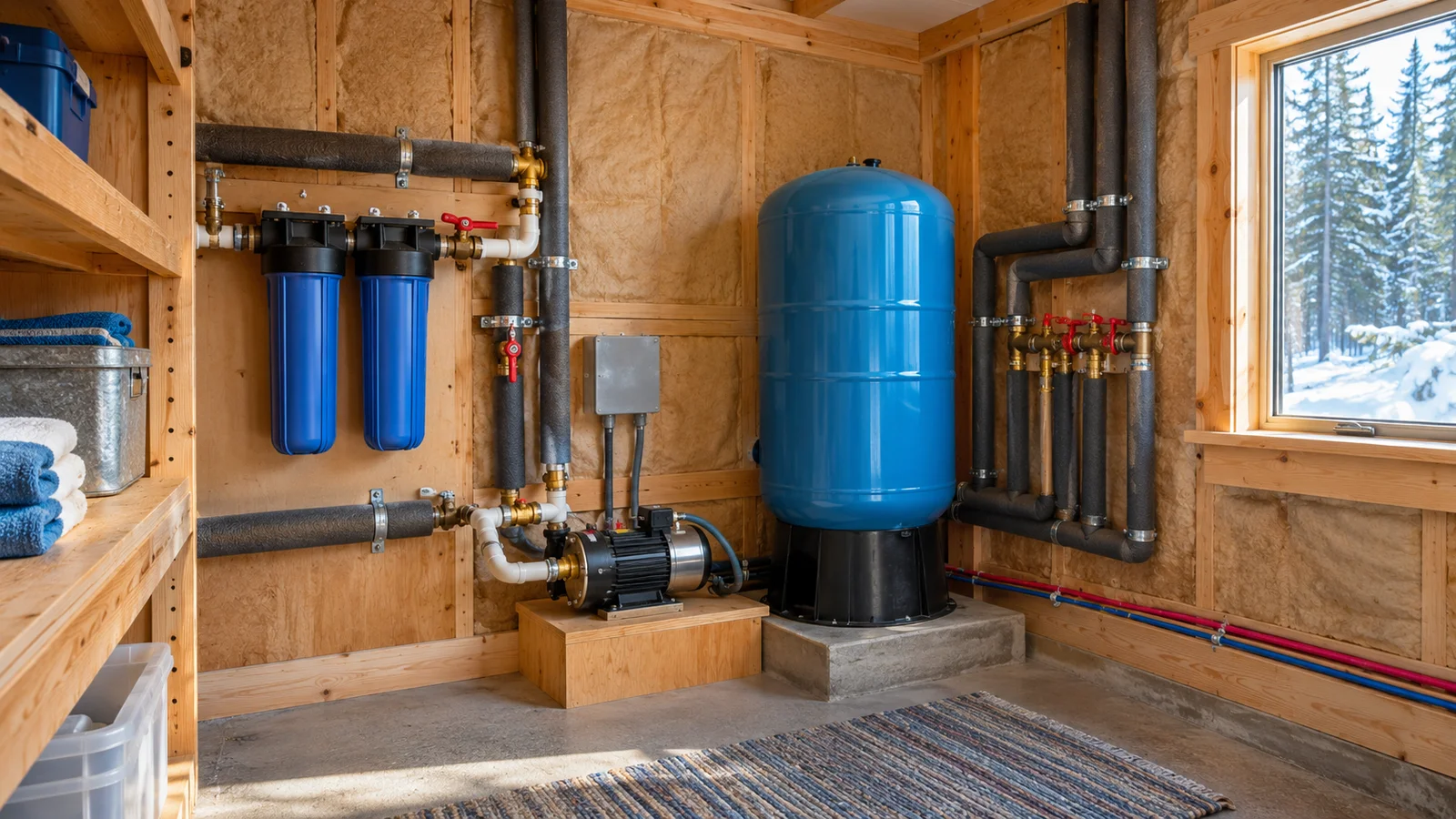
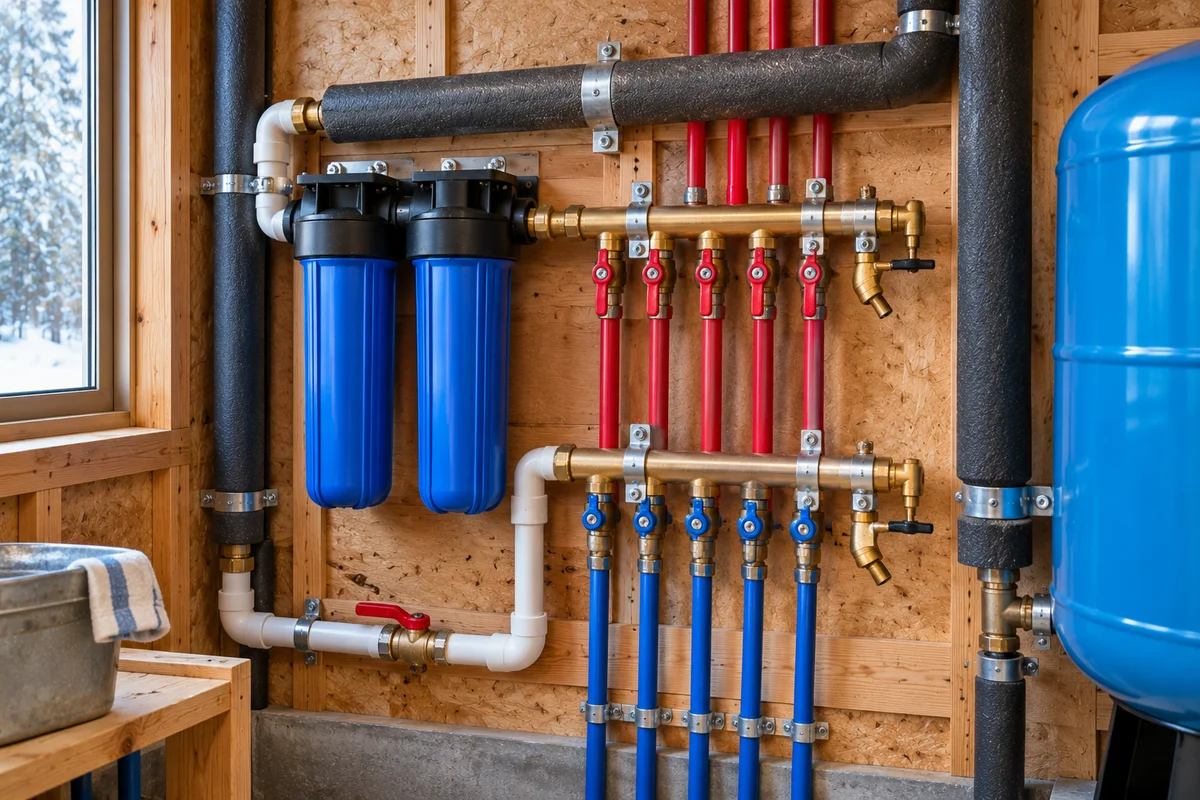
Whenever possible, pressure tanks, filters, shutoff valves, manifolds, and water treatment equipment should be located inside conditioned or insulated spaces where temperatures remain above freezing throughout the winter.
Grouping these components together simplifies maintenance while reducing the number of vulnerable locations scattered throughout the property.
Outdoor plumbing should be limited whenever practical.
Every exposed section requires additional protection, whether through burial, insulation, heat tracing, or seasonal drainage.
Keeping most of the system inside the insulated building envelope reduces both installation complexity and long-term maintenance.
Choosing Pipe Materials for Cold Climates
No plumbing material is completely freeze proof.
Every pipe can be damaged under severe enough conditions.
Some materials, however, tolerate freezing considerably better than others.
PEX
PEX has become one of the most popular plumbing materials for cold-climate installations because of its flexibility.
When water freezes inside PEX tubing, the material can expand to accommodate some of the increased volume before returning close to its original shape after thawing.
This flexibility doesn't guarantee survival under every circumstance, but it often provides a valuable margin of safety compared with more rigid piping materials.
PEX also requires relatively few fittings because long continuous runs can often be installed between manifolds and fixtures.
Fewer fittings generally reduce the number of locations where leaks may eventually develop.
HDPE
High-density polyethylene performs exceptionally well for buried service lines.
Its flexibility allows it to tolerate moderate ground movement while resisting many of the stresses created by frost heave and seasonal soil expansion.
Long continuous coils also reduce the number of underground joints, simplifying installation while reducing potential leak locations.
For properties using gravity-fed water systems or long supply lines between wells and buildings, HDPE remains one of the most dependable options available.
Copper
Copper has served residential plumbing reliably for decades and continues to perform extremely well inside conditioned buildings.
Because copper transfers heat efficiently, however, exposed sections cool rapidly when subjected to freezing air.
Outdoor copper piping should receive careful protection through proper insulation, appropriate placement, or supplemental heating where necessary.
CPVC and PVC
PVC and CPVC remain useful materials in many plumbing applications, particularly where freezing temperatures are unlikely.
In regions experiencing prolonged cold weather, however, their comparatively rigid nature provides less tolerance for repeated freeze-thaw cycles than more flexible alternatives.
When these materials are used outdoors or in unheated spaces, protecting them from freezing becomes especially important.
Designing Plumbing That Drains Properly
One of the most effective ways to prevent freeze damage is ensuring water has somewhere to go before temperatures become dangerous.
Drain-down plumbing has been used for decades in seasonal cabins, irrigation systems, agricultural buildings, and remote properties because it removes the very thing that causes freeze damage in the first place.
The concept is simple.
When a building will remain unoccupied or when portions of the plumbing system won't be needed during winter, those sections are intentionally drained rather than left full of standing water.
Designing for drain-down begins with pipe routing.
Horizontal runs should include a gentle, continuous slope toward designated drain locations wherever practical. The objective isn't to create steep grades throughout the building, but to avoid low spots where water naturally collects after shutoff.
Many plumbing systems perform perfectly throughout the summer while hiding small pockets of trapped water that only become apparent after the first hard freeze.
Every unnecessary dip becomes another location where freezing may begin.
Drain valves should be installed at natural low points within the system.
Typical locations include:
- The incoming water service.
- Branch lines serving outdoor fixtures.
- Irrigation circuits.
- Seasonal buildings.
- Livestock watering systems.
- Equipment rooms supplying detached structures.
Equally important are air vents.
Water cannot drain efficiently unless air is allowed to replace it.
Opening a drain valve while the upper portion of the plumbing remains sealed often leaves substantial amounts of water trapped inside the system.
Providing vent points at higher elevations allows gravity to empty the piping much more completely.
Many seasonal properties can be winterized by opening only a handful of carefully positioned valves.
That convenience isn't accidental.
It's the result of designing the plumbing around predictable drainage from the very beginning.
Pipe Slopes and Water Traps
Not every section of plumbing requires a continuous slope.
Household drain systems naturally require carefully controlled gradients, while pressurized supply lines often follow whatever route provides the shortest and safest installation.
However, whenever supply lines pass through vulnerable areas such as crawl spaces, utility chases, detached buildings, or seasonal structures, paying attention to slope can significantly improve winter reliability.
One of the most common problems occurs when long pipe runs sag slightly between supports.
These shallow depressions may hold only a small amount of water, yet that can be enough to create an ice blockage during severe weather.
Proper support spacing helps prevent this problem.
Flexible piping should always be supported according to the manufacturer's recommendations so the finished installation maintains its intended alignment over time.
If sections of plumbing must rise over obstacles before descending again, recognizing those high and low points during installation allows additional drains or vents to be incorporated where they're most effective.
Good routing often eliminates freeze problems before insulation or heat tracing ever become necessary.
Insulation Strategy
Pipe insulation slows heat loss.
It does not generate heat.
Understanding that distinction is important because insulation is sometimes expected to solve problems it was never designed to address.
If a pipe containing standing water remains exposed to below-freezing temperatures long enough, insulation alone will not prevent freezing indefinitely.
Its greatest value lies in delaying heat loss while protecting plumbing located inside insulated buildings, crawl spaces, utility rooms, and wall cavities that already benefit from relatively moderate temperatures.
Several insulation materials are commonly used for water systems.
Closed-cell foam insulation remains popular because it's lightweight, moisture resistant, and easy to install around straight pipe sections.
Flexible elastomeric insulation performs well around mechanical equipment and is widely used in utility rooms where condensation control is also important.
Fiberglass insulation is sometimes used in larger mechanical spaces, although it generally requires an outer protective covering when exposed to moisture.
Regardless of the material selected, insulation should remain continuous.
Small gaps around valves, fittings, unions, and elbows often become the first places where freezing begins.
Carefully sealing these transitions usually provides greater benefit than simply increasing insulation thickness elsewhere.
Using Heat Tape Effectively
Heat tape has become a valuable tool for protecting vulnerable plumbing, particularly where pipes cannot be buried below frost depth or relocated into conditioned spaces.
Modern self-regulating heat cable differs significantly from older constant-output products.
Instead of producing the same amount of heat across its entire length regardless of temperature, self-regulating cable automatically adjusts its output according to surrounding conditions. Colder sections receive more heat while warmer sections draw less power.
This improves efficiency while reducing the likelihood of overheating.
Heat tape works best when it's used selectively.
Entry points where water services enter buildings often benefit from supplemental heating because these areas frequently combine cold outdoor temperatures with exposed plumbing before the pipe reaches conditioned space.
Short sections inside crawl spaces, well houses, or utility enclosures may also justify heat tracing when relocation isn't practical.
After installation, insulation should normally be placed over both the pipe and the heat cable according to the manufacturer's instructions.
This helps retain generated heat while reducing overall energy consumption.
Heat tape should never become a substitute for correcting poor plumbing layout.
If a pipeline remains unnecessarily exposed when it could reasonably be buried, rerouted, or drained, solving the underlying design problem generally provides greater long-term reliability than relying solely on electrical heating.
Frost-Proof Hydrants and Outdoor Fixtures
Outdoor water access remains important throughout the year on many off-grid properties.
Livestock require dependable water.
Equipment needs washing.
Gardens may still require irrigation during shoulder seasons.
Standard hose bibs are poorly suited to freezing climates because water often remains inside the valve body after use.
Frost-proof yard hydrants solve this problem differently.
The operating valve is located well below the frost line rather than near the handle above ground. When the hydrant is closed, the vertical standpipe drains automatically through a small drain port beneath the frost depth.
This leaves little or no standing water inside the exposed portion of the hydrant.
Proper installation remains essential.
The drain port must empty into clean gravel or another suitable drainage medium so water can escape freely after every use.
If this drainage area becomes clogged with soil or remains submerged, the hydrant may no longer drain correctly, increasing the risk of freeze damage.
Like every other component of a cold-weather plumbing system, frost-proof hydrants benefit most from proper installation rather than relying solely on the product itself.
Protecting Buried Water Lines
Most of the attention in cold-weather plumbing focuses on the piping inside buildings, but the buried service line deserves just as much consideration.
A properly installed underground water line may remain untouched for decades, while a poorly planned installation can become a recurring source of leaks, freezing, and expensive excavation.
Burial depth should always be determined by local frost conditions rather than generalized recommendations. Frost depth varies considerably between climates, soil types, and snow cover, making local building requirements and regional experience the best sources of guidance.
The trench itself also influences long-term reliability.
Sharp rocks should be removed before pipe installation, and many installers place several inches of sand or screened soil beneath and around the pipe to reduce abrasion as the ground settles over time.
Warning tape installed above the pipeline provides another inexpensive layer of protection by alerting anyone excavating the area before they reach the water line.
Where the pipe passes beneath driveways or future building sites, installing a larger protective sleeve can make future replacement much easier without disturbing finished surfaces.
Documenting the pipeline location is equally important.
Photographs taken before backfilling, simple site maps, and measurements from permanent landmarks all make future maintenance significantly easier than relying on memory years later.
Like many parts of an off-grid property, buried infrastructure is easiest to improve while the trench is still open.
Protecting Utility Rooms and Mechanical Spaces
The utility room often receives less attention than buried water lines, yet it contains many of the components most vulnerable to freezing.
Pressure tanks, filters, manifolds, water treatment equipment, valves, and distribution piping are frequently concentrated in one location. If that room falls below freezing, a single cold night can affect nearly the entire plumbing system.
Whenever possible, utility rooms should remain within the insulated portion of the building envelope.
If that's not practical, additional insulation, controlled ventilation, and supplemental heat may be necessary to maintain safe temperatures during prolonged cold weather.
Doors, windows, and wall penetrations deserve careful inspection.
Small air leaks can create localized cold spots that repeatedly freeze exposed plumbing despite the room remaining generally warm.
Pipe penetrations should also be sealed properly.
Open gaps where water lines enter the building allow cold outdoor air to circulate directly around plumbing components while also creating opportunities for rodents and insects to enter the structure.
Keeping the utility room organized provides another practical benefit.
Clearly labeled valves, accessible manifolds, and uncluttered piping make inspections faster and simplify emergency repairs if they ever become necessary.
Designing a Plumbing System for Easy Maintenance
The easiest plumbing system to maintain is one that was designed with maintenance in mind from the beginning.
Many installations work perfectly when they're first completed but become increasingly frustrating as repairs, upgrades, and seasonal servicing are required. Valves end up hidden behind finished walls, filters become difficult to access, and replacing a single fitting requires shutting off water to the entire property.
A little planning during construction prevents many of these problems.
Whenever practical, place shutoff valves where they can be reached without removing wall panels or crawling through confined spaces. Filters should have enough surrounding clearance that cartridges can be replaced easily, and pressure tanks should remain accessible for inspection, servicing, or eventual replacement.
Grouping mechanical equipment into a dedicated utility area simplifies maintenance considerably. Bringing pressure tanks, filtration equipment, manifolds, water treatment systems, and distribution valves together allows most servicing to occur in one location instead of throughout the building.
Pipe labeling also deserves attention.
Cold-water lines, hot-water lines, branch circuits, irrigation supplies, and seasonal plumbing should all be clearly identified. Labels may seem unnecessary during installation, but they become invaluable years later when additional plumbing has been added or someone unfamiliar with the system needs to perform repairs.
Good maintenance planning also includes leaving room for future work.
Crowded plumbing is difficult to service safely. Providing adequate spacing between valves, fittings, and equipment allows repairs to be completed without dismantling large portions of the surrounding system.
A plumbing system that is easy to maintain will almost always receive better maintenance throughout its service life.
Seasonal Shutdown Procedures
Many off-grid cabins, hunting camps, and recreational properties remain unoccupied for weeks or months during winter.
In these situations, completely winterizing the plumbing system often provides far greater protection than attempting to keep every pipe above freezing throughout the season.
Although each property differs, a typical shutdown procedure follows a logical sequence.
Begin by shutting off the incoming water supply.
Open the highest fixtures within the building to admit air into the plumbing system.
Next, open drain valves at the lowest points so gravity can remove as much water as possible.
Water heaters, pressure tanks, filtration equipment, and any plumbing serving outdoor fixtures should also be drained according to the manufacturer's recommendations.
Appliances such as washing machines, dishwashers, refrigerators with ice makers, and water softeners often contain water internally even after supply lines have been emptied.
These components require individual attention before the building is left unattended.
Once draining is complete, many seasonal property owners perform one final inspection to confirm every drain valve remains open where appropriate and no sections of plumbing have been overlooked.
Developing a written winterization checklist helps ensure each step is completed consistently from year to year.
Maintenance Throughout the Winter
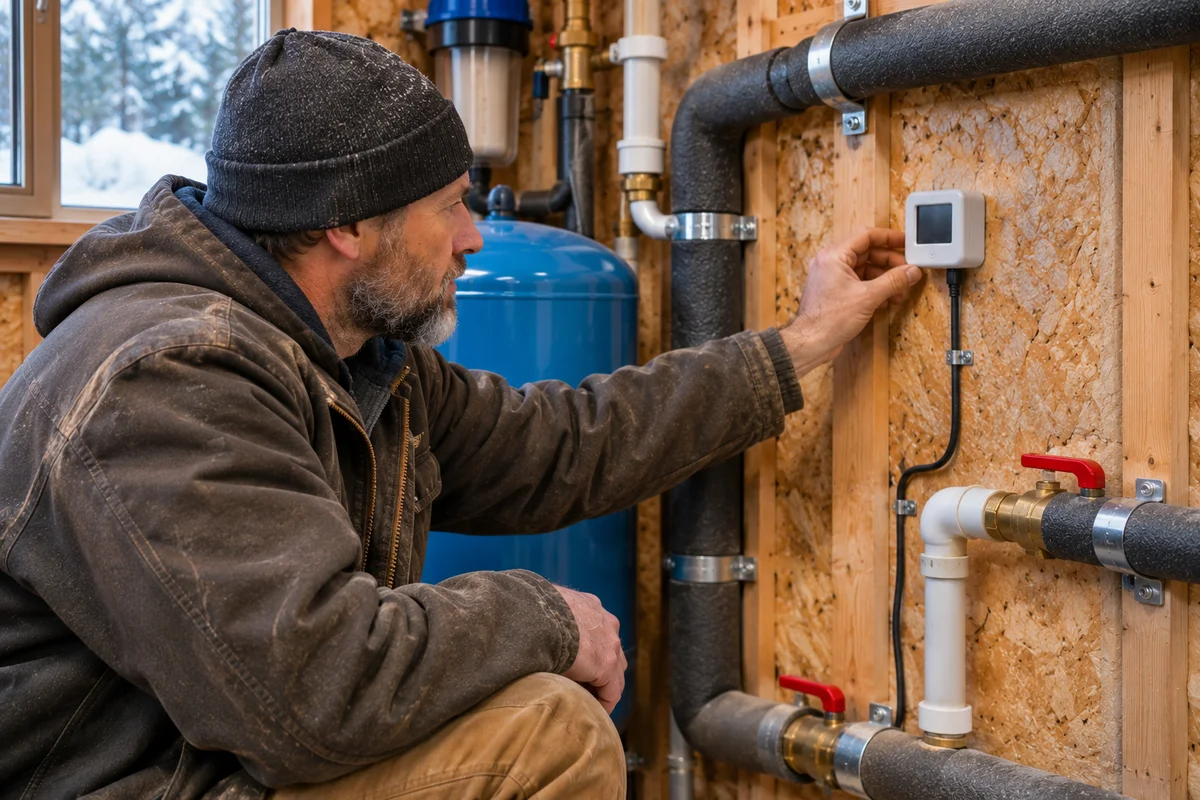
Even well-designed cold-climate plumbing benefits from regular inspection during freezing weather.
Monthly observations often identify developing problems long before they become expensive repairs.
Items worth checking include:
- Pipe insulation for damage or moisture intrusion.
- Heat tape operation where installed.
- Exposed valves and fittings.
- Utility room temperature.
- Signs of leaks or condensation.
- Frost-proof hydrants for proper drainage.
- Water pressure and normal fixture operation.
Heavy snowfall should also be considered.
Snow drifting against foundation walls can block ventilation where it's required while exposing other sections of plumbing to unexpected meltwater during spring thaw.
Outdoor valve boxes and access covers should remain visible enough that emergency shutoffs can still be reached if necessary.
Routine inspections rarely require much time, but they provide an opportunity to identify small issues before severe weather magnifies them.
Common Design Mistakes
Many freeze-related plumbing failures can be traced back to a handful of preventable design decisions.
One of the most common mistakes is assuming insulation alone will prevent freezing. Insulation slows heat loss, but it cannot keep standing water above freezing indefinitely without an accompanying heat source or a naturally warm environment.
Another frequent issue is leaving portions of the plumbing impossible to drain.
Even a small amount of trapped water inside a valve body, filter housing, or low section of pipe may be enough to cause significant damage during prolonged freezing temperatures.
Poor pipe support also contributes to long-term problems.
Flexible piping that sags between supports gradually develops low points where water collects. These hidden pockets often become the first locations to freeze.
Heat tape is sometimes installed incorrectly as well.
Following the manufacturer's installation instructions is essential, particularly regarding cable spacing, fastening methods, insulation requirements, and electrical protection. Improper installation reduces effectiveness and may create unnecessary safety hazards.
Finally, many systems suffer because maintenance is delayed until the first major cold snap.
Inspecting insulation, testing heat tracing, confirming drainage, and identifying damaged fittings before winter arrives is almost always easier than making repairs during freezing weather.
Preparing Plumbing for Extended Power Outages
Many off-grid homes continue operating during power outages, but not every plumbing system is completely independent of electricity.
Well pumps, booster pumps, pressure systems, ultraviolet purification equipment, and heat tape may all depend on electrical power even when the plumbing itself has been designed for freezing conditions.
Understanding which components require electricity helps determine how the system will behave during an extended outage.
If the property uses a well, maintaining adequate stored water becomes especially important. A pressure tank alone provides only a limited reserve, while elevated storage tanks or dedicated emergency water storage can continue supplying the home long after electrical pumping has stopped.
Water treatment equipment should also be considered.
Some systems continue operating without electricity, while others require power for ultraviolet disinfection, automatic backwashing, or electronic controls. Knowing these limitations allows appropriate contingency plans to be developed before they're needed.
Heat tape deserves particular attention.
Although self-regulating heat cable uses relatively little electricity compared with many household appliances, it still requires power to operate. If winter outages are common, relying exclusively on electrically heated plumbing may leave vulnerable sections exposed when protection is needed most.
Designing the plumbing so it remains protected through burial depth, drainage, insulation, and thoughtful routing first allows supplemental heating to become an additional layer of protection rather than the only one.
That approach improves resilience while reducing dependence on continuous electrical power during the coldest part of the year.
Final Thoughts
Cold-weather plumbing is built around preparation rather than reaction.
Every decision made during design influences how well the system performs once temperatures begin to fall. Thoughtful pipe routing, dependable drainage, appropriate materials, proper burial depth, and carefully planned insulation all work together to reduce the likelihood of freeze damage long before supplemental heating becomes necessary.
Heat tape and other protective measures certainly have their place, particularly around vulnerable entry points or sections of plumbing that cannot be relocated. Their greatest value, however, comes when they're supporting an already well-designed plumbing system instead of compensating for avoidable design shortcomings.
For most off-grid properties, freeze resistance isn't achieved through a single product or installation technique. It comes from combining several straightforward practices into a plumbing system that's easy to inspect, easy to maintain, and capable of adapting to changing winter conditions year after year.
Frequently Asked Questions
What pipe material performs best in freezing climates?
PEX and HDPE are both widely used in cold regions because their flexibility provides greater tolerance for freeze-thaw cycles than more rigid materials. Neither is immune to freezing, but both generally perform well when installed correctly.
Can insulation alone keep pipes from freezing?
No.
Insulation slows heat loss but does not create heat. If water remains inside an exposed pipe during extended freezing temperatures, insulation alone cannot prevent freezing indefinitely.
When should heat tape be used?
Heat tape is most useful where plumbing cannot reasonably be buried below frost depth or relocated into conditioned space. Entry points, well houses, crawl spaces, and isolated exposed sections are common applications.
Why are drain valves so important?
Drain valves allow sections of plumbing to be emptied before freezing weather or maintenance. Removing standing water significantly reduces the risk of burst pipes during prolonged cold conditions.
Should outdoor plumbing always be buried below the frost line?
Whenever practical, yes.
Installing water lines below the local frost depth provides one of the most reliable forms of freeze protection because surrounding soil temperatures remain much more stable than exposed air temperatures.
How often should cold-weather plumbing be inspected?
A thorough inspection before winter begins, followed by periodic checks throughout the cold season, works well for most properties. Systems using heat tape or other supplemental protection should be inspected according to the equipment manufacturer's recommendations.
Off-Grid Atlas Verdict
Reliable winter plumbing begins with thoughtful design rather than emergency repairs. Every section of pipe, every valve, and every fitting should be installed with freezing weather in mind, allowing water to drain where appropriate while protecting components that must remain in service throughout the winter.
By combining careful planning with regular maintenance, an off-grid plumbing system can continue operating reliably through years of severe weather. The result isn't simply fewer repairs. It's a water system that remains dependable when dependable infrastructure matters most.