The Back-to-the-Land Movement and the Modern Off-Grid Revival
Off-grid living is often described as though it were a new lifestyle made possible by solar panels, lithium batteries, satellite internet, and efficient appliances. The technology is new enough to change the experience dramatically, yet the underlying desire is much older. People have repeatedly stepped away from dense cities, industrial systems, consumer culture, or centralized infrastructure in search of greater control over food, shelter, work, community, and daily life. The modern off-grid revival belongs to that longer history, yet it differs substantially from the 1960s and 1970s back-to-the-land movement.
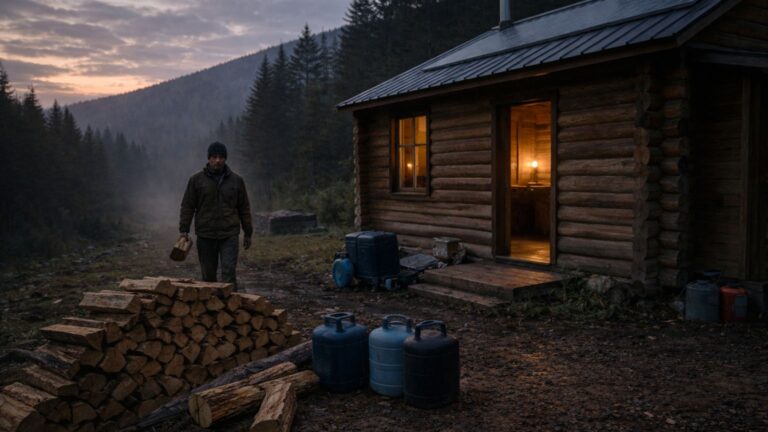
Earlier rural experiments often demanded intense manual labor, limited communications, improvised infrastructure, and a willingness to accept substantial discomfort. Contemporary systems can provide refrigeration, pressurized water, high-quality power, remote work, digital communication, automated monitoring, and many ordinary household conveniences far from utility networks. Understanding that contrast matters because cultural history and technical history shaped each other. The back-to-the-land movement helped popularize small-scale energy, organic agriculture, owner-built shelter, food co-ops, appropriate technology, and practical self-sufficiency. Later improvements in photovoltaics, batteries, pumps, inverters, communications, and building science made many of those aspirations easier to achieve while avoiding much of the hardship of an earlier era.
Back-to-the-Land Was Never One Movement
The phrase “back to the land” can suggest one organized movement with a shared ideology, but the historical reality was much broader. Different generations moved toward rural self-reliance for religious, economic, political, environmental, health, philosophical, and personal reasons. Intentional communities, small family homesteads, agrarian reformers, survival-minded households, conservationists, craftspeople, and people simply seeking cheaper land often occupied the same cultural territory while pursuing very different lives. Nineteenth-century North America already contained numerous experiments in communal and rural living. Utopian settlements, religious communities, cooperative societies, and agrarian movements all explored alternatives to dominant economic and social arrangements.
These experiments established an important precedent: moving to the land could represent more than agriculture, because it could also become a way to reorganize work, property, consumption, community, and personal responsibility. That history should remain distinct from later off-grid culture. A nineteenth-century communal settlement occupied a different technical world because centralized electrical grids were absent or largely irrelevant to rural life. The connection is cultural: people repeatedly used land, local production, and smaller-scale systems as tools for gaining more control over daily life.
The Nearings Turned Self-Sufficiency Into a Modern Model
Helen and Scott Nearing became one of the strongest bridges between earlier agrarian ideals and the twentieth-century back-to-the-land movement. During the 1930s and 1940s they built a largely self-reliant life in rural Vermont, growing food, producing maple syrup, building with stone, limiting cash needs, and organizing their work around a deliberate philosophy of simple living. Their experience eventually became the basis for Living the Good Life, published in 1954.
The Nearings mattered because they presented self-sufficiency as a conscious modern choice, separate from rural poverty imposed by circumstance. Their books described practical routines alongside a critique of industrialized, consumption-heavy living. For younger readers searching for alternatives during the 1960s and 1970s, the example showed that a family could intentionally reduce dependence on mainstream economic systems while still living an intellectually active and purposeful life. Their influence also illustrates a pattern that continues in contemporary off-grid culture. Practical systems become more powerful when they are paired with a narrative about why they matter. Gardening, wood heat, owner-built shelter, food preservation, and small-scale energy can be ordinary household technologies, but they can also become expressions of autonomy, restraint, environmental values, or resistance to excessive consumption.
The 1960s Changed the Meaning of Rural Withdrawal
The late 1960s brought a much larger wave of young people into rural communities across North America. Some were shaped by opposition to war, frustration with established institutions, environmental concerns, civil-rights struggles, changing gender roles, experimentation with communal living, and dissatisfaction with consumer culture. Others were attracted by inexpensive land, artistic freedom, spiritual exploration, or the practical appeal of building a life with fewer financial obligations. Vermont became one well-documented center of this migration. The Vermont Historical Society describes dozens of communes and alternative communities operating in the state between the late 1960s and mid-1970s, while similar movements appeared elsewhere in the United States and Canada. Some settlements shared property and income, some functioned as loose intentional communities, and many back-to-the-landers lived independently on small farms while participating in the same wider culture.
The distinction matters because the back-to-the-land movement was never synonymous with communes. A household could reject urban consumer culture, grow food, repair old buildings, heat with wood, and pursue rural self-reliance while owning its property privately and participating in the local economy. That broader layer of homesteaders ultimately proved more durable than many of the highly visible communal experiments.
Cheap Land Made Experimentation Possible
Cultural motivation alone was insufficient; access to land made large-scale experimentation possible. In many rural areas, declining agricultural economies had left old farmhouses, barns, and marginal acreage available at prices that were still within reach of young people with limited savings. Properties that were unattractive to commercial agriculture could be attractive to households willing to accept difficult access, outdated buildings, poor utilities, and substantial renovation work. That economic context shaped the culture.
Back-to-the-landers often repaired abandoned houses, salvaged materials, learned carpentry, rebuilt stoves, dug gardens, repaired wells, and adapted buildings that mainstream buyers had rejected. The scarcity of money encouraged practical skill acquisition because hiring tradespeople or replacing entire systems was frequently beyond reach. This also explains why self-sufficiency became intertwined with craft revival. Timber framing, masonry, food preservation, spinning, woodworking, small-scale farming, natural building, and equipment repair could reduce cash needs while creating products or services that generated income. In several regions, those skills later became the foundation for durable rural businesses that outlasted the original countercultural experiments.
The Whole Earth Catalog Connected Tools, Ideas, and People
The first Whole Earth Catalog appeared in 1968 and became one of the defining publications of the era. Its significance came from the way it connected practical tools, books, shelter ideas, land use, communications, crafts, ecology, education, and emerging technology within one sprawling information system. Smithsonian historians describe it as an “access service” that helped dispersed communities find useful tools and knowledge that mainstream retail and publishing channels often failed to connect. The catalog's worldview was unusually important for the future of off-grid living because it refused to treat technology and nature as opposites. Windmills, hand tools, ecological design, computers, solar energy, communications equipment, and traditional skills could all belong in the same toolkit when they gave individuals or small communities greater practical capability.
That combination helped popularize the idea later described as appropriate technology: systems scaled to human needs, local conditions, maintainability, and resource constraints. This is one of the clearest historical links to the modern off-grid revival. Contemporary off-grid systems still combine technologies from very different eras. A property might use a wood stove, gravity-fed water, solar photovoltaics, a lithium battery, satellite internet, digital monitoring, a vegetable garden, and hand tools in the same property system.
Mother Earth News Helped Make Self-Reliance Practical
The emergence of Mother Earth News in 1970 gave the movement another major channel for practical information. Articles on gardening, solar heating, homebuilding, energy conservation, alternative fuels, food preservation, and small-scale equipment translated broad ideals into household projects. The magazine reached people who had no interest in joining a commune but did want to reduce expenses, produce more of their own food, or experiment with new energy systems.
This wider audience helped self-sufficiency ideas move beyond the original counterculture. A suburban or rural household could adopt a wood stove, greenhouse, organic garden, efficient building practice, or solar experiment while remaining deeply connected to mainstream society. Over time, many technologies and habits associated with the back-to-the-land movement became ordinary parts of environmental design, homesteading, and household resilience. The publication culture mattered because knowledge was one of the movement's limiting resources. Before online forums, video tutorials, searchable manuals, and instant product sourcing, practical information could be difficult to obtain. Catalogs, magazines, books, co-ops, extension services, neighbors, and informal skill networks performed the role that digital communities now fill almost instantly.
Appropriate Technology Became a Bridge Between Ideals and Engineering
Appropriate technology gave technical form to the back-to-the-land desire for smaller, decentralized systems. The approach favored technologies that were understandable, repairable, resource-conscious, and matched to the scale of the people using them. Solar water heaters, composting systems, small wind machines, passive-solar buildings, efficient wood heat, simple water systems, and owner-maintainable equipment fit naturally within that philosophy. The movement was never purely anti-technology. Its more influential strand asked whether technology increased useful human capability while remaining understandable and proportionate to the problem. A large centralized system could be excellent where scale truly helped, while a small local system could be preferable when it reduced dependence or matched local resources more closely.
That distinction survives in modern off-grid design. The goal is rarely to eliminate technology. It is to choose technology that can operate reliably at the scale of one property, one household, or one small community while reducing how many essential functions depend on distant centralized systems.
The Energy Crises Made Alternative Energy Less Abstract
The energy shocks of the 1970s gave small-scale energy systems a new urgency. Rising fuel prices and concerns about energy security made conservation, solar heating, wood heat, wind power, and efficient building design interesting to people far beyond the original back-to-the-land culture. Technologies that had been treated as experimental or ideological began to attract engineering, government, and commercial attention. Early renewable-energy systems still involved serious limitations.
Photovoltaic modules were expensive, battery banks demanded maintenance, inverters were primitive by modern standards, and many owner-built systems required substantial technical competence. Solar thermal systems and small wind machines were often more practical than generating large amounts of household electricity. Even so, the conceptual shift was important. A house could be designed to capture local energy and reduce reliance on delivered fuel or grid power. That principle became one of the foundations of contemporary off-grid electrical design, even though the equipment used today is dramatically more capable.
Early Off-Grid Living Required a High Maintenance Tolerance
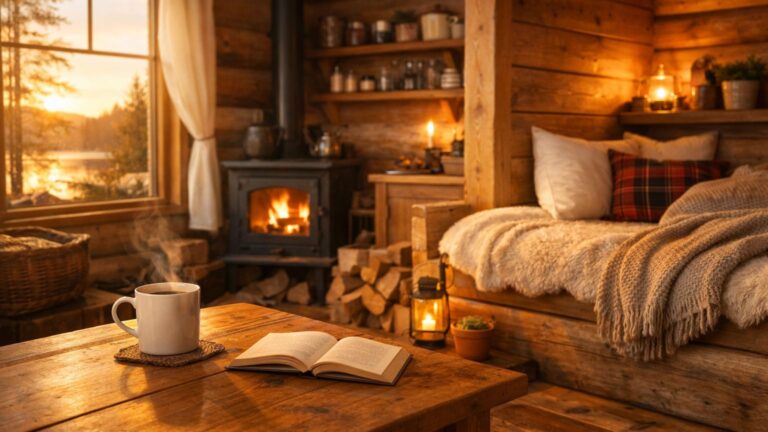
Romantic images of rural self-sufficiency can obscure how physically demanding many early back-to-the-land systems were. Water might come from a hand pump, shallow well, spring, or gravity system. Heat often required cutting, splitting, drying, stacking, and carrying wood, while food production demanded soil preparation, planting, weeding, harvesting, preserving, and storage. Electricity could be limited or absent. A small wind generator, engine-driven charger, automotive battery, kerosene lamp, propane appliance, or improvised DC system might provide selected services, but the modern expectation of continuous high-quality AC power was often unrealistic.
Communications could also be sparse, particularly on remote properties where the nearest telephone line was distant. This maintenance burden filtered who remained in the lifestyle. People who enjoyed mechanical work, gardening, building, animal care, and continuous problem solving could adapt well, while others discovered that their vision of simplicity required far more daily labor than expected. The difference between ideological simplicity and operational simplicity became one of the movement's hardest lessons.
Many Communes Faded, but Their Infrastructure Survived
By the mid-1970s, many highly visible communes had dissolved or changed form. Internal conflict, financial pressure, relationship changes, childcare, sanitation, governance, land ownership, employment, and the ordinary difficulty of maintaining shared institutions all contributed. Broader political and cultural conditions also changed from those that had shaped the late 1960s.
The decline of many communes left the movement's influence intact. Vermont historians point to lasting effects in alternative energy, food co-ops, community gardens, farmers markets, alternative schools, arts organizations, and local businesses. Former back-to-the-landers also carried rural building, farming, craft, and ecological practices into more conventional households and enterprises. This is crucial to understanding the modern revival. Cultural experiments can fail in their original form while leaving behind tools, skills, institutions, and ideas that later become mainstream. The movement's durable legacy is therefore larger than the number of communes that survived.
Self-Sufficiency Moved From Counterculture Toward Lifestyle
During the following decades, homesteading and self-reliance increasingly separated from any single political or countercultural identity. Families pursued gardening, food preservation, rural living, wood heat, small livestock, solar power, or owner-built homes for reasons ranging from cost reduction and environmental concern to personal satisfaction and preparedness. The practices became modular: people could adopt selected parts while leaving the wider cultural package behind. This modularity broadened the audience. A household could value a garden and solar array while working a conventional profession, using modern electronics, shopping online, and participating fully in the cash economy. Self-reliance became less about rejecting society and more about deciding which household functions were worth controlling locally.
Modern off-grid living grew from that change. Full disconnection from utilities remained one end of the spectrum, while partial independence, backup capability, microgeneration, remote cabins, seasonal properties, and hybrid systems created many intermediate forms. The cultural boundary between “on grid” and “off grid” became less rigid than the phrase itself suggests.
Solar Photovoltaics Changed the Economics of Remote Power
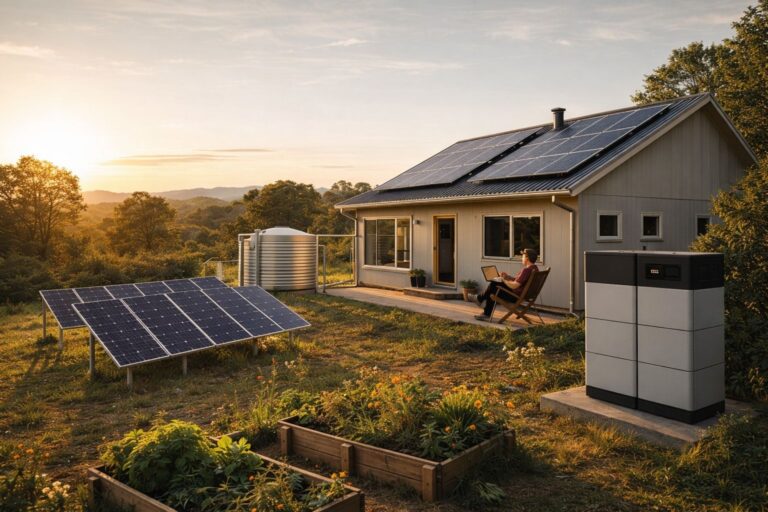
Modern photovoltaic systems changed what a remote property could expect from electricity. NREL documented steep declines in installed solar costs during the 2010s, while module prices fell even faster. At the same time, inverter quality improved, charge controllers became more capable, and system design became increasingly standardized. This changed the off-grid equation because reliable electricity no longer required constant engine-generator operation or extreme conservation.
A properly sized array could provide refrigeration, lighting, pumps, electronics, tools, communications, and ordinary household loads with minimal daily intervention. Storage still remained essential, but the generation side became quieter, more modular, and less dependent on delivered fuel. The cultural effect was significant. Earlier self-sufficiency often asked people to accept reduced electrical expectations. Modern photovoltaic systems allow many households to pursue greater independence while maintaining a level of electrical service much closer to conventional residential life.
Better Batteries Reduced Daily Maintenance
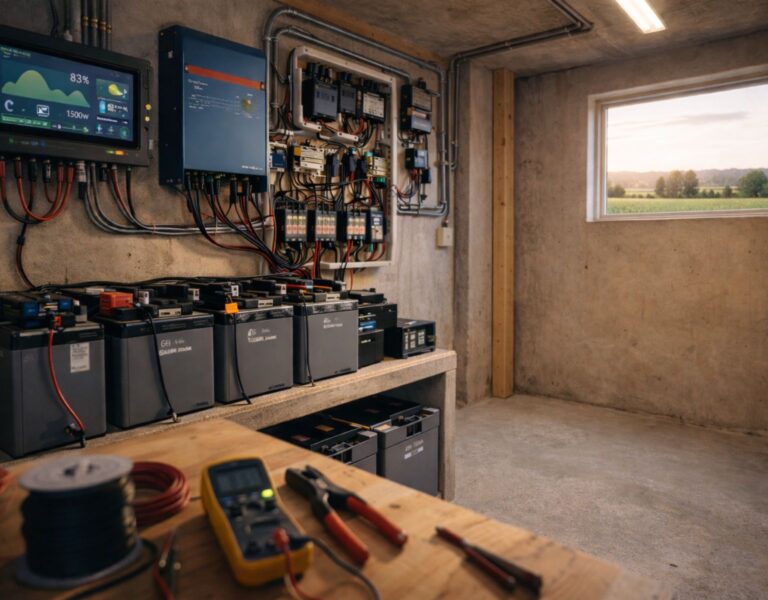
Battery storage changed just as dramatically. Traditional flooded lead-acid banks required watering, corrosion control, ventilation, equalization, conservative cycling, and careful attention to state of charge. Those requirements shaped the entire off-grid power room and rewarded owners who understood battery chemistry well. Sealed lead-acid reduced some maintenance, while lithium systems eventually changed the ownership experience much further. LiFePO4 batteries brought high charge acceptance, deep practical cycling, lower routine maintenance, relatively flat voltage, and integrated battery-management electronics.
The battery bank became less of a daily maintenance project and more of a managed electrical subsystem. That shift removed one of the old lifestyle barriers. A modern household can operate a sophisticated battery system while interacting mainly with a monitor or application, although proper design, temperature control, protection, and documentation still matter. Technology reduced routine labor while increasing dependence on electronics and configuration.
Efficient Loads Made Independence Easier
Generation and storage receive most of the attention, but load efficiency also transformed off-grid living. LED lighting reduced lighting energy dramatically. Efficient refrigerators, variable-speed motors, heat-pump technologies, electronics, induction cooking, improved insulation, and better building envelopes reduced the amount of energy required to achieve a comfortable standard of living.
Every efficiency gain compounds through an off-grid system. A lower daily load can mean fewer solar modules, less battery capacity, a smaller inverter, shorter generator runtime, and lower replacement cost. This is one reason modern off-grid systems can feel more capable even when their power plants remain modest by utility standards. The same principle applies outside electricity. Low-flow fixtures, efficient pumps, better insulation, passive-solar design, composting systems, and improved controls can reduce the amount of infrastructure required to support one household. Contemporary self-reliance often comes from efficiency first and production second.
Satellite Internet Changed the Meaning of Remoteness
Communication may be the technology that most clearly separates modern off-grid living from earlier back-to-the-land experience. A remote property in the 1970s could be physically and informationally isolated, with telephone service uncertain and specialized radio equipment required for long-distance communication. That isolation influenced employment, education, emergency response, business, and access to technical information. Modern cellular, fixed-wireless, and satellite broadband can make an isolated property digitally connected. Remote workers can participate in video meetings, families can access online education and medical information, owners can order specialized parts, and equipment can report faults through cloud monitoring. A site that is geographically remote can still operate as part of the information economy.
This connectivity fundamentally changes who can consider off-grid living. Income no longer has to come entirely from local agriculture, craft, tourism, or seasonal work. The property can support software development, consulting, design, media production, administration, online commerce, and other location-flexible work when communications are reliable enough.
The Internet Replaced Much of the Old Information Network
The Whole Earth Catalog was powerful because it helped people find tools and knowledge that were otherwise scattered. Modern online search, videos, forums, digital manuals, mapping, product databases, remote diagnostics, and e-commerce perform that access function at a scale that would have been difficult to imagine in 1968. A person designing a solar array or rebuilding a pump can now access manufacturer documents, technical discussions, and replacement parts from the same remote property. This reduces one of the largest hidden costs of self-reliance: the time required to learn unfamiliar systems.
It also lowers the barrier to entering skilled domains because the owner can study examples, compare approaches, and contact specialists before beginning work. Poor information still exists online, so judgment remains essential, but access itself has changed profoundly. Modern self-sufficiency is therefore paradoxically connected. A household can reduce dependence on centralized physical infrastructure while becoming more dependent on digital information networks, software, online suppliers, and communications services. Independence in one layer may coexist with deeper interdependence in another.
The Modern Revival Has Broader Motivations
Today's off-grid households span many cultural and practical motivations. Some are motivated by environmental goals or a desire to reduce fossil-fuel use. Others prioritize preparedness, lower long-term operating costs, access to inexpensive remote land, privacy, resilience during outages, freedom from difficult utility extensions, or a preference for rural living. Economic motives can overlap with cultural ones.
A remote parcel may cost less than serviced land but require the owner to build power, water, wastewater, access, and communications independently. In other situations, the cost of extending utility lines over a long distance makes a standalone solar-and-battery system economically attractive even for an owner with no ideological interest in being “off grid. The result is a more heterogeneous revival than popular imagery suggests. Modern off-grid living includes full-time homesteads, remote work properties, seasonal cabins, ranches, research sites, mobile systems, eco-homes, resilience-focused households, and properties that combine private infrastructure with selected utility connections.
Modern Technology Reduced Some Hardship and Added New Dependencies
A contemporary off-grid property can automate tasks that once demanded constant attention. Pumps can fill tanks from level sensors, charge controllers manage solar harvest, battery-management systems protect lithium cells, inverters start generators automatically, thermostats regulate heating, and networked monitors can report faults before the owner notices a problem manually. These systems substantially reduce daily labor.
Automation also creates new dependencies. Electronic controls can fail, software settings can be lost, proprietary components can become obsolete, and communications links can disappear. A modern system may require fewer routine chores while demanding better documentation, spare-parts planning, firmware awareness, and diagnostic capability. This changes the meaning of self-reliance. Earlier generations often relied more heavily on mechanical simplicity and physical labor. Modern systems can provide greater capability with less labor, but resilience increasingly depends on understanding electronic systems well enough to maintain, bypass, or replace them when required.
The New Off-Grid Ideal Is Often Hybrid
The most durable modern systems rarely pursue independence from every outside network at any cost. They combine local capability with external services wherever each works best. A property may generate its own electricity while relying on propane deliveries, use a private well while purchasing groceries, maintain satellite internet while keeping radio backup, or remain grid-connected while retaining enough solar and storage to operate through outages. This hybrid approach differs from the cultural image of complete withdrawal. It recognizes that resilience can come from multiple overlapping pathways. Public infrastructure, private infrastructure, stored resources, local production, and community relationships can reinforce one another.
That philosophy also aligns with the historical record. Even famous self-sufficiency experiments traded goods, sold products, purchased tools, used roads, relied on medical systems, and participated in wider economies. Genuine independence has almost always been selective and partial.
Community Remained Part of Self-Reliance
Back-to-the-land culture is sometimes remembered as a movement toward individual isolation, yet much of its infrastructure was communal. Food co-ops, shared equipment, collective farms, skill exchanges, alternative schools, neighborhood networks, farmers markets, and informal labor arrangements allowed people with limited cash to accomplish work that would have been difficult alone. Modern off-grid culture can overlook this lesson because technology makes individual households more capable.
A large battery, well pump, satellite connection, and online shopping account can reduce day-to-day reliance on nearby people. During serious failures, however, local knowledge, spare equipment, transportation, medical help, mechanical skills, and human labor still matter. Community and autonomy therefore reinforce each other more often than they conflict. A household that can meet many of its own needs becomes a stronger participant in a local network, while a capable local network reduces the amount of redundancy every household must maintain alone.
The Revival Is More Comfortable but Still Demands Systems Thinking
Modern equipment has made off-grid living easier while leaving the basic engineering constraints of an independent property intact. Water still has to come from somewhere. Energy production still changes with weather. Batteries still have finite capacity. Wastewater still needs a safe destination, buildings still need maintenance, roads still become difficult, and replacement parts still fail at inconvenient times. The difference is that the burden can now be managed with better tools.
Solar and storage reduce fuel handling, efficient buildings reduce heating demand, satellite internet reduces informational isolation, and automation reduces repetitive work. These improvements allow owners to spend less time feeding infrastructure and more time using the property for ordinary life. That is probably the largest difference between the 1970s back-to-the-land movement and the modern off-grid revival. Earlier experiments often required lifestyle to bend around the limitations of small-scale systems. Modern systems increasingly bend around the lifestyle the owner wants to maintain.
What the Earlier Movement Still Teaches
Technology solved many problems that challenged earlier back-to-the-landers, but the older movement still offers useful lessons. Simplicity matters because every component eventually needs maintenance. Skills matter because outside service can be slow or unavailable on remote properties. Local food, efficient buildings, repairable equipment, careful consumption, and strong community networks still reduce vulnerability regardless of how advanced the electrical system becomes. The movement also demonstrated the value of questioning default assumptions. A household can benefit from local production while still relying on wider markets for many needs.
It can choose smaller systems while using advanced technology, and it can reduce infrastructure dependence while remaining socially connected. Perhaps the most durable lesson is that self-reliance works best when it remains practical. Ideology can inspire a move, but the property succeeds through maintenance, budgeting, design, cooperation, documentation, and realistic expectations. Those operational disciplines matter as much today as they did fifty years ago.
From Withdrawal to Distributed Capability
The back-to-the-land movement often imagined rural life as a way to step outside systems that felt too large, impersonal, or controlling. The modern off-grid revival still contains that impulse, but its technological form has changed. Solar panels, batteries, pumps, satellite networks, digital controls, and efficient appliances give one household capabilities that once required either centralized infrastructure or a much larger amount of manual labor. That creates a different kind of autonomy. A modern off-grid household can be physically remote while digitally connected, locally powered while globally informed, and highly self-reliant in some systems while deeply networked in others. The result is less a rejection of modern technology than a redistribution of where infrastructure lives and who operates it.
Seen across the longer history, the continuity is clear. The desire for greater control over daily life keeps returning, while the tools available to pursue it change from generation to generation. The back-to-the-land movement supplied much of the cultural language of modern self-sufficiency, and contemporary technology transformed how comfortably, reliably, and selectively those ideas can now be put into practice.
Final Thoughts
The modern off-grid revival predates inexpensive solar panels and lithium batteries. It grew from a much longer history of agrarian ideals, intentional communities, self-sufficient homesteads, countercultural experimentation, appropriate technology, environmental concern, and practical household problem solving. The 1960s and 1970s back-to-the-land movement became one of the most visible points where those strands converged. What changed is the technical threshold required to live remotely.
Modern power, storage, communications, pumping, efficiency, and automation allow a property to preserve far more of the comfort and connectivity associated with ordinary contemporary life. Self-reliance can therefore be pursued with less daily labor and fewer sacrifices than many earlier generations accepted. The cultural question remains familiar even when the equipment has changed. People continue asking how much of daily life should depend on distant systems, how much capability should remain close to home, and what kind of work and infrastructure produce a satisfying life. Off-grid living remains one answer among many, shaped by old aspirations and increasingly modern tools.