Off-Grid Atlas: Top 10 Off-Grid Communication Radios for Emergencies (2026 Edition)

When the Grid Goes Silent, Radio Still Speaks
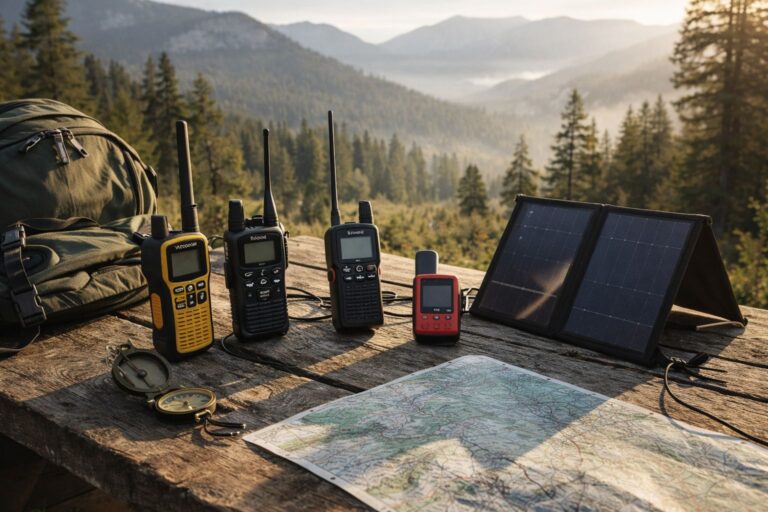
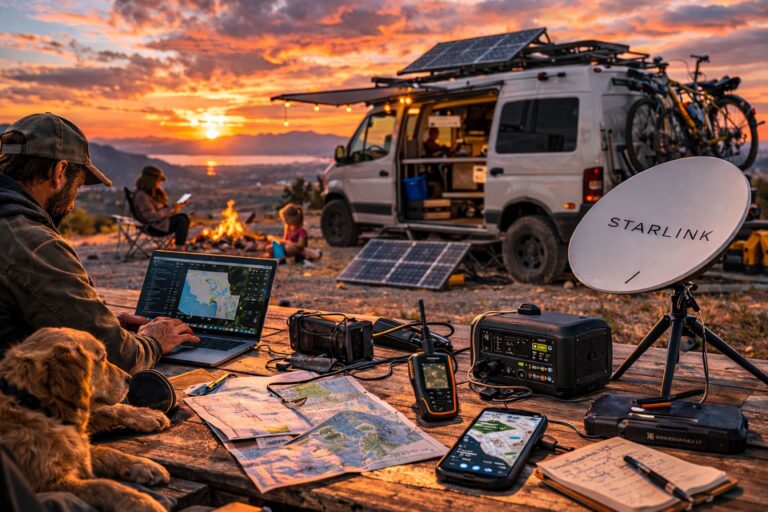
An off-grid communication plan needs several independent paths. Local radios help a household coordinate on the property and with nearby people. A receiver provides weather and broadcast information. Amateur radio can add regional or long-distance capability for trained, licensed operators. Satellite messaging provides an entirely different route when no local infrastructure is available.
No single device covers every job. Range depends on terrain, antenna height, frequency, power, local repeaters, licensing, and the person operating the equipment. The sensible goal is a layered system that the household has practised using: a local voice option, a receive-only information source, a charged portable backup, and a last-resort way to contact help. This guide ranks current equipment and system types for that role.
1. Midland MXT500 GMRS — Best Local Base and Vehicle Radio
Type: GMRS mobile radio | Published output: 50 watts | Power: nominal 13.8V DC | Use: Local and regional voice communication
The Midland MXT500 is a powerful GMRS mobile radio for a cabin, farm vehicle, or base installation. Midland lists a full 50-watt output, 15 high-power GMRS channels, eight repeater channels, NOAA weather radio with alert, and compatibility with Midland FRS/GMRS handhelds on shared channels. It turns a well-installed antenna and regulated DC supply into a serious local communications tool.
GMRS is primarily line-of-sight. A well-sited antenna and access to a local repeater can matter far more than raw transmitter power. In the United States, GMRS transmission requires an FCC licence; confirm the rules, channel permissions, callsign requirements, and equivalent regulations in your own country before operating. Install the radio using the manufacturer’s current RF-exposure, antenna, power, and grounding instructions.
Best for: Cabin-to-vehicle coordination, neighbours, and established local GMRS networks. Watch for: A licence, antenna installation, and real terrain testing are part of the system.
2. Yaesu FT-70DR — Best Amateur-Radio Handheld
Type: VHF/UHF amateur handheld | Published output: up to 5W | Bands: 144/430 MHz | Modes: analog FM and C4FM digital
The Yaesu FT-70DR is a compact dual-band amateur-radio handheld for operators who want a credible path into local VHF/UHF repeaters and amateur-radio practice. Yaesu identifies it as a 5-watt 144/430 MHz transceiver with conventional analog FM and C4FM digital capability. Its loud front speaker, established accessory ecosystem, and manufacturer documentation make it a more dependable choice than an unknown-budget radio for a serious operator.
An amateur licence is required to transmit on amateur bands. Earning that licence adds more value than simply owning the radio: the operator learns band rules, callsign procedure, frequency coordination, antenna basics, and how repeaters work. For emergency readiness, program local repeaters and simplex channels in advance, carry a spare battery or approved battery case, and practise a short clear message format.
Best for: Licensed operators building practical local repeater and simplex capability. Watch for: A handheld’s range is limited by terrain and antenna height; repeater access and training determine the result.
3. Garmin inReach Mini 2 or Current inReach Messenger — Best Satellite SOS Layer
Type: Satellite communicator | Network: Iridium | Use: Two-way messaging, location sharing, SOS
Garmin inReach communicators provide a communications path that does not depend on local towers, repeaters, or neighbouring radio operators. Garmin states that inReach devices use GPS satellites for location and the Iridium network for sending and receiving messages. Current inReach products offer two-way messaging, tracking, and interactive SOS functions, with a subscription plan required for active service.
This is a final-layer device, not a substitute for local radio. It needs a clear view of the sky, a current subscription, charged battery power, and contacts who understand what messages mean. Set it up before any trip, add emergency contacts, test ordinary messaging, learn its SOS workflow, and carry it on your person during remote travel. A satellite messenger is most useful when people know how to operate it calmly.
Best for: Remote travel, medical emergencies, and locations beyond reliable cellular coverage. Watch for: Subscription cost, sky view, and preparation are part of the capability.
4. Quality FRS Handheld Pair — Best Licence-Free Family Layer
Type: Licence-free handheld radio where permitted | Use: Property, trail, and short-range family coordination
A matched pair or small group of quality FRS handhelds is often the most useful first radio purchase for an off-grid household. They are easy to hand to a family member, use rechargeable packs or common battery options, and work well for short clear line-of-sight communication around a property, between vehicles, or during a walk to the water source or wood lot. Choose a current reputable model with weather alert reception, a clear display, a secure belt clip, and a charging solution that fits the cabin.
FRS is governed by national rules, and range claims on packaging are best viewed as ideal-condition marketing. Dense forest, ridges, buildings, and low antenna height can reduce it dramatically. Buy radios for clear local coordination, test them where they will actually be used, and write down the agreed channel and privacy-tone setting. Privacy tones reduce unwanted audio; they do not create privacy or prevent others from hearing the transmission.
Best for: Families, cabins, work crews, and short-range travel. Watch for: Use the correct service and legal channels for the country and radio model.
5. C. Crane Skywave SSB 2 — Best Receive-Only Information Radio
Type: AM/FM/shortwave/air-band/NOAA receiver | Power: AA batteries | Use: Weather, broadcasts, and situational awareness
The C. Crane Skywave SSB 2 is a compact multi-band receiver that can collect information when internet and cellular service are unavailable. It covers AM, FM, shortwave, aviation band, and NOAA weather reception, with single-sideband capability that broadens what a knowledgeable listener can monitor. It uses replaceable AA batteries, a strong advantage for a kit intended to remain useful through a long outage.
Receive-only equipment is a major part of emergency communications because information changes decisions. Keep spare batteries, use headphones to reduce power use, learn the local weather frequencies, and practise tuning the radio before a storm. A small external wire antenna can improve shortwave reception, provided it is installed safely and disconnected during lightning risk.
Best for: Weather awareness, broad broadcast reception, and low-power emergency information. Watch for: It receives information; it does not provide a way to call for help.
6. Desktop Shortwave Receiver with External Antenna — Best Home Listening Station
Type: Multi-band receiver | Power: AC or approved DC supply by model | Use: Home information and signal monitoring
A larger desktop shortwave receiver makes sense for a permanent cabin communications shelf. Current receivers from established makers can provide better speaker audio, controls, and external-antenna options than a pocket radio. The exact model should be chosen from current availability and the bands that matter to the owner, because products change more often than the underlying need.
Set up the station with a simple, safe antenna plan. Keep feedline protected from moisture, use strain relief, identify the disconnect point, and follow lightning-protection practices suited to the building and local conditions. A receiver should be powered from a stable low-noise source, because cheap inverters, charge controllers, and poorly filtered LED drivers can make radio reception difficult.
Best for: Fixed cabins that want stronger broadcast and shortwave monitoring. Watch for: Antenna safety, lightning precautions, and electrical noise control matter more than a flashy receiver.
7. Xiegu G90 — Best Compact HF Amateur Transceiver
Type: HF amateur transceiver | Published output: 20W | Use: Regional and long-distance amateur communication
The Xiegu G90 is a compact 20-watt HF transceiver with an internal antenna tuner, widely used by amateur operators who want portable HF capability. HF can support communication over much greater distances than local VHF/UHF systems when band conditions, antenna design, propagation, and operating skill align. The radio itself is only one part of the station.
An effective HF setup requires an amateur licence, a safe antenna, suitable feedline, grounding and counterpoise decisions appropriate to the installation, a low-noise power supply, and practice. The G90 can be a rewarding cabin radio for an operator who wants to learn, yet it should never be bought as a magic long-range emergency box. Test the complete station, make routine contacts, and learn how propagation changes by time of day and season.
Best for: Licensed amateurs seeking portable HF capability. Watch for: Antenna work, operating knowledge, and legal authorisation carry more weight than transmitter output alone.
8. FosPower Solar Crank Emergency Radio — Best Independent Broadcast Backup
Type: AM/FM/NOAA emergency receiver | Power: Internal battery, USB, solar panel, and hand crank | Use: Weather alerts and basic charging
A FosPower-style solar-crank emergency radio belongs in every off-grid communications kit because it separates basic information gathering from the main battery system. Models in this category combine AM/FM and NOAA weather reception with several charging options, a light, and limited USB backup power. The hand crank and small solar panel are slow charging sources, yet they are valuable when every other charging path has failed.
Keep the radio where everyone can find it, test it monthly, and regard the crank as an emergency reserve instead of the primary source of daily power. A weather radio works best when the household already knows local alerts, evacuation routes, and the meaning of warning language. Pair it with paper maps, a written contact plan, and spare batteries for the more capable receiver.
Best for: Weather alerts and last-resort information during a prolonged outage. Watch for: The built-in solar panel and crank support basic resilience; they will not replace a normal charging system.
9. Bivy Stick or Comparable Iridium Messenger — Best Phone-Paired Satellite Option
Type: Phone-paired satellite messenger | Network: Iridium by product | Use: Two-way text, location sharing, SOS
A phone-paired satellite messenger offers a lighter alternative to a dedicated screen-based communicator. Products in this category use a companion app for typing messages and viewing maps while the satellite device handles the connection. They work well for a person who already carries a phone and wants satellite messaging without adding a larger handheld GPS.
The same limits apply to every satellite messenger: it needs an active plan, a charged device, an open view of the sky, and a user who has rehearsed the app. Keep the phone and satellite unit charged separately, bring a paper map and written contacts, and confirm the current rescue, insurance, and subscription terms before relying on any particular product.
Best for: Travellers who want a compact phone-paired satellite layer. Watch for: Phone pairing adds convenience and another battery to manage.
10. Portable Solar Charging and AA Battery Kit — Best Communications Power Reserve
Type: Communications support kit | Power: Folding solar panel, power bank, rechargeable AA cells | Use: Keeping handhelds and receivers alive
The final item is a system component because a radio with no power is only stored hardware. Build a small communications power reserve around a quality folding solar panel, a power bank that matches the panel and device input, rechargeable AA cells, a smart charger, short labelled cables, and an approved 12-volt adapter for radios that accept it. Separate it from the general electronics bin so the essential gear remains available.
Standardise where possible. A household that uses USB-C, AA rechargeable cells, and one well-understood 12-volt charging path can keep more devices operating with fewer mistakes. Test charging under cloudy conditions, protect cells from freezing and moisture, and retain a small supply of primary AA lithium batteries for long storage where appropriate.
Best for: Every radio system, from simple FRS sets to satellite and HF equipment. Watch for: Confirm voltage, polarity, connector type, and current limits before connecting any radio to a solar or vehicle source.
Comparison Table
| System | Main job | Power approach | Licence or plan |
| Midland MXT500 | Local GMRS base/mobile voice | 13.8V DC | GMRS licence in U.S. |
| Yaesu FT-70DR | VHF/UHF amateur local voice | Rechargeable battery | Amateur licence |
| Garmin inReach | Satellite text and SOS | Internal rechargeable battery | Subscription |
| FRS handheld pair | Property and short-range voice | Rechargeable or replaceable cells | Rules vary by country |
| Skywave SSB 2 | Weather and broadcast reception | AA batteries | Receive only |
| Desktop receiver | Fixed monitoring station | Stable DC or AC supply | Receive only |
| Xiegu G90 | HF amateur communication | 13.8V DC | Amateur licence |
| Crank emergency radio | Weather information | Crank, solar, USB | Receive only |
| Phone-paired satellite messenger | Satellite text and SOS | Internal rechargeable battery | Subscription |
| Solar charging reserve | Power support | Solar, battery bank, AA cells | None |
How Terrain Affects Radio Performance in the Real World
Advertised range does not describe a forested ridge, a deep valley, a metal-roof cabin, or a property with tall wet trees. GMRS, FRS, and most VHF/UHF communication depend heavily on line of sight. A hill between two stations can block a signal entirely, while an antenna placed above the roofline can transform the same radio’s usable area.
Start with the site. Walk the property using the handhelds, log dead zones, and try higher antenna locations before spending on a more powerful radio. Keep antennas clear of metal, direct them according to the manufacturer’s guidance, and protect outdoor connections from moisture. A licensed antenna installer or experienced local amateur can be valuable when the site is complex.
Solar equipment can also affect reception. Inverters, switching chargers, LED drivers, and poorly routed DC cable can produce radio-frequency noise. Test the receiver with and without major electrical loads running. If noise appears, identify the source, improve separation and filtering where appropriate, and use equipment known for low interference. Good communications equipment needs a quiet electrical environment.
How to Power Radios Off-Grid
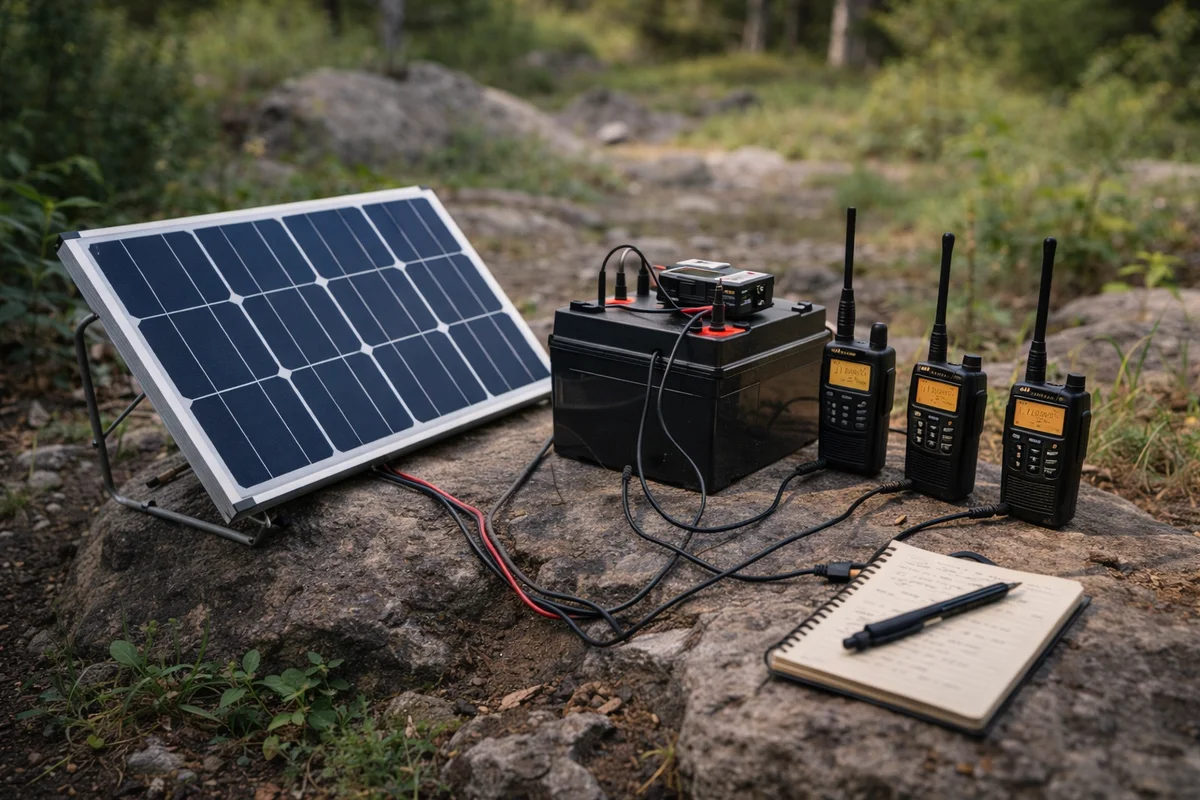
Base and mobile radios commonly use nominal 13.8V DC and should be fed from a properly fused regulated circuit. Handhelds can charge from a USB supply, vehicle adapter, or manufacturer-approved charging cradle. Receivers that use AA cells deserve a dedicated battery supply, and satellite messengers should have their own charging cable and a small reserve power bank.
Keep power paths simple and labelled. Store spare batteries charged according to their type, keep one solar panel and power bank dedicated to communications, and test the setup away from shore power. Protect radios from voltage spikes, reversed polarity, moisture, and improvised adapters. A reliable radio plan includes the cables and power supplies that make every device usable.
Frequencies You Should Know
| Service or band | Practical role | Key point |
| FRS | Local short-range voice | Licence-free use depends on national rules |
| GMRS | Local and repeater-enabled voice | U.S. transmission requires an FCC licence |
| Amateur VHF/UHF | Local simplex and repeaters | Requires amateur authorisation to transmit |
| Amateur HF | Regional and long-distance communication | Requires skill, licence, and an effective antenna |
| NOAA weather radio | Weather warnings in the United States | Receive-only information source |
| Iridium satellite messaging | Global text, tracking, SOS | Requires device plan and sky view |
Building a Simple Off-Grid Repeater Setup
A repeater is a community infrastructure project, not a casual add-on. It receives on one frequency and retransmits on another, extending coverage from an elevated site. Proper installations need authorised frequencies, site permission, suitable radio hardware, duplex filtering, low-loss feedline, lightning protection, regulated power, battery reserve, monitoring, and someone responsible for maintenance.
For most cabin owners, the practical move is to learn which existing local repeaters are available and how to use them legally. A personal low-power simplex base station with a good antenna can provide excellent property and neighbour coverage without creating a separate repeater project. If a community truly needs a repeater, work through the relevant amateur or GMRS community, licensing authority, and experienced technical volunteers.
Building a Resilient Comms Layer
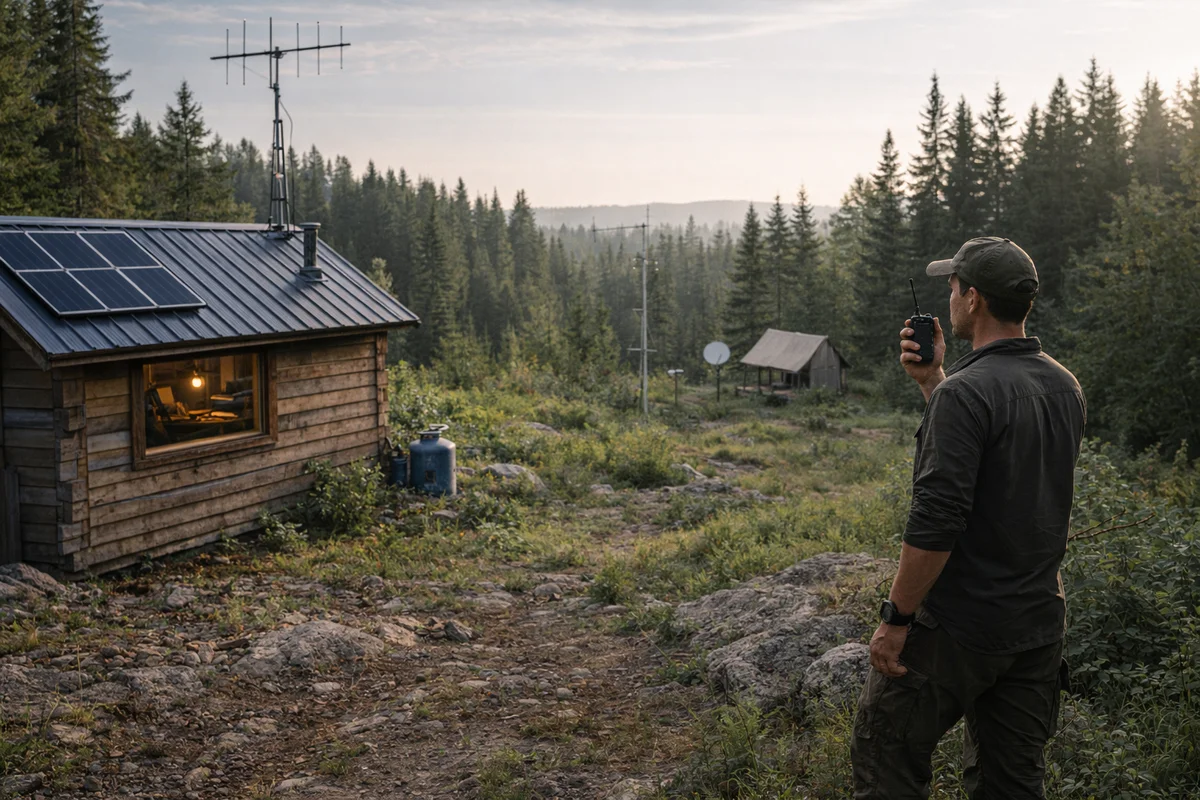
- Local layer: FRS or GMRS radios for people near the cabin, vehicle, or property.
- Information layer: NOAA-capable and shortwave receivers for alerts and broadcasts.
- Amateur layer: VHF/UHF or HF capability for trained, licensed operators.
- Satellite layer: An inReach or comparable device for remote two-way text and SOS.
- Power layer: Solar charging, spare cells, and labelled adapters dedicated to communications.
Each layer should remain useful when another layer fails. The system works because it offers choices, not because every device is expensive.
Common Radio Failures and What Actually Breaks First
Most failures are physical or operational: flat batteries, loose antenna connectors, water in coax, a damaged antenna, an incorrect channel, an uncharged satellite messenger, or an operator who has never tested the system. Radios often survive hard use while their cables, power packs, and accessories quietly degrade.
Inspect antennas, feedline, seals, charging ports, battery packs, and mounting hardware. Keep channel plans and important frequencies on waterproof paper, check the programming after updates, and carry a spare antenna for the primary handheld. Never transmit through a damaged or unknown antenna system; reflected power can damage equipment.
Maintenance Checklist
- Test every layer monthly from the locations where it will be used.
- Recharge and cycle handheld and satellite-device batteries according to their manuals.
- Inspect antenna mounts, coax, connectors, and weatherproofing each season.
- Verify emergency contacts, subscription status, repeater information, and local frequencies.
- Keep paper maps, a written contact plan, and a short radio-message template with the kit.
Choosing the Right Radio for Your Situation
Choose by the people and distances you actually need to cover. A family on one property may be served well by FRS handhelds and a weather receiver. A cabin community with a local GMRS network may benefit from a licensed mobile base radio. A trained amateur operator can add repeaters and HF. A person travelling alone beyond cell service should consider satellite messaging.
Complexity is a real selection factor. A simple radio used well is more useful than a sophisticated transceiver that remains in its box. Buy the gear you will learn, program, charge, and test. Then add one new layer at a time until the household has local voice, information, and a route to help.
Training & Mindset
- Practise calling another household member using the actual channels and locations.
- Use clear plain language: who you are, where you are, what happened, what you need, and when you will call again.
- Join a local amateur or GMRS community if that service is part of the plan.
- Rehearse satellite messaging and keep emergency contacts informed of the device.
- Maintain paper maps and written rendezvous plans for every regular travel route.
Final Verdicts
| Category | Winner | Why |
| Best Local Base Radio | Midland MXT500 | Powerful GMRS capability with repeater channels |
| Best Amateur Handheld | Yaesu FT-70DR | Proven dual-band analog and digital platform |
| Best Satellite SOS Layer | Garmin inReach | Two-way satellite messaging and interactive SOS |
| Best Family Starter Layer | Quality FRS handheld pair | Simple short-range coordination |
| Best Information Receiver | C. Crane Skywave SSB 2 | Broad low-power receive coverage |
| Best HF Path | Xiegu G90 | Compact 20W HF station for licensed operators |
| Best Broadcast Backup | Solar-crank emergency radio | Independent weather and broadcast reception |
Real Emergency Communication Scenarios (What Actually Happens)
During a regional outage, cell service can become congested or unavailable while local radio and broadcast alerts remain useful. A household with agreed channels, a charged handheld pair, and a weather receiver has a clear way to coordinate locally and receive official information. The satellite messenger becomes valuable if the family must leave the area or contact someone beyond the local radio network.
During an evacuation, the priority is concise communication and safe movement. Use a prearranged channel for vehicles in a convoy, keep messages brief, and avoid relying on a single repeater or app. A satellite device can send location and status when terrain separates vehicles or cellular coverage disappears. Follow all official instructions and use emergency services only for genuine emergencies.
For a medical emergency at a remote property, a device helps only when the operator can tell someone where they are and what assistance is needed. Keep the civic address, GPS coordinates, access directions, medical information, and emergency contacts written near the radios. Confirm in advance whether a neighbour monitors a local channel and how satellite SOS works for the device you own.
A Simple Cabin Communications Plan
Begin with the people who will actually use the system. Put two charged handheld radios at the cabin, one in the vehicle, and one with the regular caretaker or neighbour if that arrangement makes sense. Agree on one primary local channel, one backup channel, and one simple calling procedure. Include the callsign whenever the service requires it. Post the plan beside the charger in language that every member of the household can follow.
Add a receiver for weather and information. Keep local alert frequencies, evacuation routes, important phone numbers, property coordinates, and meeting locations on paper. A weather radio can tell a household what is happening; a radio pair can coordinate what the household is doing. Those two layers cover many common outages without demanding a complex technical station.
The third layer is the route beyond the property. This may be an established GMRS repeater, amateur-radio capability operated by a licensed person, or satellite messaging. Choose one route, learn it deeply, and test it at realistic times and locations. A satellite messenger should be configured with contacts and an active subscription; an amateur or GMRS setup should be programmed, licensed, and tested with the people who will answer.
Antennas, Coax, and Lightning Awareness
An antenna is the part of the radio system that reaches into the landscape. Use antennas designed for the radio service and frequency range, mount them according to their instructions, and keep outdoor connections weatherproof. Coaxial cable should have a suitable impedance and connector type for the equipment, with gentle bends, drip loops, strain relief, and a clear inspection path. Do not run feedline where it will be crushed by doors, damaged by roof edges, or exposed to constant abrasion.
Any outdoor antenna changes the building’s lightning and surge considerations. Follow local code, manufacturer guidance, and qualified advice for grounding, bonding, surge protection, antenna disconnects, and safe placement. Disconnecting an antenna may be appropriate during certain storms when the station is unattended, but it does not replace a complete lightning-protection plan. Never install an antenna where it can contact power lines or create a climbing hazard.
Power Discipline for Communications Gear
Radio equipment uses less energy than many cabin appliances, yet its value during an emergency is high enough to justify dedicated reserve. Measure the idle and transmit current of base radios, the charging draw of handhelds, and the real power consumed by a receiver. Keep the communications branch on its own fuse and label it clearly. This lets the household protect the equipment even when discretionary cabin loads are shut down.
Handheld radios should rotate through a regular charge-and-test schedule. Store spare packs according to the manufacturer’s instructions, keep AA receivers supplied with known-good cells, and charge satellite messengers before travel. A small folding solar panel and power bank can keep this equipment alive during an extended outage. Test the panel, cables, and adapters before relying on them away from home.
Message Discipline Under Stress
The most useful emergency radio message is short and structured. State who you are, where you are, what happened, what you need, and whether the situation is changing. Listen before transmitting, leave pauses for a reply, and write down important information. Avoid long explanations, speculation, or personal details that do not help the person receiving the message act.
Practise these habits during ordinary outings. Ask a family member to report arriving at the wood lot, returning from a trail, or reaching the cabin gate. Practise using coordinates from a paper map and describe a location with recognisable landmarks. Familiarity reduces stress and keeps the equipment from becoming a drawer full of unused gadgets.
Final Thoughts
Good off-grid communications come from a tested system: local radios for nearby people, receivers for information, licences and training for the services that require them, satellite messaging for remote contact, and dedicated power for every layer. Buy equipment slowly, learn it thoroughly, and practise before it matters.