Rain to Reservoir: Complete Guide to Off Grid Rainwater Harvesting Systems
When the tap runs dry, or doesn’t exist at all, rain becomes sacred. It’s one of the most reliable, renewable, and free sources of off-grid water. But turning rain into safe drinking water requires more than a barrel under a downspout.
A resilient rainwater system moves water through a full chain: roof to gutter, diverter to filter, tank to tap. When each stage is designed properly, rain becomes a dependable year-round water supply.
This guide walks through how to build a field-tested rainwater harvesting system that works through storms, droughts, and freezing seasons. Whether you’re on a remote homestead or running a small off-grid cabin, this is how you turn rainfall into survival.
Why Rainwater is Your Best Off Grid Ally
In many off-grid environments, properly harvested rainwater can outperform municipal water in reliability and independence.
Properly harvested rainwater is:
- Naturally soft, meaning less scale buildup in pipes and appliances
- Low in contaminants before it touches ground sources
- Independent from utilities and grid infrastructure
- Scalable, from small barrels to multi-thousand gallon systems
- Fully renewable, replenished every storm cycle
With the right purification steps, rainwater can supply:
- Drinking water
- Cooking and dishwashing
- Showers and laundry
- Toilets and greywater systems
- Gardening and livestock
The key is designing a system that protects, stores, and purifies every drop.
In real-world off-grid builds, rainwater often becomes the primary water source, not the backup. Systems that are designed properly can outperform wells in certain environments, especially where drilling is difficult or groundwater quality is poor.
The Full System From Catchment to Consumption
A complete rainwater system follows a simple but important flow:
Roof → Gutter → First Flush Diverter → Filter Screen → Storage Tank → Sediment Filter → Purifier → Tap or Pump
Each stage removes contamination and protects the water before it reaches storage.
Skipping one of these steps often leads to clogged tanks, algae growth, or unsafe water.
Practical Insight
Think of your system like a chain. Each link matters.
If contamination enters early, every downstream component has to work harder. That leads to faster filter clogging, more maintenance, and reduced water quality.
Getting the early stages right dramatically reduces long-term workload.
Step 1 Roof and Gutter Setup
Roofing Material
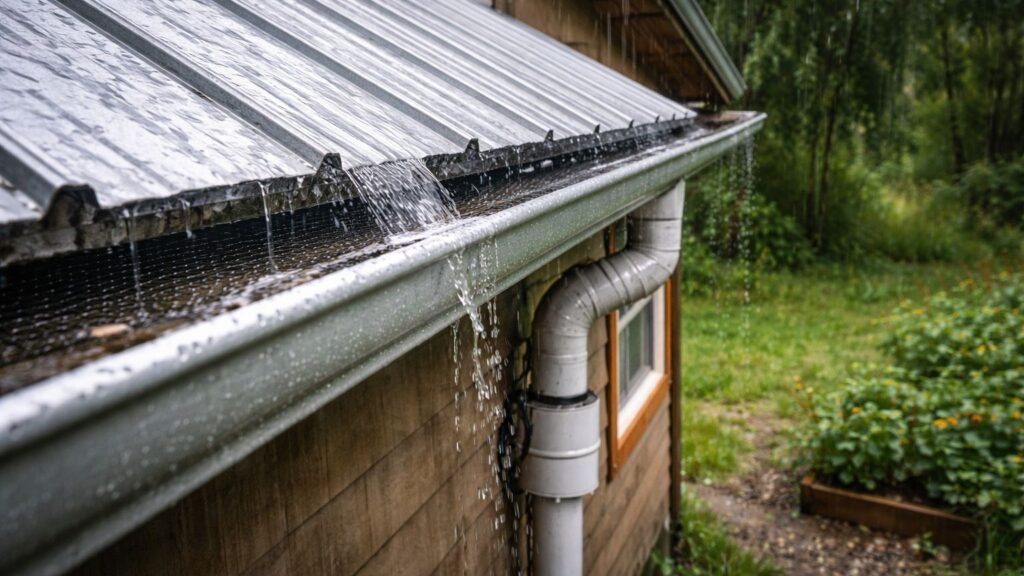
The roof becomes your water collector, so material matters.
Best options include:
- Galvanized steel roofing
- Corrugated metal panels
- Standing seam metal roofs
Avoid harvesting from:
- Asphalt shingles that may leach chemicals
- Cedar shake roofs with organic debris
- Roofs with moss, mold, or heavy leaf buildup
A clean metal roof produces the safest rainwater catchment.
Gutter Setup
Your gutter system directs water from roof to storage.
Recommended setup:
- 5 inch K-style or 6 inch half-round gutters
- Minimum slope of about 1/16 inch per foot
- Leaf guards and gutter mesh screens installed
Keeping debris out at this stage prevents downstream filtration problems.
Field Note
Oversizing gutters is often worth it. During heavy storms, undersized gutters overflow and waste water, exactly when you want maximum capture.
Step 2 First Flush Diverters
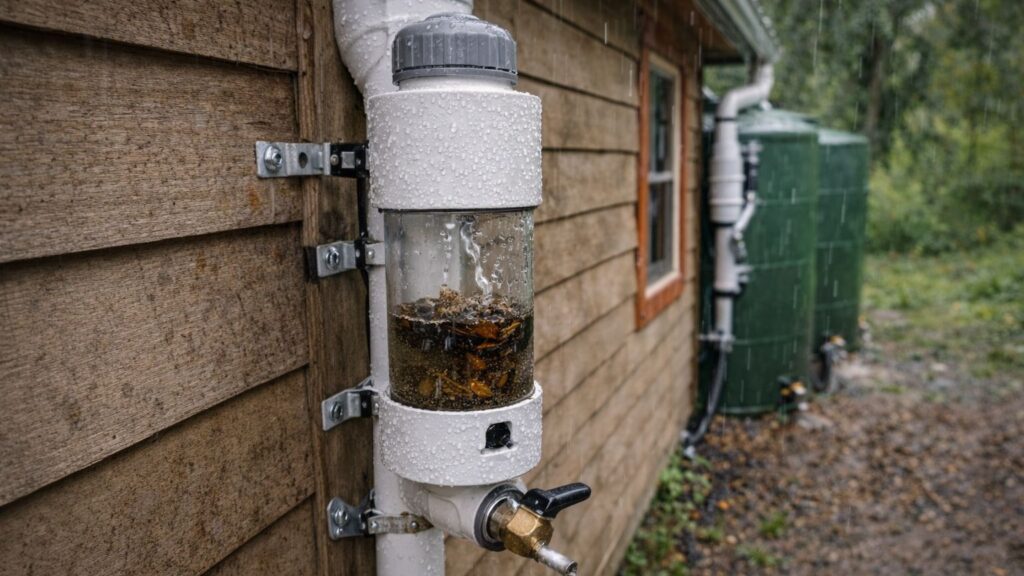
The first rainfall after a dry period washes dust, pollen, and bird droppings from the roof.
A first flush diverter discards this initial contaminated water before it enters your storage tank.
How a First Flush System Works
- Rainwater first fills the diverter pipe
- Debris and contaminants settle in this chamber
- Once the chamber fills, cleaner water bypasses into the tank
The diverter can later be drained to remove collected debris.
First flush diverters dramatically improve water quality and reduce filtration load later in the system.
Real-World Tip
In dusty or forested environments, increasing diverter capacity slightly improves water quality significantly. A small adjustment here can reduce downstream filter maintenance by weeks or months.
Step 3 Storage Tanks
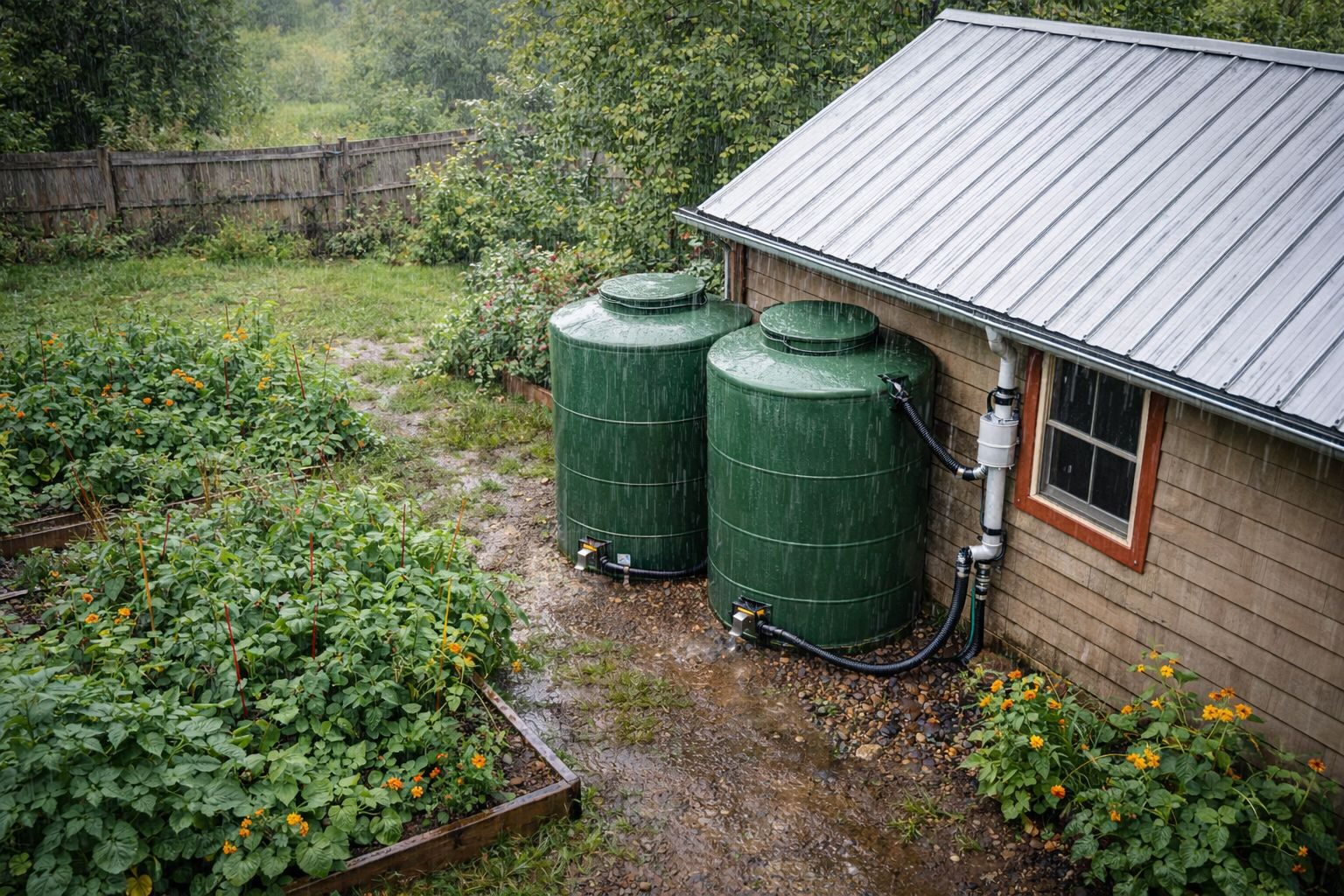
Storage capacity determines how resilient your water system will be during dry periods.
Capacity Planning
One inch of rainfall on a 1,000 square foot roof produces roughly:
About 623 gallons of water
For full-time off-grid living, systems typically aim for:
1,500 to 5,000 gallons of storage
This buffer helps bridge droughts or dry seasons.
Tank Materials
Common tank types include:
Food grade HDPE plastic
Affordable and widely available.
Galvanized steel tanks
Extremely durable and UV resistant.
Concrete cisterns
Permanent and frost resistant, but expensive and heavy.
Tank Placement
Key considerations include:
- Tanks should be opaque to prevent algae growth
- Place tanks on level, reinforced surfaces
- Elevate tanks if using gravity fed systems
- Ensure easy access for cleaning and inspection
Practical Insight
Shade matters. Tanks placed in direct sunlight heat up, accelerating algae growth and degrading water quality. Even partial shading can significantly improve long-term storage conditions.
Step 4 Filters Screens and Sediment Defense
Physical filtration removes debris before purification begins.
Tank Screens
Install mosquito-proof mesh screens at tank inlets and vents.
This prevents insects, leaves, and organic debris from entering the system.
Sediment Filters
Before water reaches a pump or tap, install a sediment filter such as a spin-down filter or cartridge filter.
These remove fine particles like sand, rust, and roof dust.
Regular cleaning or cartridge replacement keeps water flowing and protects pumps and purification equipment.
Why This Matters
Most pump failures in off-grid systems are caused by unfiltered debris. A simple sediment filter can dramatically extend the life of your entire system.
Step 5 Purification Methods
Even clean rainwater must be purified before drinking.
Several reliable off-grid purification methods exist.
UV Sterilization
UV systems destroy bacteria, viruses, and protozoa using ultraviolet light.
They require electricity but provide continuous purification for household systems.
Boiling
Boiling remains the most universally reliable purification method.
Bring water to a rolling boil for one minute to eliminate pathogens.
Chlorination
Small doses of unscented household bleach can disinfect stored water.
This method is useful for long-term storage or emergency sanitation.
Carbon Filtration
Activated carbon filters improve taste and remove chlorine, odors, and certain chemical contaminants.
Many off-grid systems combine sediment filters, carbon filtration, and UV purification for maximum safety.
[Related: Top 10 Water Filtration & Purification Units]
System Sizing: How Much Water Do You Actually Need?
A common mistake is either underbuilding or massively overbuilding a system.
A simple daily estimate helps:
- Drinking + cooking: 3–5 gallons per person
- Basic hygiene: 10–20 gallons per person
- Laundry and extended use: 20–40+ gallons per person
A conservative off-grid estimate is:
25–50 gallons per person per day
From there, storage should be sized to cover at least:
2–4 weeks without rain
This creates a realistic buffer for dry periods.
Pump Systems vs Gravity Systems: What Actually Works Off Grid
One of the most important decisions in a rainwater system is how water moves from storage to use.
There are two primary approaches: gravity-fed systems and pump-driven systems.
Gravity Systems
Gravity systems rely on elevation. Water flows naturally from a raised tank down into your home or usage point.
Pros:
- No electricity required
- Extremely reliable
- Minimal maintenance
- Silent operation
Cons:
- Lower water pressure
- Requires elevated tank placement
- Limited flow for multiple fixtures
Gravity systems are ideal for:
- Cabins
- Backup systems
- Minimalist off-grid setups
Pump Systems
Pump systems use electric pumps to pressurize water, delivering it similarly to a traditional home.
Pros:
- Strong, consistent pressure
- Supports full household use
- Works with ground-level tanks
Cons:
- Requires power
- More components = more failure points
- Needs maintenance over time
Common pump types include:
- 12V DC pumps (solar compatible)
- AC jet pumps
- Submersible tank pumps
The Hybrid Approach (Best in Practice)
Most well-built off-grid systems combine both:
- Gravity for baseline reliability
- Pump system for daily comfort
This creates redundancy. If your pump fails or power goes down, you still have water access.
In off-grid design, redundancy improves long-term resilience.
How Much Rain You Can Actually Capture (And Why Most Systems Underperform)
Most people underestimate how much water they can collect from rain.
At the same time, many systems underperform, not because of poor rainfall, but because of inefficient design.
Understanding both sides is key.
The Basic Collection Formula
Rainwater harvesting follows a simple calculation:
Roof Area (sq ft) × Rainfall (inches) × 0.623 = gallons collected
Example:
- 1,000 sq ft roof
- 1 inch of rain
→ ~623 gallons collected
This number surprises most people.
Even small structures can generate significant water during a single storm.
Why Real Systems Collect Less Than Expected
In practice, most systems don’t capture 100% of that water.
Losses occur at several points:
- gutter overflow during heavy rain
- debris blocking flow
- first flush diverter discard volume
- minor leaks or inefficiencies
Real-world efficiency is typically:
75%–90% of theoretical collection
The Biggest Bottleneck: Storage Capacity
The most common limitation is storage capacity.
If your tanks are already full when it rains, excess water is lost.
This is why systems with small tanks often feel unreliable, not because rain is insufficient, but because excess water was never stored.
Matching Storage to Rainfall Patterns
Instead of sizing based on average rainfall, think in terms of:
- long dry periods
- seasonal rainfall patterns
- storm frequency
In some regions, most annual rainfall comes from a few large storms.
Without enough storage, those opportunities are wasted.
Increasing Your Capture Efficiency
Small improvements can significantly increase usable water:
- oversize gutters to handle heavy flow
- install multiple downspouts to reduce overflow
- keep gutters clean and debris-free
- use smooth pipe runs to reduce restriction
These upgrades are inexpensive but dramatically improve performance.
Expanding Catchment Area
If your system isn’t collecting enough water, increasing catchment area is often easier than drilling a well or adding complexity.
Options include:
- adding gutters to sheds or outbuildings
- installing simple metal awnings
- linking multiple roof sections into one system
Even small additions can increase total collection by hundreds of gallons per storm.
Field Insight
Most underperforming rain systems are limited by:
- poor flow design
- undersized gutters
- or insufficient storage
Fix those, and the system often performs far better than expected.
The Rule That Makes Rain Systems Reliable
If your system can:
- capture efficiently
- store enough water
- and minimize losses
…rain can provide a dependable primary water source.
Collection and storage design usually determine overall system performance.
[See Related: How to Build a Simple Reliable Off-Grid Water System 2026]
Seasonal Prep and Freeze Protection
Rainwater systems must adapt to seasonal changes.
Winter Preparation
In cold climates:
- Drain exposed pipes before freezing
- Bury cisterns below frost line where possible
- Use pipe insulation or heat tape
- Install tank heaters if needed
Summer Drought Planning
During dry seasons:
- Expand catchment surfaces such as sheds or awnings
- Add additional storage tanks
- Reuse greywater for irrigation
Seasonal preparation ensures year-round water security.
Real World Rainwater Systems
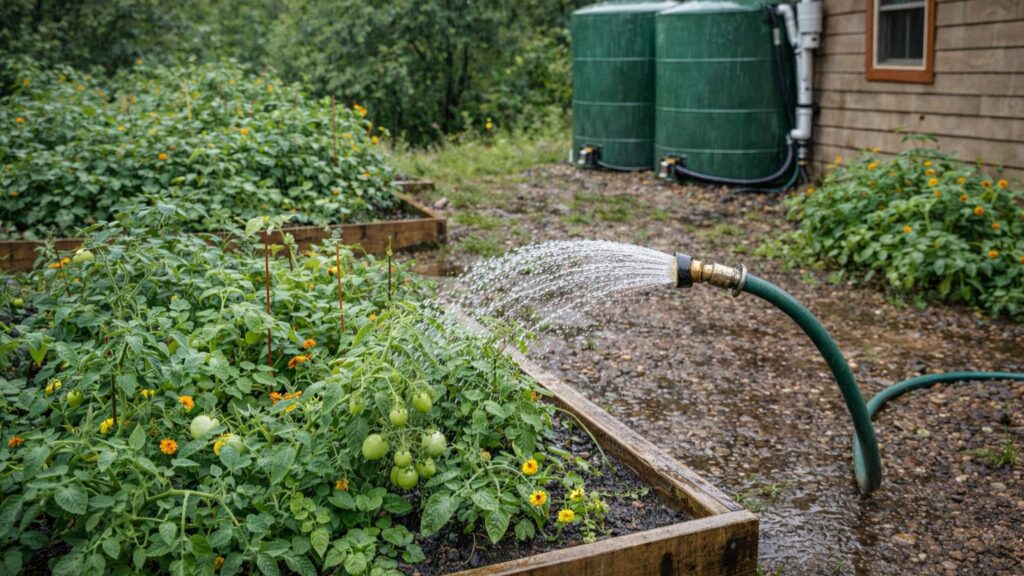
Rainwater systems can scale dramatically depending on needs.
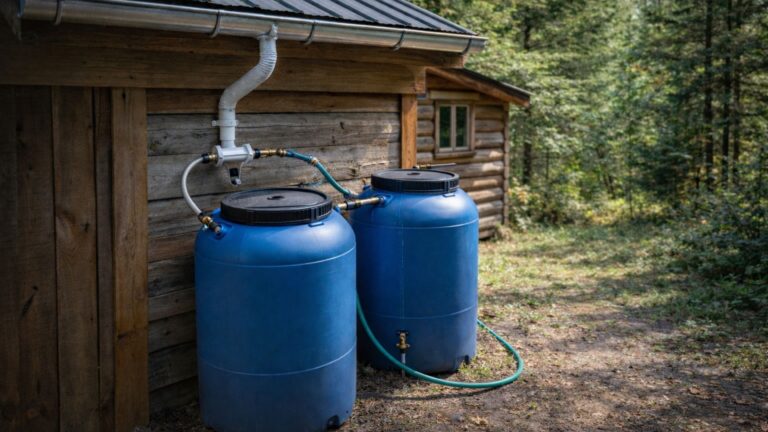
55 Gallon Barrel System
A simple starter system can include:
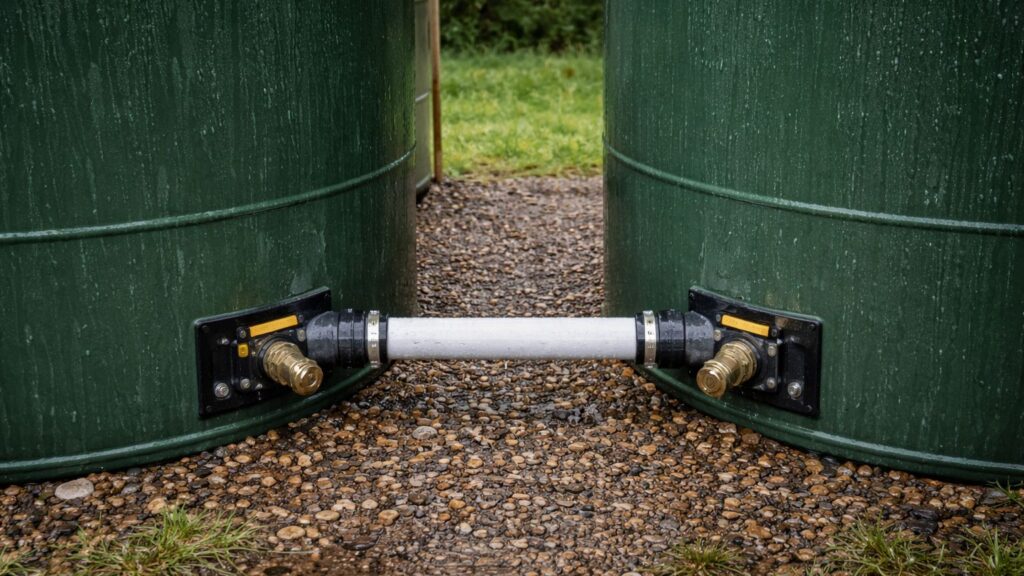
- Roof downspout connection
- First flush diverter
- Two linked barrels with bulkhead fittings
- Mosquito screens and spigot
Ideal for gardens and small cabins.
330 Gallon IBC Tote System
IBC totes offer affordable intermediate storage.
A typical setup includes:
- Metal roof catchment
- First flush diverter
- IBC tote storage
- Sediment filter and inline purifier
These systems are popular with cabins and tiny homes.
1,500 Gallon Homestead System
A mid-scale homestead setup might include:
- 1,000 sq ft metal roof catchment
- Dual downspouts and diverters
- Multiple storage tanks totaling 1,500+ gallons
- Sediment filtration and UV purification
This can support a full family when properly managed.
3,000+ Gallon Cabin System
Large off-grid homes often combine several roofs into a central catchment.
Water flows to multiple large tanks and passes through filtration and UV purification before entering the home.
This level of storage provides true water independence.
Water Safety: What Can Go Wrong (And How to Prevent It)
Rainwater is clean, until it isn’t.
Most water issues in off-grid systems come from contamination introduced during collection, storage, or handling.
Biological Risks
- Bacteria from bird droppings
- Algae growth in sunlight-exposed tanks
- Mosquito breeding in unsealed systems
Prevention:
- Use first flush diverters
- Keep tanks sealed and opaque
- Install fine mesh screens on all openings
Chemical Contamination
- Roofing materials leaching compounds
- Airborne pollutants in urban or industrial areas
- Improper storage materials
Prevention:
- Use metal roofing when possible
- Avoid collecting near heavy pollution sources
- Use food-grade storage tanks only
System Failures
- Clogged gutters backing up water
- Overflow flooding foundations
- Pump failures leaving systems dry
Prevention:
- Regular inspection and cleaning
- Proper overflow routing
- Backup water access or redundancy
The Big Insight
Most failures develop slowly through preventable issues that build over time.
A clean system stays clean through:
- Simple design
- Regular maintenance
- Proper filtration at every stage
If you respect the system, it will take care of you.
Common Mistakes to Avoid
- Skipping first flush systems
- Using transparent tanks that grow algae
- Undersizing storage capacity
- Poor gutter maintenance
- Inadequate filtration before pumps
- Assuming rain is automatically safe to drink
Most failures come from skipped maintenance and overlooked basics.
Field-Tested Upgrades That Make a Difference
Small upgrades can significantly improve system reliability:
- Add overflow routing away from foundations
- Install tank level indicators
- Use quick-disconnect plumbing fittings
- Label valves and system flow directions
- Keep spare filters on hand
These small details reduce maintenance and make troubleshooting easier.
Off Grid Proven Gear
| Item | Function |
|---|---|
| RainHarvest First Flush Kit | Removes initial roof contamination |
| Norwesco Water Tanks | Reliable rainwater storage |
| Rusco Spin Down Filter | Sediment removal |
| Viqua UV System | Bacteria and virus removal |
| BlueBarrel DIY Kit | Entry level rainwater systems |
| SteriPEN UV Wand | Portable water purification |
Final Thoughts
Water independence changes everything about off-grid living.
When you control your own water supply, storms and droughts stop being emergencies. Your crops grow. Your home functions. Your family drinks safely.
A well designed rainwater harvesting system captures every storm and protects every drop from roof to reservoir.
Because when the grid disappears, access to water becomes essential for survival.