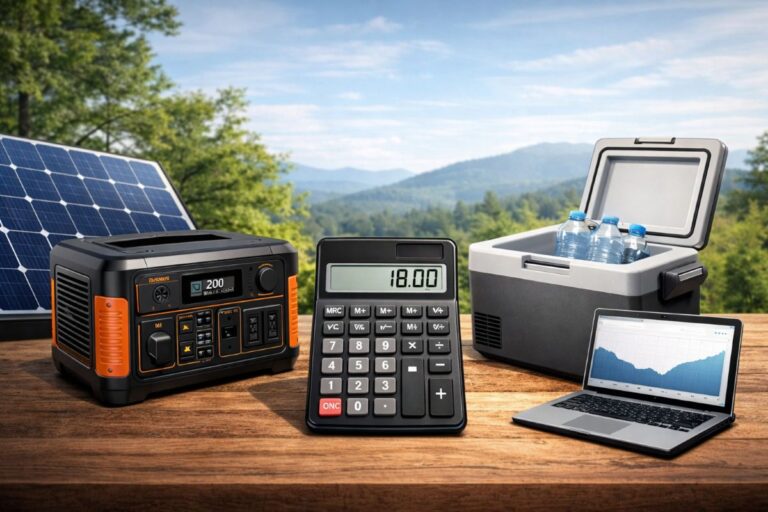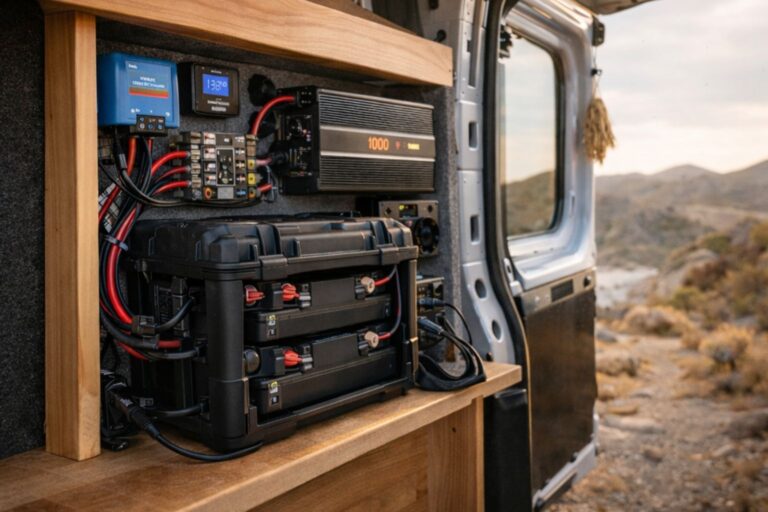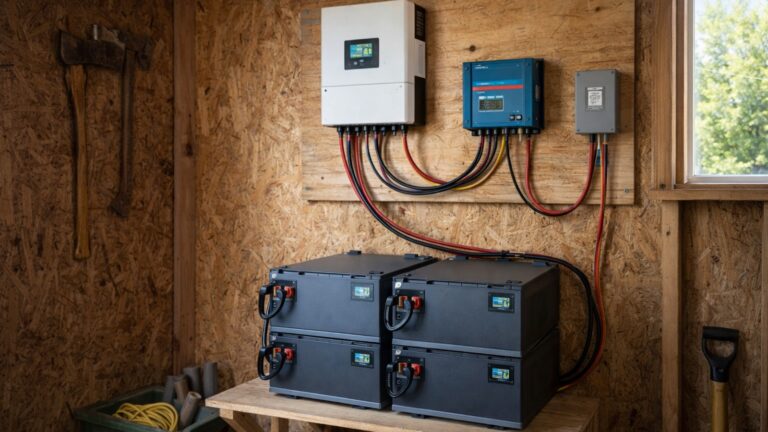
Top 10 Off-Grid Battery Setups for Reliable Solar Power
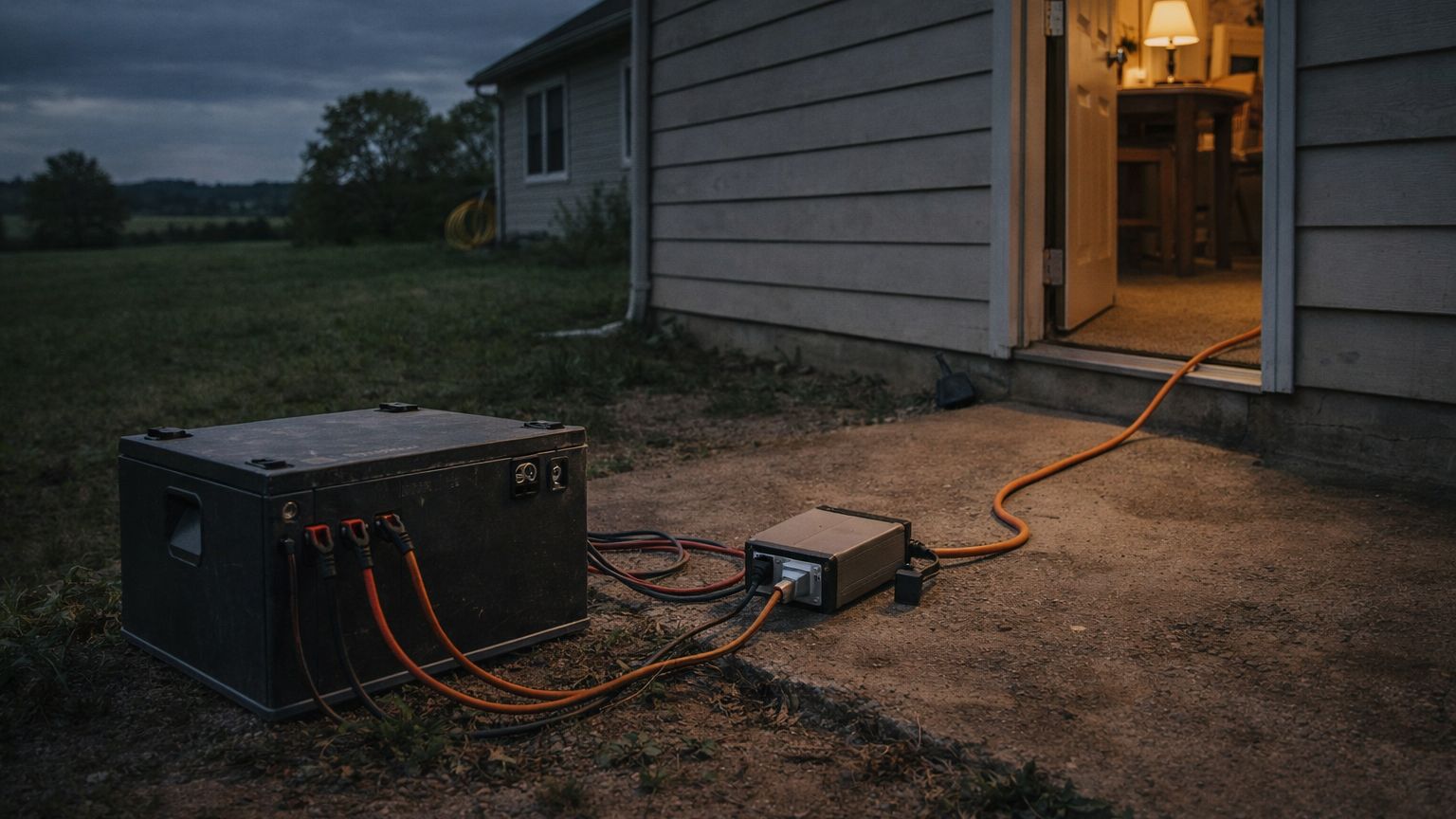
When the grid fails, batteries decide who stays lit and who goes dark.
They’re the silent backbone of every off-grid setup, storing the day’s sunlight and turning it into night-time power. But not all batteries are created equal. Some can take deep discharge and come back for more, while others die quietly after a single hard season.
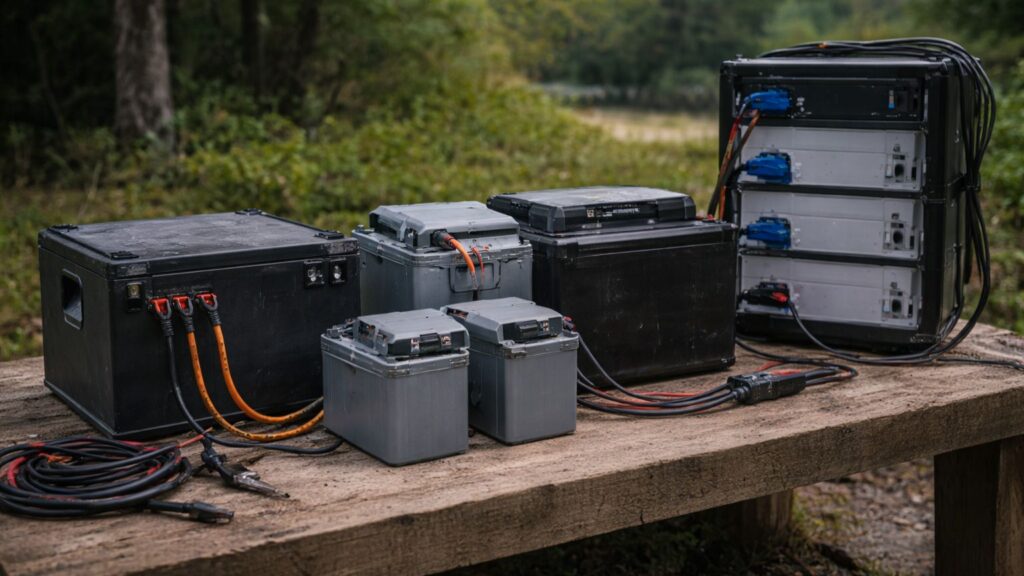
In this full guide, we’ll break down the 10 best off-grid battery setups — from budget-friendly AGMs to absolute LiFePO₄ monsters — and help you choose the right fit for your system, your climate, and your wallet.
1. Renogy Deep Cycle AGM 100Ah — Budget King
If you’re just getting started, Renogy’s AGM deep cycle battery is the most forgiving first step. It’s affordable, maintenance-free, and reliable for basic lighting, small pumps, and emergency loads.
Why it works off-grid:
- Sealed lead-acid design = zero off-gassing or water refills.
- Performs decently in cold weather.
- Simple drop-in compatibility with 12V solar charge controllers.
What to watch for:
Heavier and less efficient than lithium. Limit depth of discharge (DOD) to 50% to preserve lifespan.
Specs:
- 12V 100Ah (1.1 kWh)
- 600 cycles @ 50% DOD
- Weight: 66 lbs
Pair it with:
- Renogy 20A Battery Monitor
- Renogy 100W Solar Panel Starter Kit
Best for: Beginners, cabins, or RVs that just need lights and a small inverter.
2. Battle Born LiFePO₄ 100Ah — The Off-Grid Standard
Ask any veteran homesteader which battery they trust, and you’ll hear one name: Battle Born. These 12V 100Ah LiFePO₄ packs are built in Nevada and are the benchmark for reliability.
Why it works off-grid:
- 3,000–5,000 cycles with 80–100% usable energy.
- Integrated BMS for thermal and over-discharge protection.
- Lightweight (31 lbs) and easily stackable.
Field insight:
They can handle freezing conditions with internal heat kits and recharge lightning-fast from solar.
Specs:
- 12.8V 100Ah (1.28 kWh)
- 95% efficiency
- 10-year warranty
Pair it with:
- Victron SmartShunt Bluetooth Monitor
- Renogy 60A DC-DC Charger
Best for: Long-term off-grid cabins, vans, or anyone who wants to “buy once, cry once.”
3. Ampere Time (LiTime) 12V 300Ah LiFePO₄ — Mid-Range Powerhouse
If Battle Born is the Tesla of batteries, LiTime (formerly Ampere Time) is the Toyota — efficient, affordable, and surprisingly tough.
Why it works off-grid:
- Massive 3.84 kWh capacity in a single unit.
- 4000+ cycles, 95% usable energy.
- Low internal resistance = faster charge times.
Field tip:
One of the best values-per-kWh on the market. Perfect for a full weekend cabin system or mobile power wall.
Specs:
- 12.8V 300Ah (3.84 kWh)
- 4,000–6,000 cycles
- 47 lbs
Pair it with:
- Renogy Rover 60A MPPT Controller
- Victron Multiplus-II 12/3000 Inverter
Best for: Cabin owners wanting big capacity without breaking the bank.
4. EcoFlow DELTA Pro — Plug-and-Play Freedom
The EcoFlow DELTA Pro combines portability with substantial power capacity. It’s an all-in-one generator alternative — inverter, charger, and LiFePO₄ battery combined.
Why it works off-grid:
- Expandable from 3.6 to 25 kWh with Smart Extra Batteries.
- Recharges from solar, AC, or even EV stations.
- Built-in 3600W inverter powers heavy tools and appliances.
Field tip:
Perfect for nomads, renters, or anyone who wants power independence without a fixed installation.
Specs:
- 3.6 kWh expandable to 25 kWh
- 3,500 cycles
- App-based monitoring
Pair it with:
- EcoFlow Smart Extra Battery
- EcoFlow 400W Folding Solar Panel
Best for: Hybrid setups, mobile bases, or backup power.
5. Bluetti AC500 + B300S Expansion — The Modular Titan
The Bluetti AC500 pushes modular power systems into full-home territory. With a 5000W inverter and expandable battery modules, it’s basically a portable microgrid.
Why it works off-grid:
- Stackable modules let you scale from 3kWh to 18kWh.
- 3,000W solar input and 240V split-phase capability.
- App-controlled with full remote diagnostics.
Specs:
- 18.4 kWh max
- 3500+ cycles
- LiFePO₄ chemistry
Pair it with:
- Bluetti PV420 Solar Panel
- B300S Expansion Battery
Best for: Full cabins, RV conversions, or tiny homes wanting grid-like power.
6. Tesla Powerwall 2 — The Grid Ghost
The Powerwall is the dream setup for permanent off-grid homes. Sleek, silent, and smart, it can store enough power to run a small house for a day — or bridge multiple cloudy days.
Why it works off-grid:
- 13.5 kWh capacity.
- 90% round-trip efficiency.
- Smart load management via Tesla app.
Field note:
Usually sold via certified installers, but used/refurbished units can be integrated with third-party inverters like Sol-Ark or Schneider.
Best for: High-end, solar-rich properties and remote grid-tied homes transitioning to autonomy.
7. DIY 48V Server Rack Setup — The Builder’s Favorite
For those who like to tinker and save big, building a 48V rack system from modular batteries is the sweet spot between power and cost.
Why it works off-grid:
- High voltage = lower current and efficiency loss.
- Modular: swap or upgrade cells individually.
- Easy integration with Growatt, EG4, and Victron systems.
Example Setup:
- 4× SOK 48V 100Ah Rack Batteries (20 kWh total)
- Victron Multiplus-II 48/3000 Inverter/Charger
- Smart BMS and monitoring system
Best for: Serious off-gridders who understand wiring, fusing, and balance of system design.
8. Lion Energy Safari UT1300 — Lightweight Workhorse
This one punches above its weight. Designed for portability and endurance, the Safari UT1300 is perfect for RVs, vanlifers, and backup kits.
Why it works off-grid:
- LiFePO₄ chemistry, 3,500+ cycles.
- Built-in BMS and fast charge capability.
- One of the lightest 100Ah units (23 lbs).
Specs:
- 12.8V 105Ah
- 1.34 kWh capacity
- 11-year warranty
Pair it with:
- Lion Safari ME Expansion Pack
- Jackery 100W SolarSaga Panel
Best for: Minimalist setups and mobile living.
9. Redodo 12V 200Ah LiFePO₄ — Budget Beast
This one’s a sleeper hit in the DIY community. Redodo offers affordable lithium packs that actually deliver their rated capacity — perfect for large multi-bank builds.
Why it works off-grid:
- 4000+ cycles, 2560 Wh usable energy.
- Excellent price-per-kWh ratio.
- Built-in BMS with low-temp cutoff.
Specs:
- 12.8V 200Ah
- 25.6 lbs
- 10-year service life
Pair it with:
- Victron SmartSolar MPPT 100/30
- Renogy 200W Panels
Best for: DIY solar enthusiasts building scalable battery walls.
10. Fortress eVault Max 18.5kWh — Permanent Powerhouse
When you’re done experimenting and ready to go fully off-grid for life, the Fortress eVault Max is the endgame. A single 18.5kWh unit can power an entire homestead with industrial-grade stability.
Why it works off-grid:
- 48V LiFePO₄ with integrated CAN/RS485 communications.
- 8000+ cycle lifespan.
- Works with Schneider, Sol-Ark, and Victron inverters.
- Maintenance-free and UL 9540 certified.
Specs:
- 18.5 kWh, 48V
- 95% round-trip efficiency
- 15-year warranty
Best for: Permanent installations and microgrids.
What This Looks Like in a Real Off-Grid Setup

In a real off-grid system, batteries act as the buffer between unpredictable energy production and consistent daily use.
Most setups begin small and expand over time. A user might start with a single battery and quickly realize that real-world usage is higher than expected. Cloud cover, seasonal changes, and inverter losses all add up.
A typical progression:
- Start with a small 12V system
- Add capacity after tracking real usage
- Upgrade to LiFePO₄ for efficiency and lifespan
- Move to 24V or 48V for better system performance
The key difference between a good system and a frustrating one is margin. Systems that operate at their limit fail under stress. Systems with headroom continue working quietly in the background.
(See Related: From Grid-Dependent to Grid-Ignorant: Designing Systems You Forget Are There)
Common Battery Mistakes That Kill Systems Early
Most battery failures come from usage mistakes rather than product defects.
Over-discharging is the most common issue. Lead-acid batteries suffer quickly when pushed below 50%, while lithium systems degrade faster when repeatedly drained to zero.
Another mistake is mismatched components. A large inverter paired with a small battery bank creates constant strain.
Temperature is also critical. Cold reduces available capacity, while heat accelerates degradation.
Undercharging is often overlooked. If your solar array cannot fully recharge your batteries, long-term capacity loss is inevitable.
Finally, lack of monitoring leads to blind operation. Without tracking real usage and charge levels, problems go unnoticed until failure occurs.
Upgrade Path: From Starter System to Full Off-Grid Power
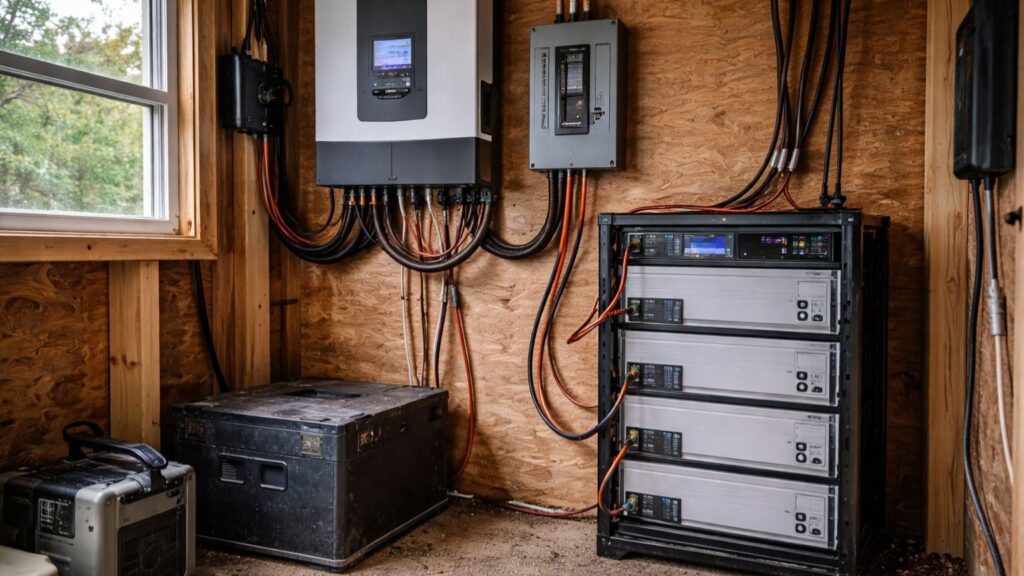
Most people expand their systems gradually over time.
A realistic upgrade path looks like this:
Stage 1:
- AGM battery + small solar kit
- Basic lighting and device charging
Stage 2:
- Switch to LiFePO₄
- Add inverter and increased solar input
Stage 3:
- Expand battery bank capacity
- Introduce monitoring and system optimization
Stage 4:
- Transition to 48V system
- Integrate full-home loads and redundancy
Building in stages allows you to learn your system while avoiding expensive mistakes upfront.
How to Choose the Right Battery Setup for Your Situation
Choosing the best battery setup means matching your system to your actual usage and environment.
Start by asking three simple questions:
1. How much energy do you use daily?
If you’re running lights, a laptop, and a small fridge, your needs are completely different from someone powering a full homestead with pumps, tools, and heating systems.
2. How many days of backup do you need?
A weekend cabin might only need one day of storage. A full-time off-grid home should aim for 2–3 days of autonomy, especially in winter or cloudy climates.
3. How fast can you recharge?
Recharge capability is just as important as storage capacity. A large battery bank with insufficient solar input creates long-term performance problems.
From there, match your setup:
- Small systems (under 2 kWh/day): AGM or single lithium battery
- Mid-range systems (2–5 kWh/day): 200–400Ah LiFePO₄
- Large systems (5+ kWh/day): 48V rack batteries or modular systems
The goal is balance. Avoid paying for unused capacity while maintaining enough headroom for normal operation.
(See Related: How Much Battery Do You Need to Power Devices Off Grid)
Battery Placement, Safety, and Longevity Considerations
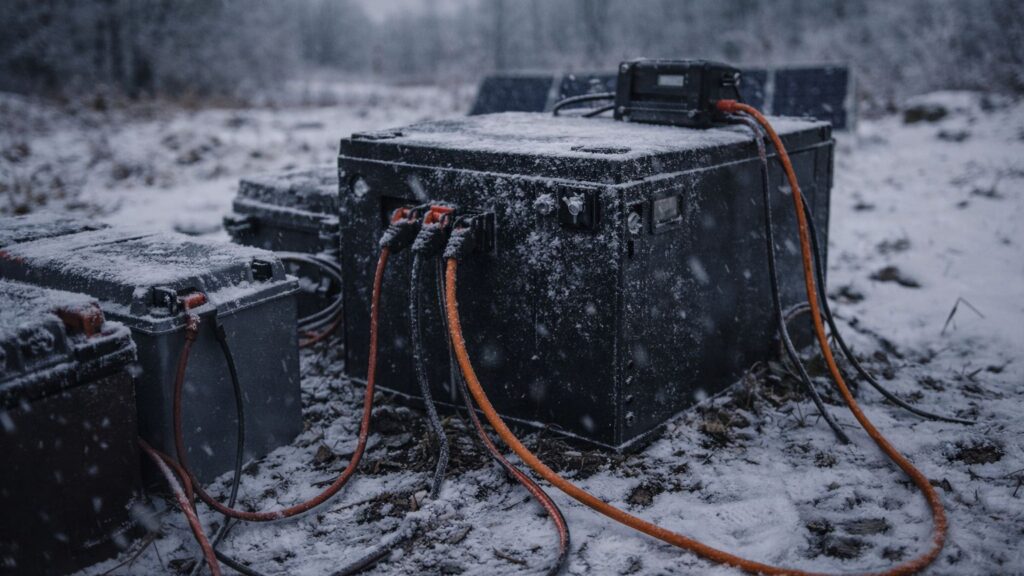
Installation quality is just as important as battery selection.
Ventilation and spacing are critical, especially for enclosed setups. While LiFePO₄ batteries are far safer than lead-acid, they still benefit from stable temperatures and airflow.
Avoid extreme temperatures whenever possible.
- Cold reduces usable capacity and can prevent charging
- Heat accelerates long-term degradation
If you’re in a cold climate, consider:
- Insulated battery boxes
- Low-watt heating pads with thermostats
- Indoor utility room placement
If you’re in a hot environment:
- Keep batteries out of direct sunlight
- Ensure airflow around the system
- Avoid sealed compartments
Cable management and protection also matter.
Loose or undersized cables create resistance, heat, and inefficiency. Use properly sized wiring, secure connections, and appropriate fusing between all major components.
Finally, think about access. A system that’s easy to inspect and service will last longer simply because you’ll catch problems early.
A clean, accessible, and temperature-stable installation can add years to the life of your battery system.
Battery Chemistry Breakdown
| Chemistry | Cycle Life | Depth of Discharge | Efficiency | Cost/kWh | Ideal Use |
|---|---|---|---|---|---|
| AGM Lead-Acid | 400–800 | 50% | 80% | $150 | Starter systems |
| Gel | 600–1000 | 60% | 85% | $200 | Low-load cabins |
| LiFePO₄ | 3000–8000 | 80–100% | 95% | $350–$600 | All-purpose |
| NMC (Tesla) | 3000–5000 | 90% | 92% | $500–$700 | Whole-home setups |
Verdict: LiFePO₄ has become the preferred chemistry for off-grid living thanks to its safety, deep discharge capability, and long cycle life.
System Design & Sizing Tips
1. Go 48V if you can.
Higher voltage means smaller cables, less heat, and more inverter compatibility.
2. Leave headroom.
Never drain lithium below 10% or lead-acid below 50%. Over-discharge kills lifespan.
3. Use a Battery Monitor.
Voltage alone lies — measure current and state-of-charge accurately (Victron SmartShunt or Renogy 500A Monitor).
4. Temperature matters.
Keep batteries between 0°C and 35°C. Add heaters or ventilation as needed.
Redundancy & Expansion Strategy
- Combine fixed banks (rack or wall units) with portable power stations like Bluetti or EcoFlow for flexibility.
- Keep a spare inverter and charge controller in storage for emergency swap-outs.
- For long-term setups, balance charge multiple batteries with a proper bus bar and fuse system.
Real-World Example: Cabin System
A small off-grid cabin using:
- Fridge (60W avg)
- Lighting (40W)
- Laptop/router (60W)
- Pump (100W intermittent)
- Inverter loss (10%)
= ~2.5 kWh/day total draw.
Recommended Setup:
- 300Ah 12V LiFePO₄ (≈3.8 kWh usable)
- 600W solar array minimum.
- 40A MPPT controller.
- 1500–2000W inverter.
This setup easily powers lights, refrigeration, and electronics for 2+ days of autonomy.
Final Thoughts: Power Equals Freedom

Off-grid life rewards thoughtful system design and efficient energy use. A solid battery system is your silent ally through storms, outages, and long winters. The best setups provide reliable power and peace of mind.
Start with what you can afford. Expand as your system grows.
And when in doubt, remember: the strongest power setup is the one you never have to think about.