How Much Battery Do You Need to Power Devices Off Grid (Runtime Calculator + Real Examples 2026)
This off-grid battery runtime guide explains how to calculate exactly how long your power system will run lights, fridges, routers, laptops, and other essential devices.
“How long will it run?” is the most asked, least answered question in off-grid life.
Every builder, traveler, or prepper has asked it at some point, usually while squinting at a battery display that’s dropping faster than expected.
The truth is: you don’t need a degree in electrical engineering to answer it. You just need a little math, and a realistic sense of what your devices actually draw.
This guide turns power anxiety into power clarity.
The Core Formula
Runtime (hours) = (Battery Capacity in Wh × System Efficiency) ÷ Load (W)
Where:
Battery Capacity (Wh) = Volts × Amp-hours
System Efficiency = typically 0.9 (90%) for inverter and cable loss
Load (W) = your device’s continuous watt draw
That’s it. Plug those three numbers in and you can predict runtime with surprising accuracy.
Example:
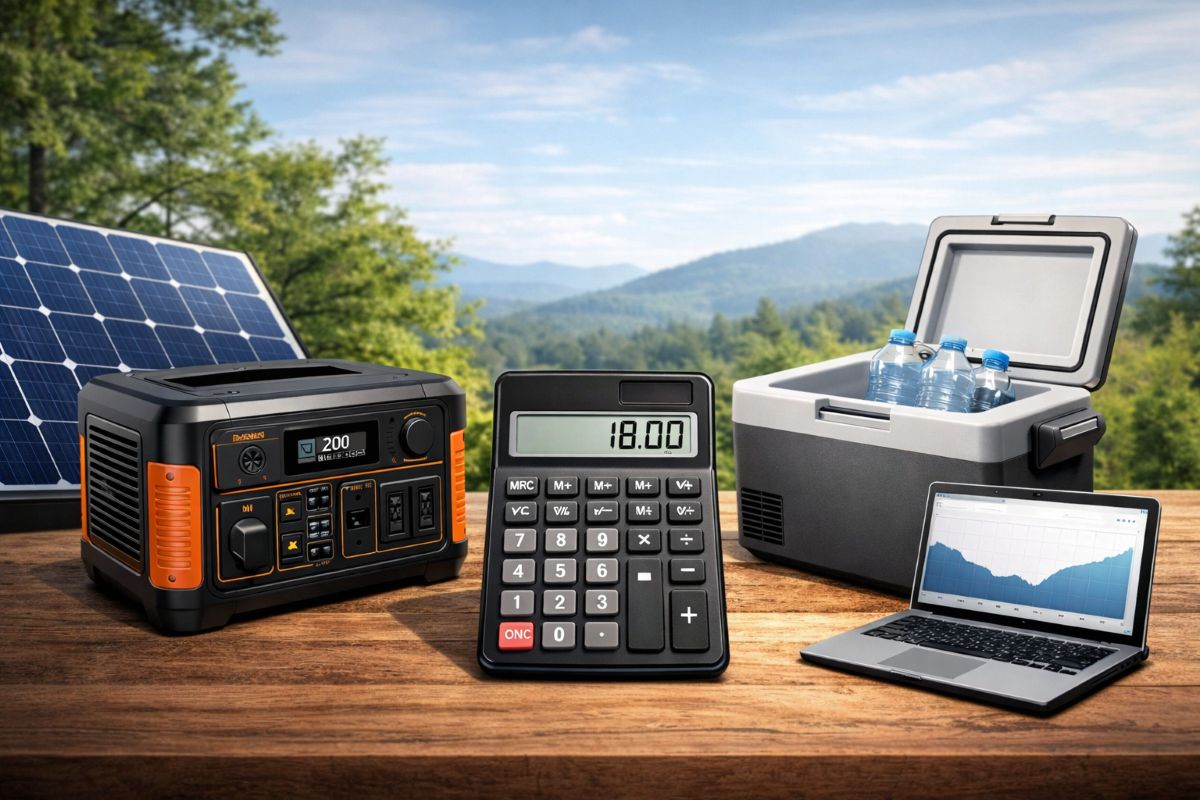
A 2,000 Wh LiFePO₄ battery running a 100 W fridge:
(2000 × 0.9) ÷ 100 = 18 hours of runtime
That’s one full day and part of the next before you need to recharge.
Field insight:
This formula is accurate, but only if your inputs are realistic. Most people underestimate load and overestimate efficiency, which leads to disappointment in real-world use.
Quick Runtime Calculator
If you want a fast estimate without doing the full formula, use this shortcut.
Battery Wh ÷ Device Watts ≈ Runtime Hours
Example:
A 2000 Wh power station running a 50 W device
2000 ÷ 50 = 40 hours
Now subtract about 10% for inverter losses.
≈ 36 hours of real-world runtime
This quick rule gets you surprisingly close without needing spreadsheets or engineering tools.
When to use this:
- quick planning
- comparing devices
- estimating runtime in the field
Understanding the Variables
Battery Capacity (Wh)
This is your fuel tank.
A 1,000 Wh battery holds one kilowatt-hour of energy, enough to run a 100 W light for ten hours, or a 1,000 W heater for one hour.
Common sizes:
Small station: 500–1,000 Wh (day trips, small rigs)
Mid-range: 2,000–3,000 Wh (cabins, vanlife, small homesteads)
Large system: 5,000–10,000 Wh (household-level autonomy)
Important:
Not all of that energy is usable. Lithium systems allow ~90–95% use. Lead acid systems often allow only ~50%.
[Related: Best Off Grid Battery Systems for 2026]
System Efficiency (The 0.9 Rule)
Every conversion wastes energy.
Inverters are not perfectly efficient and electrical cables create resistance.
A 90% efficiency estimate works for most real-world setups.
If your system uses long wires or undersized cables, efficiency may drop closer to 85%.
DC-only systems (no inverter) can reach 95–97% efficiency.
Real-world impact:
On a 2000Wh battery, a 5% efficiency drop is 100Wh lost. That’s an extra hour of runtime gone on a 100W load.
Device Wattage (Load)
This is how fast your battery energy gets used.
Tip: Use a Kill-A-Watt meter or watt monitor plug to measure real device draw. Manufacturer labels often overestimate by 20–30%.
Typical loads:
LED bulb: 10 W
Laptop: 60 W
12 V fridge: 60–100 W (cycles)
Starlink router: 35 W
Water pump: 60 W
Space heater: 500–1500 W (avoid on battery systems)
Key insight:
Devices that cycle (like fridges) don’t draw full power continuously, which is why real runtime can sometimes exceed simple calculations.
Why Real Runtime Never Matches the Math Exactly
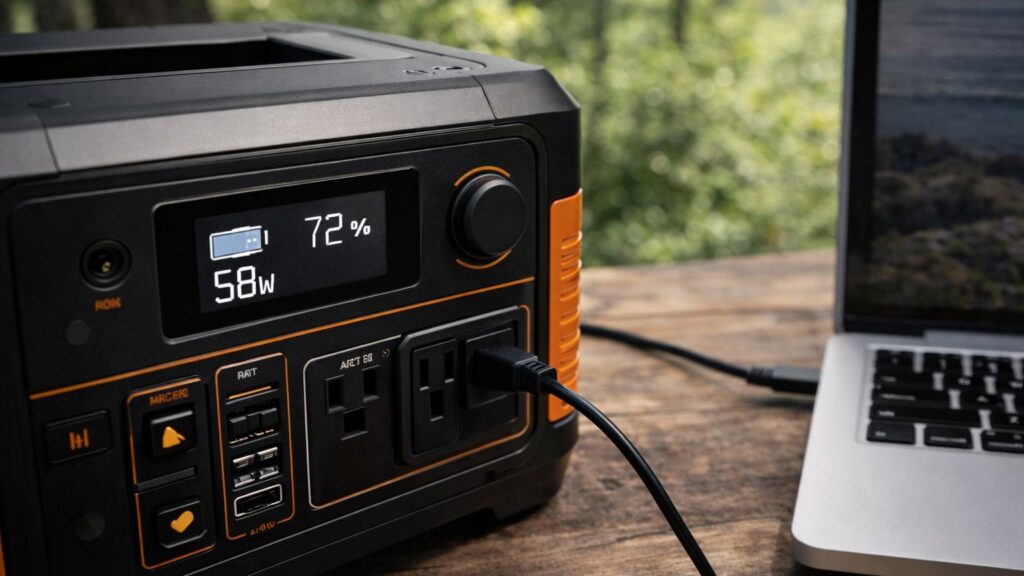
The runtime formula is accurate.
But real-world results almost never match it perfectly.
This is where most people get frustrated, not because the math is wrong, but because reality adds layers the formula doesn’t fully capture.
Understanding these gaps is what separates a system that feels predictable from one that constantly surprises you.
Devices Don’t Draw Power the Way You Think
Most devices don’t use a steady, constant wattage.
They fluctuate.
Examples:
- refrigerators cycle on and off
- laptops spike during charging, then drop
- routers stay steady but vary slightly under load
- pumps run in short bursts, not continuously
So while a fridge may be labeled at 70W, it might only average 30–40W over time.
This is why runtime sometimes exceeds expectations, and sometimes falls short.
Inverter Behavior Changes Under Load
Inverters are not equally efficient at all power levels.
At very low loads:
- efficiency drops slightly
- standby consumption becomes more noticeable
At high loads:
- efficiency improves
- but heat and conversion losses increase
This creates a “sweet spot” where your system runs most efficiently.
Systems running far below or near maximum capacity tend to perform worse than expected.
Standby Loads Add Up Fast
One of the most overlooked factors in runtime calculations is standby consumption.
Many systems draw power even when you’re not actively using devices.
Examples:
- inverter idle draw (often 10–30W)
- battery management systems
- always-on electronics (routers, monitors, controllers)
A constant 20W standby load equals:
480 Wh per day
That’s nearly 25% of a 2000 Wh battery gone without doing anything useful.
This is one of the biggest hidden drains in off-grid systems.
Voltage Drop Under Load Changes Usable Capacity
As batteries discharge, voltage gradually drops.
Under heavy load, this drop happens faster.
In some systems, the inverter will shut down early to protect the battery, even if some energy technically remains.
This makes it feel like you “lost capacity.”
In reality:
- the energy is still there
- but not accessible under current conditions
Larger battery banks reduce this effect because the load is spread across more cells.
Temperature Quietly Affects Runtime
Cold temperatures reduce available battery capacity.
In winter conditions:
- lithium batteries may lose 10–20% usable capacity
- charge rates are limited or disabled below freezing
This is one of the reasons systems feel weaker in winter, even with the same usage.
Heat, on the other hand, slightly reduces efficiency but mostly affects long-term lifespan.
Cable Losses and System Design Matter
Energy is lost not just in devices, but in how the system is built.
Losses increase with:
- long cable runs
- undersized wiring
- poor connections
Even small inefficiencies compound over time.
A poorly wired system can lose an additional 5–10% of usable energy without the user realizing it.
Human Behavior Changes the Outcome
The biggest variable in any system is not the battery.
It’s the user.
Small changes in behavior dramatically affect runtime:
- running appliances during solar hours
- spacing out high-draw devices
- turning off unused systems
- charging devices when the battery is full
These habits don’t require discipline forever. They become automatic.
And once they do, systems feel significantly larger than they are.
Why Experienced Users Oversize Everything
After a few months off-grid, most people come to the same conclusion:
The math is useful, but it’s not enough.
Real systems need:
- buffer capacity
- flexibility
- tolerance for bad conditions
This is why experienced builders consistently oversize:
- battery capacity
- solar input
- inverter headroom
Not because they don’t understand the math, but because they do.
The Reality Check
If your calculations say:
“this system should be enough”
…it probably isn’t.
If your calculations say:
“this system has margin”
…it probably will feel comfortable.
The Simple Rule That Actually Works
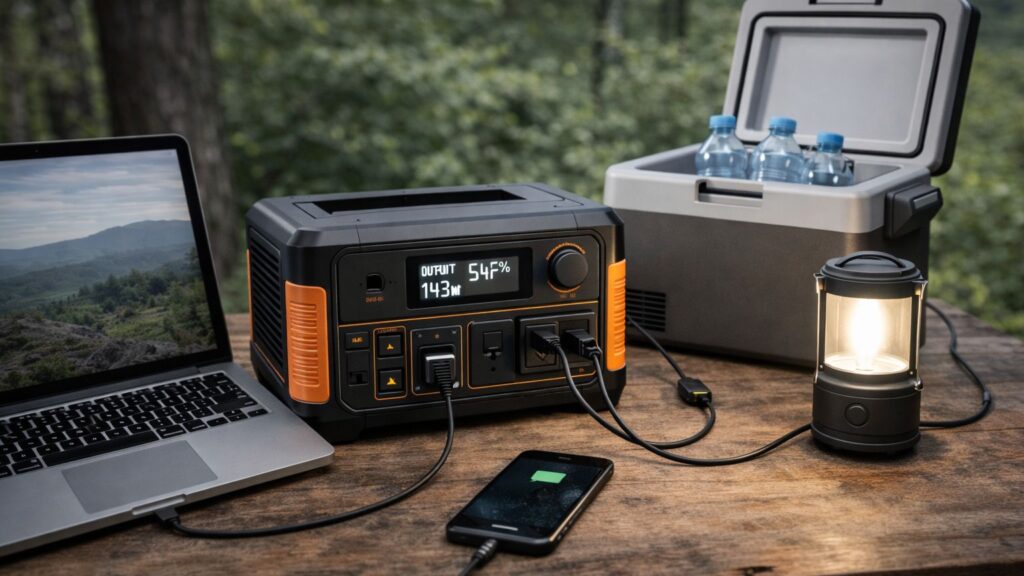
If your system can:
- handle your average load
- absorb unexpected usage
- recover fully in a day of good sun
…it will feel reliable.
If it can’t, you will constantly be adjusting around it.
The goal isn’t perfect calculations.
It’s predictable performance.
And that only comes from understanding how systems behave beyond the numbers.
Real World Runtime Examples
| Device Setup | Load (W) | Battery (Wh) | Runtime | Notes |
|---|---|---|---|---|
| 12 V Fridge | 60 | 2,000 | 30 h | ~1¼ days |
| Laptop + Router + LED | 90 | 1,000 | 10 h | Workday setup |
| Cabin Heater + Lights | 540 | 2,000 | 3.3 h | Heaters drain fast |
| Starlink + Router + Laptop | 120 | 2,000 | 15 h | Remote work |
| Water Pump | 60 | 1,000 | 15 h | intermittent load |
| Cabin Essentials | 300 | 5,000 | 15 h | 1–2 day autonomy |
Quick rule:
Every 100 W of draw consumes roughly 100 Wh per hour.
How Long Will Popular Devices Run on a 2000Wh Battery
Many portable power stations use roughly 2,000 Wh batteries, making them a useful reference point.
| Device | Power Draw | Estimated Runtime |
|---|---|---|
| Laptop | 60 W | ~30 hours |
| LED Light | 10 W | ~180 hours |
| Starlink Router | 35 W | ~50 hours |
| 12V Fridge | 70 W | ~25 hours |
| Phone Charger | 5 W | ~360 hours |
| Small TV | 80 W | ~22 hours |
These numbers assume about 90% system efficiency.
Appliances like refrigerators cycle on and off, which means real runtime can sometimes be longer than simple calculations suggest.
How Much Battery Do Most Off Grid Systems Actually Need
Many people dramatically underestimate their energy needs.
Here are typical battery sizes used by real off-grid systems.
| Use Case | Minimum Battery |
|---|---|
| Laptop + lights | 1 kWh |
| Vanlife setup | 2–3 kWh |
| Weekend cabin | 3–5 kWh |
| Full-time cabin | 8–12 kWh |
| Whole-home backup | 15–30 kWh |
The goal isn’t building the smallest system possible.
The goal is building one that never feels strained.
Most experienced builders oversize battery capacity by 25–50% beyond calculated requirements.
Extending Runtime With Solar
The battery is only half the equation.
Solar input can extend runtime indefinitely if your panels collect as much energy as you consume.
Daily solar generation formula:
Panel Watts × Sun Hours × 0.8 = Daily Watt Hours
Example:
400 W solar array × 5 peak sun hours × 0.8
= 1600 Wh per day
Enough to refill a 2 kWh battery with room for inverter losses.
Reality check:
Solar production is not consistent. Weather, panel angle, shading, and season all affect output.
Oversizing solar is often more important than maximizing battery size.
Planning Around Lifestyle, Not Just Numbers
The best off-grid systems are designed around habits.
Ask yourself:
How many hours per day do you really need power?
What devices are non-negotiable?
What can shift to daylight hours?
Morning-heavy users often need stronger inverters.
Evening-heavy users need more battery storage.
Weekend cabins can recharge slowly all week and draw heavily during visits.
Design your system around how you actually live, not just theoretical numbers.
Example Off Grid System Sizes
| System Type | Battery Bank | Solar Array | Typical Use |
|---|---|---|---|
| Weekend Cabin | 2 kWh | 400 W | lights + fridge |
| Vanlife Rig | 3 kWh | 600 W | mobile work |
| Small Homestead | 5 kWh | 1000 W | pumps + tools |
| Full Time Cabin | 10 kWh | 1600 W | daily living |
| Mini Grid Home | 20 kWh | 3000 W | whole home backup |
Pro tip:
Oversize solar input by 25–30% to compensate for clouds, dust, and seasonal changes.
Why Most People Undersize Their Battery Systems
The biggest mistake new off-grid builders make is designing systems that are too small for real life.
The math may say a 2 kWh battery is enough, but real-world usage almost always expands.
Common reasons include:
Extra devices get added later
Cloudy weather reduces solar charging
Inverter losses accumulate
Standby devices draw power 24/7
This is why experienced builders usually add 25–50% extra battery capacity beyond calculated requirements.
A slightly oversized system feels effortless.
An undersized one feels stressful.
Quick Runtime Cheat Sheet (Field Reference)
When you’re off-grid, you don’t always want to run calculations.
Sometimes you just need a fast, reliable mental estimate.
This is the kind of quick-reference logic experienced users rely on in the field.
The 100 Watt Rule
Every 100W of continuous draw uses:
~100 Wh per hour
So:
- 100W device → ~10 hours on 1000Wh
- 200W load → ~5 hours on 1000Wh
- 500W load → ~2 hours on 1000Wh
This rule gets you within 10–15% accuracy instantly.
The 2 kWh System Reality Check
A 2000Wh system (common size) typically supports:
- light usage → 1–2 days
- moderate usage → 8–16 hours
- heavy usage → 2–5 hours
This is why small systems feel great at first, but quickly feel limited with real use.
Daily Consumption Benchmarks
Use these as quick mental anchors:
- Minimal setup → 500–1000 Wh/day
- Light cabin → 1000–2000 Wh/day
- Moderate off-grid → 2000–4000 Wh/day
- Full system → 5000 Wh+ per day
If your battery can’t cover your daily usage, you’re relying entirely on solar timing.
Fast Load Impact Guide
Some devices change everything instantly:
- kettle → drains ~150 Wh in minutes
- microwave → heavy short bursts
- heater → destroys runtime quickly
These don’t just use power, they reshape your entire runtime window.
The “Feels Right” Test
After using your system for a few days, ask:
- Does it comfortably last through the evening?
- Can it handle one unexpected load?
- Does it recover the next day?
If yes, your system is sized well.
If not, you’re operating too close to the edge.
This kind of quick-reference thinking is what makes off-grid systems feel intuitive instead of restrictive.
You stop calculating and start knowing.
Common Mistakes
Sizing by price instead of load
Ignoring inverter losses
Forgetting standby draws
Relying on cloudy-day charging
Mixing 12 V and 24 V systems improperly
Assuming every watt-hour is usable
Always keep 10% reserve capacity.
The Field Logic
Experienced off-grid builders think in watt-hours the way others think in dollars.
They know their daily energy budget.
They oversize solar capacity.
They build systems with redundancy.
Predictable runtime isn’t luxury, it’s peace of mind.
Field Verdict

Know your loads.
Do the math once.
Oversize your system by 25%.
A system built on honest numbers won’t surprise you — it will simply keep running through storms, outages, and long nights.
Freedom off-grid isn’t just about having power.
It’s about knowing exactly how long it will last.