The 5 Best Off Grid Internet Options for Remote Living
Power keeps your systems running.
Signal keeps you connected to the world.
When cellular bars disappear and home internet ends miles down the road, reliable connectivity becomes critical for remote work, safety alerts, navigation, and communication. Off-grid internet systems allow cabins, homesteads, and remote work setups to stay connected even when traditional infrastructure is unavailable.
This guide explains the most reliable off-grid internet solutions available today and highlights the five best connectivity systems for remote living.
Why Off Grid Internet Matters
Reliable connectivity provides several essential benefits for off-grid living.
Remote work capability
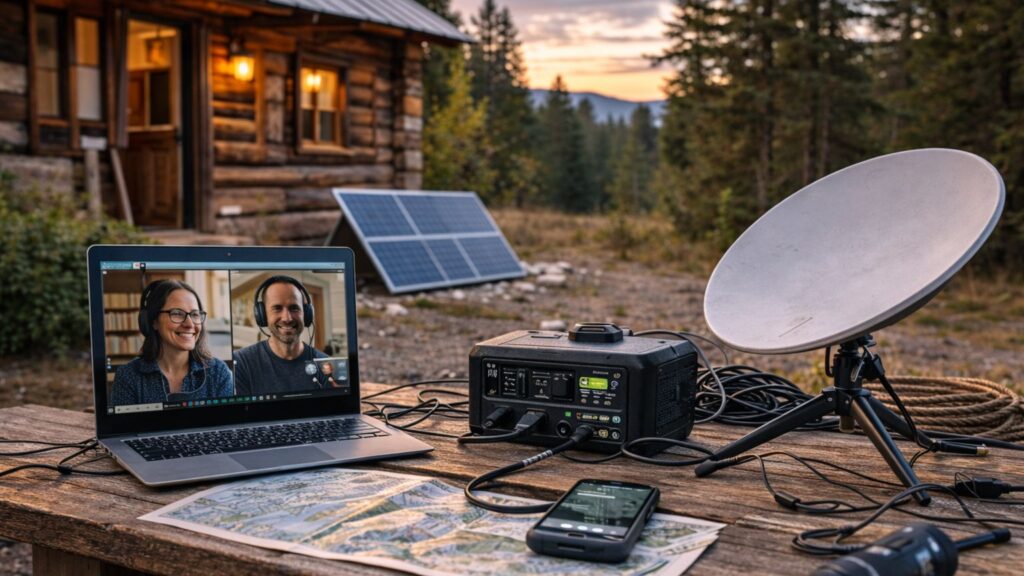
Many off-grid residents still rely on internet access for work, file transfers, and video calls.
Emergency information
Weather alerts, wildfire maps, and emergency updates often require internet connectivity.
Navigation and mapping
Satellite imagery, GPS overlays, and route updates help with travel and land management.
Communication and reassurance
Being able to send a quick message or make a call provides peace of mind for family and crews working in remote areas.
Connectivity has quietly become part of modern survival infrastructure.
When Off-Grid Internet Becomes Essential
There is a point where internet access shifts from convenience to necessity.
For part-time cabin users, connectivity may simply be a bonus. But for full-time off-grid living, remote work, or managing land and infrastructure, reliable internet becomes a core utility.
Many off-grid homeowners rely on internet access for:
- Monitoring solar and battery systems remotely
- Managing security cameras and alerts
- Accessing weather data for planning and safety
- Coordinating deliveries, logistics, or contractors
Without reliable connectivity, even simple tasks can become time-consuming or risky.
As more systems become connected, internet access is no longer just about communication. it becomes part of how the entire property operates.
The Hidden Challenges of Staying Connected Off Grid
While modern systems have made remote connectivity easier than ever, off-grid internet still comes with real-world challenges that are often overlooked.
Power vs performance tradeoff
High-speed systems like satellite internet require continuous power draw. In winter or low-sun conditions, this can put significant strain on your battery system.
Environmental interference
Trees, mountains, and even heavy weather can impact signal quality. Satellite systems require clear sky exposure, while cellular systems depend on terrain and tower proximity.
Setup complexity
Some systems work out of the box, while others require mounting, alignment, or tuning. Understanding your system ahead of time prevents frustration during deployment.
Cost over time
Monthly subscriptions, hardware upgrades, and maintenance all add up. Off-grid internet is not just a one-time purchase — it is an ongoing system.
Understanding these limitations early allows you to build a setup that remains reliable over months and years, not just initial installation.
The Main Types of Off Grid Internet Systems
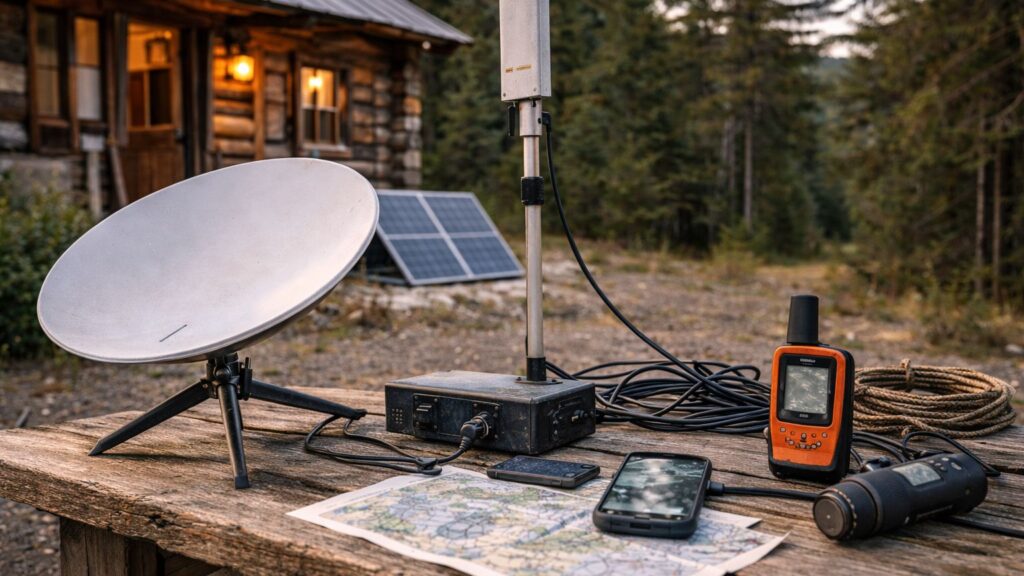
Several technologies can provide internet access beyond traditional cable or fiber networks.
Satellite Internet
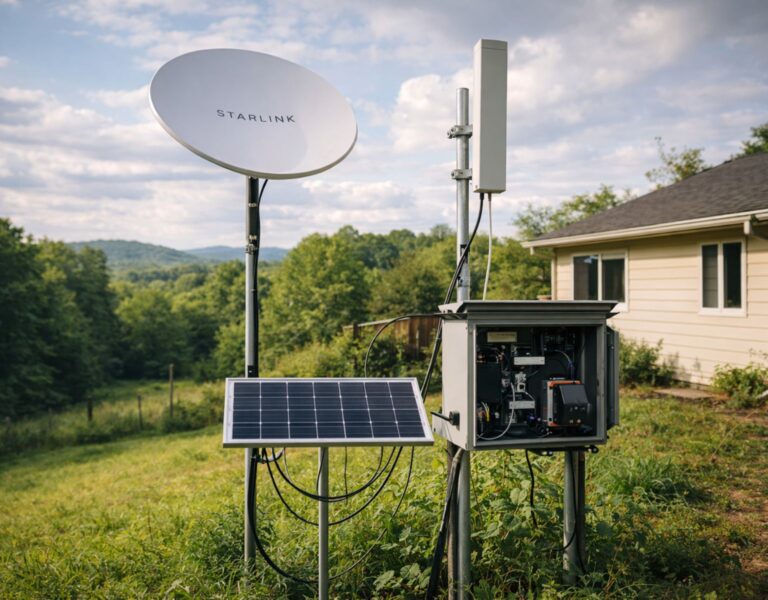
Satellite internet systems connect directly to orbiting satellite networks rather than ground infrastructure. The most widely used system today is Starlink, which provides high-speed internet across large portions of the world.
Modern satellite systems can deliver speeds between 50 and 150 Mbps depending on location and sky visibility.
Advantages
- Works almost anywhere with open sky
- High data speeds compared to older satellite systems
- Reliable for remote homes and cabins
Limitations
- Higher power draw than other communication devices
- Requires clear sky visibility
- Monthly subscription plans are required
Cellular Signal Boosters
Signal boosters capture weak cellular signals and amplify them to improve call quality and mobile data speeds.
These systems work best in fringe areas where one or two bars of signal are available but unstable.
Advantages
- Relatively low power draw
- Improves both calls and mobile data
- Useful for cabins near rural cell coverage
Limitations
- Cannot create signal where none exists
- Performance depends heavily on nearby towers
Satellite Messengers
Satellite messengers provide low-bandwidth communication through global satellite networks such as Iridium or Globalstar.
These compact devices allow users to send text messages, share location updates, and trigger emergency SOS alerts.
Advantages
- Extremely low power consumption
- Global coverage
- Reliable emergency communication
Limitations
- Limited data capability
- Not suitable for full internet browsing
What to Look For in an Off Grid Internet System
Choosing the right connectivity system depends on several important factors.
Coverage and latency
Lower latency improves video calls and remote work performance.
Power consumption
Off-grid systems must fit within solar or battery power limits.
Portability
Mobile systems are ideal for vanlife or temporary camps.
Subscription costs
Monthly service plans can range from $25 to over $150 depending on the system.
Durability
Equipment must withstand weather, dust, and temperature extremes common in remote environments.
Balancing Performance and Power Consumption
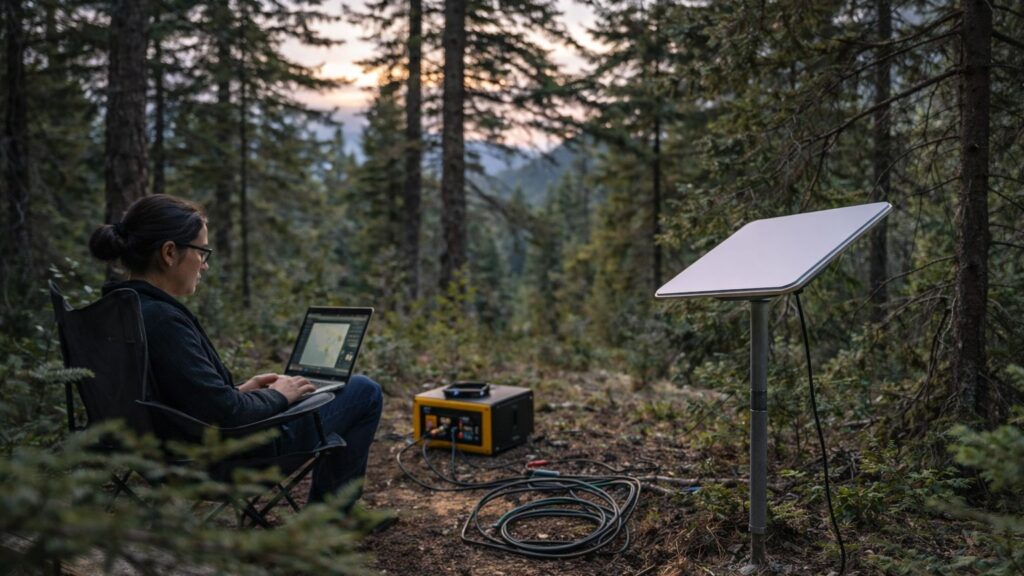
One of the most important decisions in an off-grid internet setup is how much performance you actually need.
High-speed systems like Starlink can support streaming, video calls, and large file transfers, but they require consistent power draw. In contrast, low-power communication devices offer excellent reliability but limited functionality.
This creates a balance:
- High performance → higher energy demand
- Lower power systems → reduced capability
In many real-world setups, users prioritize performance during specific hours, such as work periods, and reduce usage during evenings or overnight to conserve energy.
Understanding your daily usage patterns allows you to design a system that delivers performance when needed without overloading your power infrastructure.
Matching the System to Your Environment

The best off-grid internet setup depends heavily on where and how you live.
Dense Forest or Mountain Terrain
Satellite systems may struggle with obstructions, requiring careful dish placement or elevated mounting positions.
Cellular boosters may perform inconsistently depending on tower placement and terrain shadowing.
Open Land or Desert
Satellite systems perform extremely well with clear sky visibility.
Cellular boosters may also work effectively if towers are within range.
Mobile and Travel Setups
Portability becomes critical. Systems must be quick to deploy and pack away, and power consumption must be tightly managed.
Flat-panel satellite systems and compact boosters are ideal in these scenarios.
Extreme Weather Environments
Cold temperatures reduce battery efficiency, while snow and ice can obstruct equipment.
Choosing rugged hardware and planning for maintenance becomes essential in these conditions.
Matching your system to your environment is often more important than choosing the “best” product overall.
The 5 Best Off Grid Internet Solutions
1. Starlink RV Kit (V4 Hardware)
Starlink currently provides the fastest and most reliable off-grid internet available. The flat dish automatically aligns with satellites and can operate in remote locations with a clear view of the sky.
Users frequently report download speeds exceeding 100 Mbps even in wilderness areas.
Verdict
For cabins, homesteads, or remote work setups that require full internet access, Starlink remains the best option available.
2. WeBoost Drive Reach
The WeBoost Drive Reach is one of the strongest cellular signal boosters available for vehicles and remote properties.
It can transform weak signal areas into usable LTE connections for calls and basic data usage.
Verdict
If your location has even minimal cellular coverage, this booster can dramatically improve reliability.
3. SureCall Fusion2Go Max
SureCall’s Fusion2Go Max offers excellent signal amplification at a slightly lower price than competing systems.
Digital gain control helps prevent signal distortion while maintaining stable performance.
Verdict
A strong choice for cabins or vehicles operating in fringe coverage zones.
4. Garmin inReach Mini 2
The Garmin inReach Mini 2 provides two-way satellite messaging and emergency SOS capability through the Iridium network.
Its compact size and extremely low power draw make it ideal for remote travel and backup communication.
Verdict
Every remote traveler should carry a satellite messenger as a safety backup.
5. ZOLEO Satellite Messenger
ZOLEO offers seamless switching between Wi-Fi, cellular, and satellite networks depending on availability.
Its simple interface and predictable subscription plans make it easy for teams and families to stay connected.
Verdict
One of the easiest satellite messaging systems to use for everyday off-grid communication.
Real-World Use Case Examples
Understanding how these systems work in practice helps clarify what you actually need.
Full-Time Off-Grid Home

A permanent off-grid residence often uses satellite internet as a primary connection, supported by a cellular booster for redundancy. A satellite messenger provides emergency backup.
This setup allows for full remote work capability while maintaining safety.
Vanlife and Mobile Living
Mobile setups prioritize portability and efficiency.
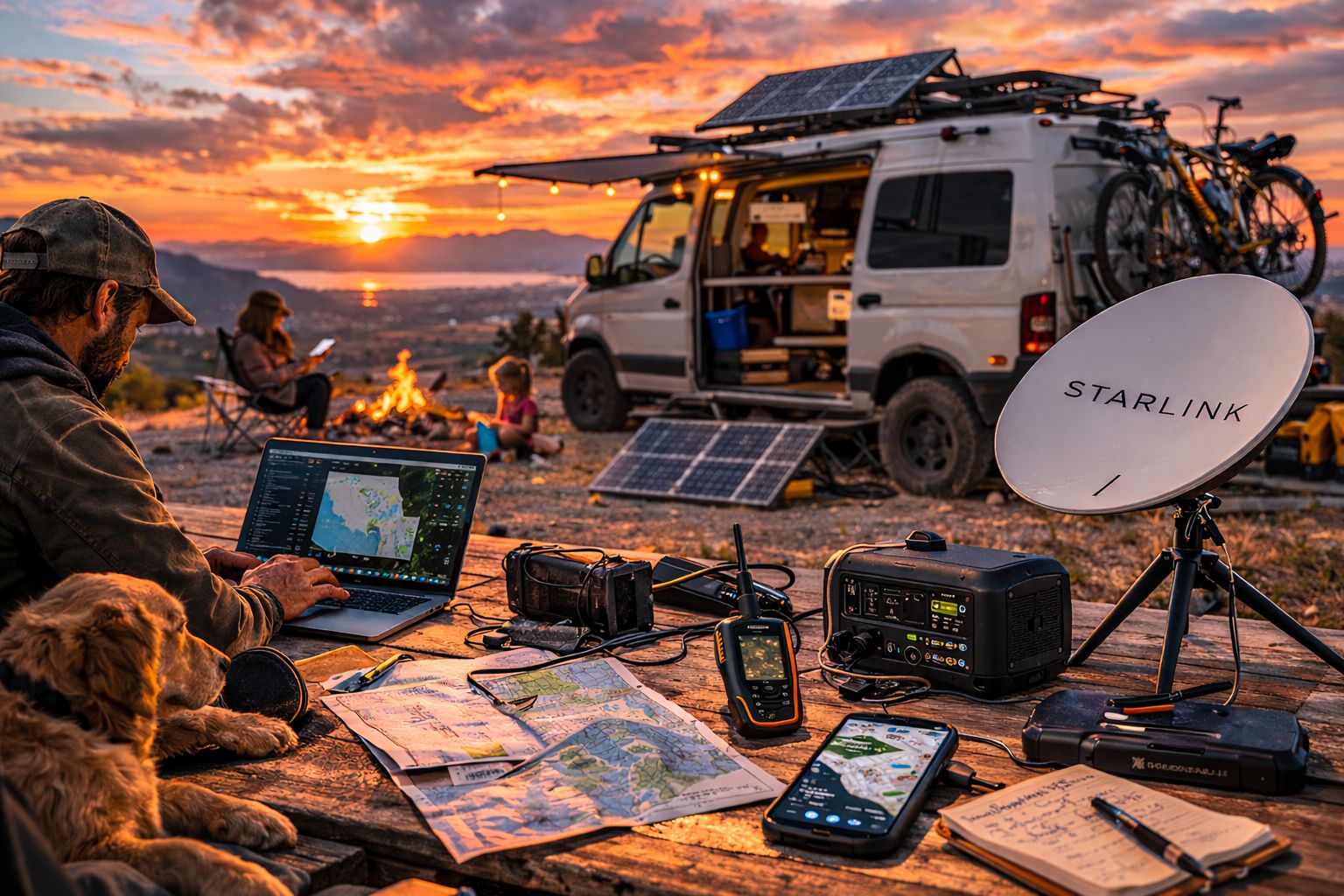
A compact satellite system combined with a small battery bank provides internet access during travel, while low-power devices maintain communication when stationary power is limited.
Remote Cabin or Seasonal Property
For part-time use, a simpler system may be sufficient.
Cellular boosters can provide basic connectivity if coverage exists, while satellite messengers ensure emergency communication.
In these cases, full-time internet may not be necessary, reducing both cost and power requirements.
Real-World Performance Expectations
Marketing specifications rarely reflect real-world performance.
Understanding what to expect helps set realistic expectations.
Speed variability
Satellite internet speeds can fluctuate based on network congestion and time of day.
Latency considerations
Even modern satellite systems have slightly higher latency than wired connections.
Signal consistency
Cellular boosters may vary depending on tower load and environmental conditions.
Uptime reality
No system is perfect. Occasional interruptions should be expected.
The goal is reliability — not perfection.
Building a Layered Connectivity System
Experienced off-grid users rarely rely on a single communication system.
A layered approach improves reliability and resilience.
| Layer | Tool | Purpose |
|---|---|---|
| Primary | Satellite Internet | Broadband connectivity |
| Secondary | Cellular Booster | Regional signal improvement |
| Backup | Satellite Messenger | Emergency communication |
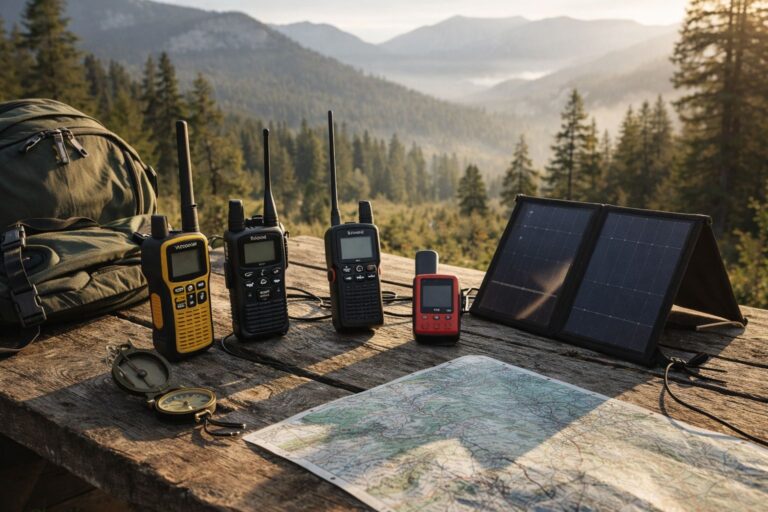
| Local | Radio or Mesh Network | Local coordination |
Combining multiple technologies ensures communication remains available even if one system fails.
Common Setup Mistakes to Avoid
Many off-grid internet frustrations come from simple setup errors.
Undersizing your power system
Running a satellite system without sufficient battery capacity leads to unreliable uptime.
Poor equipment placement
Obstructed satellite dishes will struggle to maintain stable connections.
Relying on a single system
Redundancy is critical for reliability.
Skipping real-world testing
Every environment behaves differently.
Ignoring weather exposure
Proper mounting and protection extend system lifespan.
Avoiding these mistakes dramatically improves long-term performance.
The Future of Off-Grid Connectivity
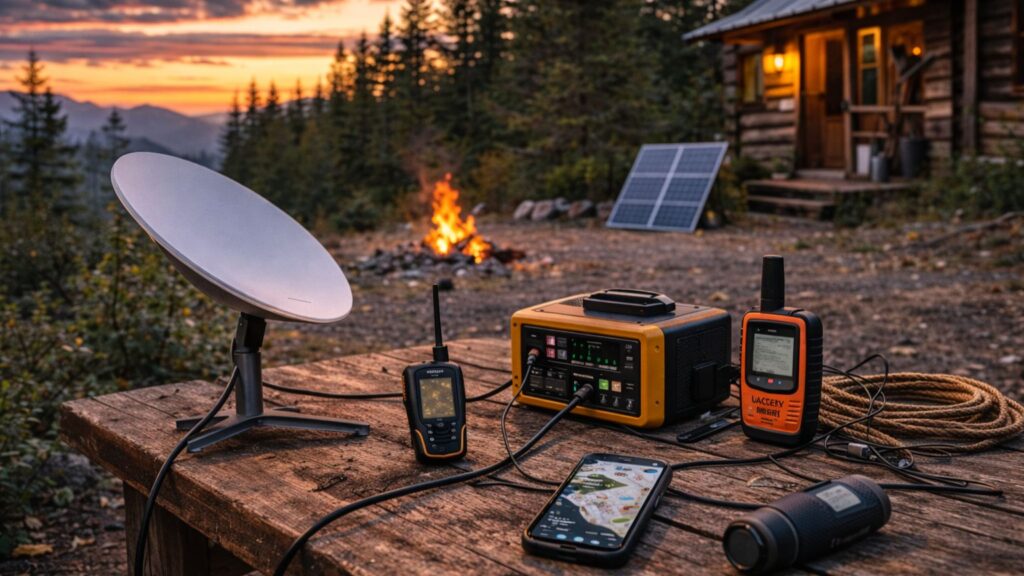
Off-grid internet is evolving rapidly.
New satellite networks are increasing coverage and reducing latency, while hardware continues to become more efficient and portable.
Over time, the gap between grid-connected and off-grid internet will continue to shrink.
This means future systems will:
- Require less power
- Deliver higher speeds
- Become easier to deploy
For off-grid living, this trend is significant. Reliable connectivity is becoming more accessible, making remote lifestyles more practical than ever before.
Planning your system with future upgrades in mind can help extend its usefulness over the long term.
Final Considerations Before You Choose
Before committing to any off-grid internet system, take a moment to step back and evaluate your real-world usage.
Ask yourself:
- How often do I actually need high-speed connectivity?
- What happens if my primary system goes offline?
- Does my power system support continuous operation?
The best setups are not the most powerful — they are the most balanced.
A system that aligns with your lifestyle will always outperform one that simply looks impressive on paper.
Field Verdict
Reliable connectivity is now part of modern off-grid living.
Satellite internet systems provide broadband access almost anywhere, while cellular boosters and satellite messengers add redundancy and emergency communication.
The most resilient off-grid setups combine multiple communication layers to maintain connectivity through outages, storms, and remote travel.
A well-designed communication stack ensures that even the most remote homestead can remain connected when it matters most.