Battery Banks on the Move: Building a Modular Power Kit You Can Take Anywhere
You don’t need a massive solar installation to run reliable off-grid power. In many situations, mobility matters more than raw capacity.
A modular battery kit lets you bring power wherever you go. It can ride in the back of a truck, power an overland rig, support a remote job site, or move between cabins and camps with minimal setup.
For vanlifers, field technicians, and off-grid travelers, portability is often the difference between having power when you need it and leaving critical gear behind.
This guide explains how to build a modular portable battery system using durable, field-tested components that can scale from a small grab-and-go pack to a serious off-grid power kit. :contentReference[oaicite:0]{index=0}
Why Modular Matters in the Field
Fixed solar systems are excellent for permanent installations, but they lack flexibility. Once installed, they’re difficult to relocate, expand, or repair quickly.
Modular power systems solve that problem by keeping power flexible and adaptable.
A modular system allows you to:
- Scale capacity by adding additional batteries
- Replace failed components without rebuilding the system
- Carry power where it’s needed
- Charge from multiple sources
- Maintain redundancy if one part fails
For off-grid users, redundancy and mobility often matter more than total system size.
In real-world scenarios, modularity also reduces downtime. If a battery fails in a fixed system, you may lose everything. In a modular setup, you isolate the issue, swap the component, and keep going.
Core Components of a Mobile Battery Kit
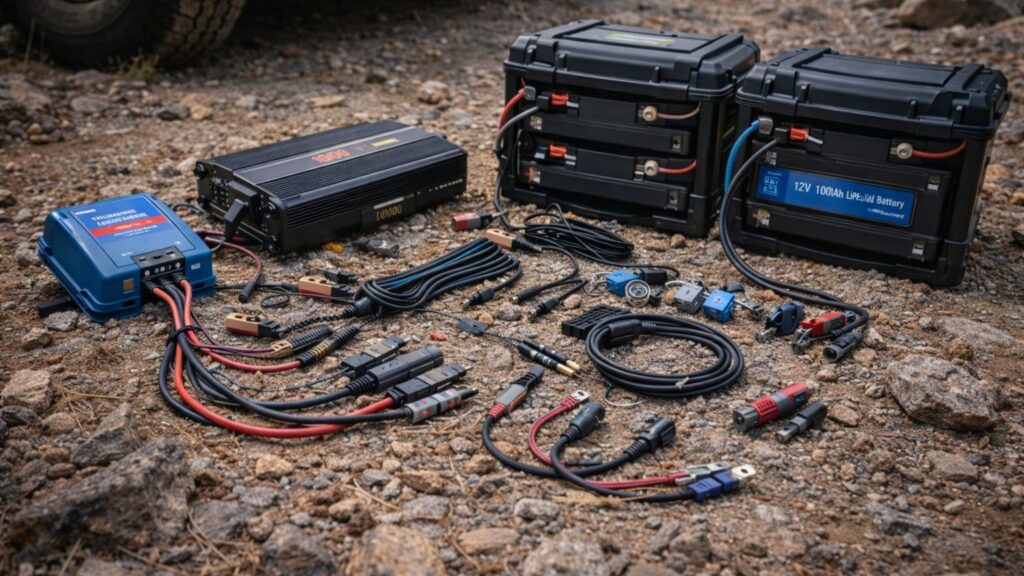
Most portable battery systems are built around five essential components.
- Battery modules (LiFePO4 batteries are now the standard)
- Battery management system or built-in protection
- Charging inputs such as solar, AC charger, or vehicle charging
- Power outputs like an inverter, 12V outlets, or USB ports
- Protective enclosure or frame for mobility and durability
Choosing rugged, reliable parts at each stage determines whether your system survives real-world field use.
Practical Insight
The biggest mistake beginners make is focusing only on battery capacity. In reality, wiring quality, enclosure design, and charging flexibility are what determine how usable your system is day to day.
A smaller, well-built system will outperform a larger, poorly wired one every time.
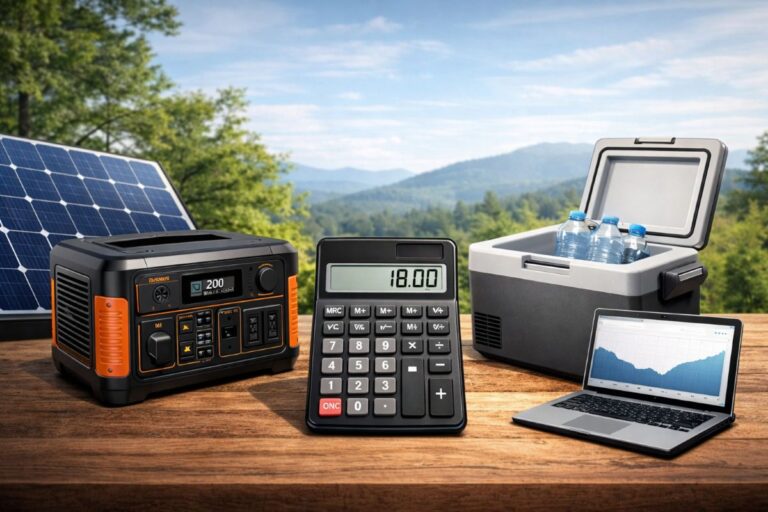
Power Budgeting in a Mobile System (What Can You Actually Run?)
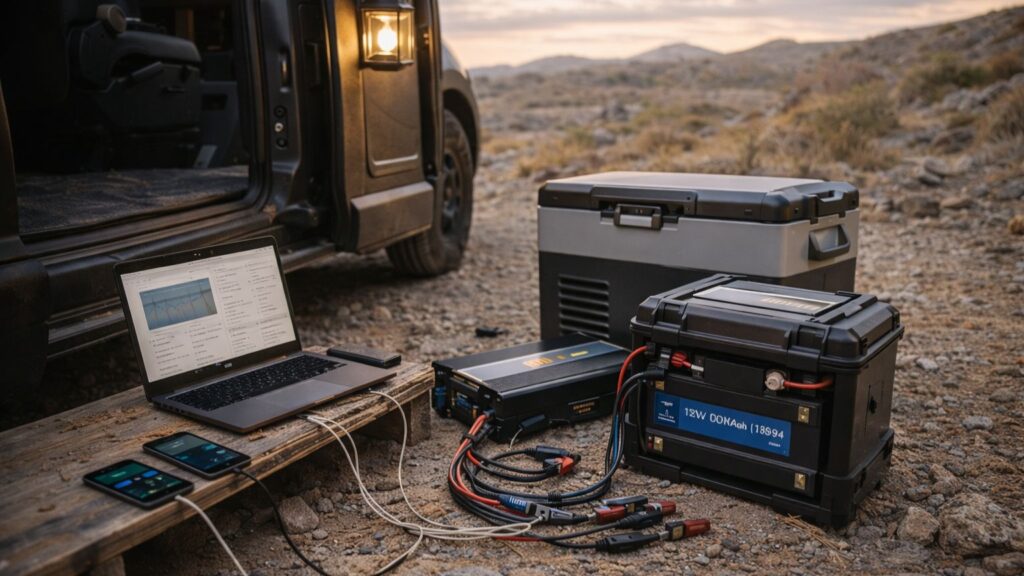
One of the most common questions with portable battery systems is simple:
what can this actually power?
Understanding your power budget is what turns a battery setup from a guess into a reliable tool.
Basic Power Math
Every device you use draws power measured in watts.
Your battery capacity (in watt-hours) determines how long those devices can run.
For example:
- 100W device running for 5 hours = 500Wh
- 1,280Wh battery can theoretically run that setup for over 12 hours (before losses)
Real-world systems will lose some energy through inverter inefficiency and wiring, so it’s always best to assume about 80–90% usable capacity.
Common Device Power Draw
Here’s what typical off-grid gear consumes:
- Laptop: 40–100W
- Portable fridge: 40–60W (cycling)
- LED lighting: 5–20W
- Starlink or router: 50–100W
- Power tools: 500–1500W (short bursts)
Example Real-World Scenario
A 1.2kWh system running:
- Laptop (60W × 5h = 300Wh)
- Fridge (50W avg × 10h = 500Wh)
- Lights + small devices (100Wh total)
Total: ~900Wh per day
This setup would comfortably run for a full day without recharge. Longer with solar input.
Why This Matters
Without a power budget, systems either:
- run out of power unexpectedly
- or are massively oversized and inefficient
A simple calculation upfront ensures your system is built for how you actually live and work.
In off-grid environments, predictability is everything.
Best Modular LiFePO4 Batteries Off Grid Proven
Ampere Time 12V 100Ah LiFePO4
- 1,280Wh capacity
- Integrated 100A BMS
- Long cycle life
This battery has become a popular foundation for DIY off-grid systems thanks to its balance of reliability and price. Multiple units can easily be wired in parallel to expand capacity.
Field note: this battery does not include internal heating, so cold-climate users may need to insulate it.
Bluetti B300 Expansion Battery
- 3,072Wh capacity
- Plug-and-play expansion design
- Compatible with many Bluetti power stations
The B300 is designed specifically for modular expansion and pairs well with Bluetti portable power systems for larger mobile setups.
EcoFlow Delta Pro Extra Battery
- 3.6kWh capacity
- Expandable ecosystem design
- Smart monitoring through the EcoFlow app
EcoFlow’s ecosystem allows portable power systems to grow significantly in size while maintaining mobility.
Dakota Lithium 12V 54Ah
- 691Wh compact battery
- Lightweight construction
- IP65 rated enclosure
This smaller lithium battery is ideal for lightweight systems used in kayaks, gear boxes, and compact rigs.
Smart Chargers and Solar Input Options
A good modular system should support more than one charging method.
Victron Blue Smart IP67 Charger
- Waterproof AC charger
- Bluetooth monitoring
- Designed for marine and RV environments
Victron chargers are widely used in professional off-grid builds because of their reliability and monitoring features.
Renogy Rover MPPT Charge Controller
- Lithium compatible charge controller
- Efficient MPPT solar tracking
- Supports medium-size portable solar arrays
This controller pairs well with portable panels in the 200W to 400W range.
EcoFlow 220W Bifacial Solar Panel
- 220W front output
- Additional rear-side gain from reflected light
- Foldable portable design
Bifacial panels can generate extra power in bright environments where reflected light boosts efficiency.
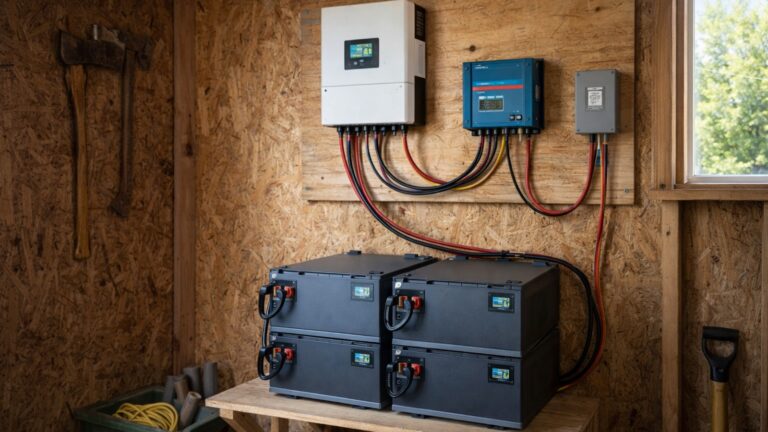
Wiring Harnesses Fuses and Connectors
Reliable wiring is one of the most important parts of a modular power system.
Portable battery builds should include:
- Quick-swap wiring harnesses
- Proper inline fusing
- Secure battery terminals
Common components used in field systems include:
- Blue Sea Systems marine fuse blocks
- Anderson Powerpole connectors for quick disconnects
- MC4 solar connectors
- ANL fuse holders for battery protection
Why This Matters
Loose or undersized wiring is one of the most common causes of system failure in mobile setups. Vibration, movement, and repeated handling put constant stress on connections.
Well-built wiring isn’t just about performance. It’s about safety.
Enclosures and Mobility Frames
Portable power systems must be protected from vibration, dust, and weather.
Pelican 1620 Case
A rugged waterproof case capable of housing batteries, wiring, and chargers. These cases are widely used in industrial and expedition environments.
EcoFlow Delta Pro Rolling Case
For larger portable power stations, rolling hard cases provide mobility without sacrificing protection.
Budget DIY Crate System
Some builders use reinforced plastic crates with wood bases and foam inserts to create lightweight battery boxes.
This approach can be surprisingly effective when properly secured.
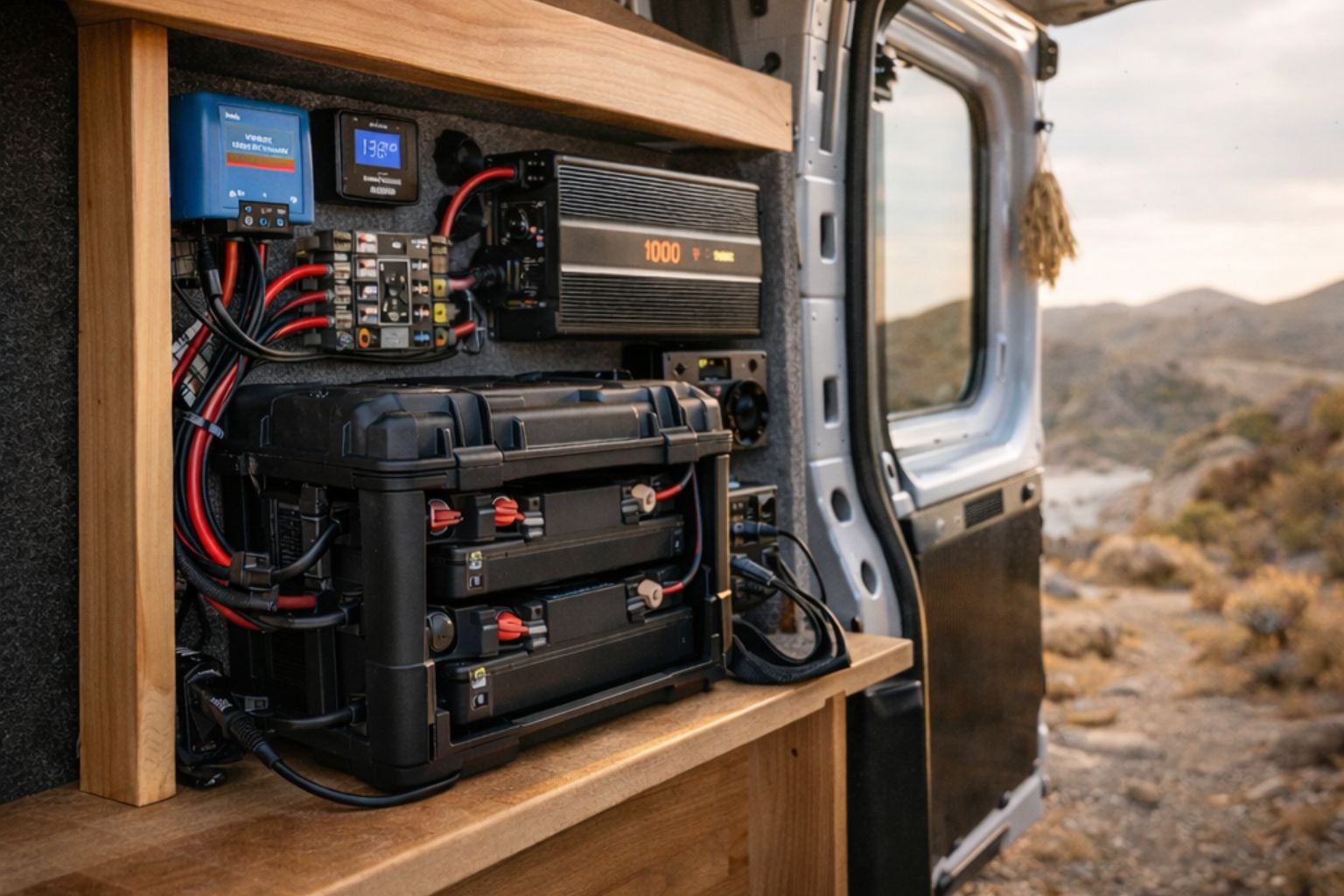
Real-World Setup Example
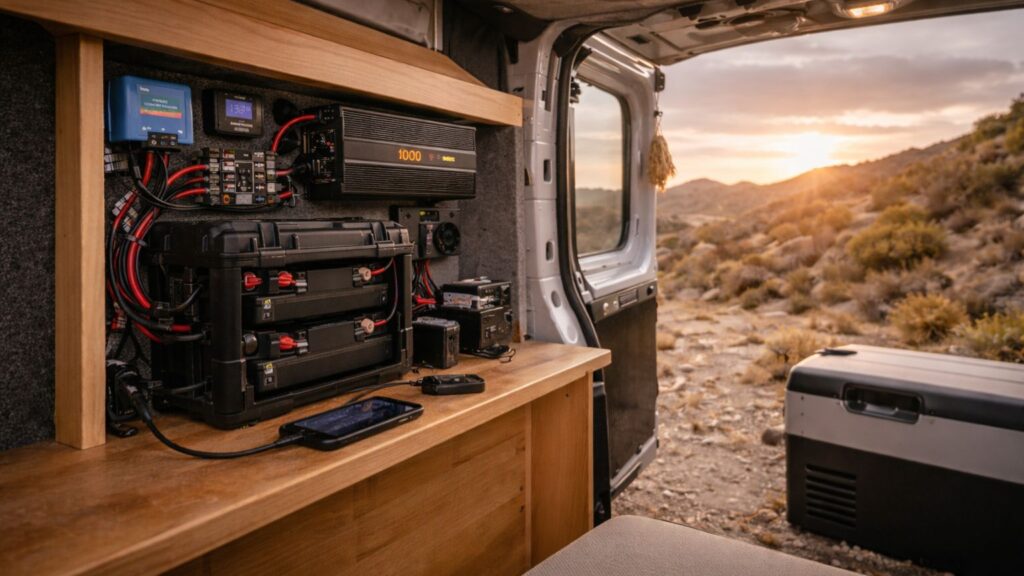
A van-based off-grid system uses two 100Ah LiFePO4 batteries mounted in a reinforced enclosure behind the driver seat.
The system includes:
- 1000W inverter
- MPPT charge controller
- Roof-mounted solar array
- Quick-disconnect wiring harness
The setup allows:
- Easy battery expansion
- Fast component replacement
- Reliable daily power for work and living
When one component fails, the system continues operating. This is the core advantage of modular design.
What Breaks First in Mobile Power Systems (And How to Prevent It)
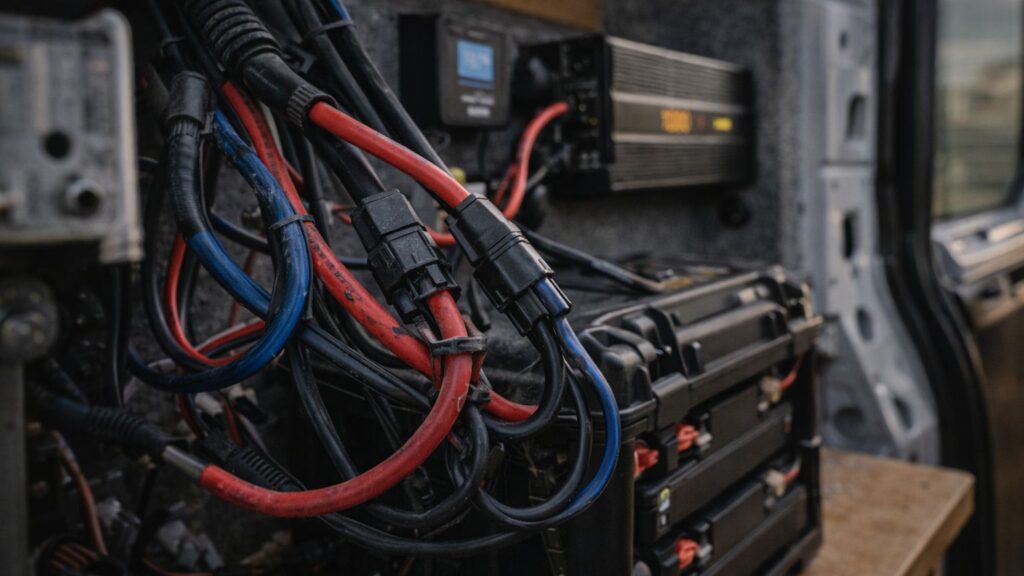
Portable battery systems live a much harder life than fixed installations.
They get moved, bumped, exposed to temperature swings, and used in unpredictable environments. Because of that, failure patterns look very different compared to stationary systems.
Understanding what fails first, and why, is one of the fastest ways to build a system that actually holds up.
Wiring and Connection Points
The most common failure in mobile systems isn’t the battery.
It’s the wiring.
Constant vibration and movement slowly loosen connections over time. Even a slightly loose terminal can cause:
- voltage drops
- heat buildup
- intermittent power loss
- eventual connector failure
Quick-disconnect systems are especially vulnerable if they’re not properly secured.
Prevention:
- use properly crimped connectors (not hand-twisted wires)
- periodically check and re-tighten terminals
- secure cables so they don’t move freely during transport
A well-secured cable will outlast a high-end battery with poor connections.
Fuse and Protection Failures
Fuses are designed to fail — but in mobile systems, they sometimes fail prematurely due to:
- vibration fatigue
- heat buildup in tight enclosures
- poor-quality fuse holders
A blown fuse in the field can shut your system down completely if you don’t have spares.
Prevention:
- use marine-grade fuse blocks and holders
- keep spare fuses in your kit
- mount fuse blocks in stable, protected locations
Inverter Stress and Overload
Inverters are another common failure point, especially in systems used for tools or high-draw devices.
Problems occur when:
- loads exceed rated capacity
- startup surges are not accounted for
- ventilation is poor
This leads to overheating, shutdowns, or long-term degradation.
Prevention:
- size your inverter with headroom (not at maximum load)
- allow proper airflow around the unit
- avoid enclosing inverters in sealed boxes
Battery Handling and Mounting Issues
Lithium batteries are durable, but they are not immune to physical stress.
Improper mounting can lead to:
- internal damage over time
- loose terminals
- case wear or cracking
This is especially common in vehicle-based systems where vibration is constant.
Prevention:
- mount batteries securely using brackets or foam isolation
- avoid hard impacts during transport
- prevent sliding or shifting inside enclosures
Charging System Weak Points
Charging failures are often overlooked until the system stops replenishing energy.
Common issues include:
- damaged solar connectors
- loose MC4 connections
- poor vehicle charging wiring
- incompatible charging profiles
If your system doesn’t charge reliably, capacity becomes irrelevant.
Prevention:
- inspect solar connectors regularly
- use strain relief on charging cables
- verify charge controller settings for lithium batteries
The Pattern Behind Most Failures
Across real-world builds, failures rarely come from major components.
They come from:
- small connection issues
- overlooked mounting details
- poor cable management
These are not expensive problems — but they are common.
The Field Rule That Changes Everything
In mobile systems:
Durability matters more than specs.
A slightly smaller system that is:
- well secured
- properly wired
- easy to service
…will outperform a larger system that isn’t built for movement.
Build for the Environment, Not the Spec Sheet
Ask yourself:
- Will this survive vibration?
- Can I fix this quickly in the field?
- Are the connections secure over time?
If the answer is yes, your system will hold up.
If not, it will eventually fail, no matter how expensive the components are.
Portable power isn’t just about what you build.
It’s about how well it survives being used.
Common Mistakes to Avoid
- Overcomplicating the system too early
- Using undersized wiring
- Skipping proper fusing
- Poor ventilation for batteries and inverters
- Relying on a single charging source
- Not planning for expansion
Most issues come from trying to do everything at once instead of building in stages.
Expansion Strategy: Building Over Time
One of the biggest advantages of modular systems is that you don’t need to build everything at once.
A smart approach looks like this:
Stage 1 — Base System
- Single LiFePO4 battery
- Small inverter
- Portable solar panel
Stage 2 — Added Capacity
- Second battery in parallel
- Improved wiring and fuse protection
Stage 3 — Full System
- Dedicated solar array
- Permanent mounting
- Redundant charging inputs
This staged approach spreads cost over time and allows you to learn the system as you build it.
[Related: Choosing the Right Solar Generator Size]
12V vs 24V vs 48V Systems (When to Upgrade Your Voltage)
As modular systems grow, voltage becomes an important design decision.
Most small portable setups start at 12V, but larger systems often benefit from higher voltage configurations.
12V Systems
Best for:
- Small portable kits
- Van builds
- Basic off-grid setups
Advantages:
- Simple wiring
- Widely compatible components
- Easy to expand in small increments
Limitations:
- Higher current at larger loads
- Thicker cables required
- Less efficient at scale
24V Systems
Best for:
- Medium-size mobile systems
- Larger van or trailer builds
Advantages:
- Lower current than 12V
- Improved efficiency
- Better support for mid-range inverters
48V Systems
Best for:
- High-capacity mobile systems
- Hybrid portable + cabin setups
Advantages:
- Much lower current
- Thinner wiring
- High efficiency for large loads
Limitations:
- More complex setup
- Less beginner-friendly
When to Upgrade
A good rule of thumb:
- Stay 12V under ~1500W systems
- Consider 24V for 1500–3000W
- Move to 48V above that
Upgrading voltage too early adds complexity.
Upgrading too late creates inefficiency.
The goal is balance. Match your voltage to your actual usage, not your future plans.
Practical Takeaway
For most modular, portable systems:
👉 12V is the right starting point
👉 24V is the smart upgrade
👉 48V is for serious power users
Build simple first, then scale intelligently.
Field-Tested Upgrades That Make a Difference
Some small upgrades dramatically improve usability and reliability:
- Install voltmeters or battery monitors for real-time tracking
- Use labeled wiring to simplify troubleshooting
- Add quick-disconnect connectors for fast swaps
- Mount components securely to prevent vibration damage
- Keep spare fuses and connectors on hand
These details don’t show up in product specs, but they matter in the field.
Our Favorite Mobile Off Grid Power Components
| Product | Use Case |
|---|---|
| Ampere Time 100Ah LiFePO4 | Reliable modular battery foundation |
| Renogy Rover MPPT | Solar charge controller |
| Victron Blue Smart Charger | AC lithium battery charging |
| EcoFlow B300 | Modular expansion battery |
| Pelican 1620 Case | Rugged battery enclosure |
| IWISS Crimp Tool Kit | Wiring tools for field builds |
When a Modular System Is the Wrong Choice
Modular battery systems are incredibly flexible, but they’re not the right solution for every situation.
In some cases, a fixed system will outperform a portable one.
Permanent Full-Time Homes
If you are living full-time in one location with stable infrastructure, a fixed solar and battery system is usually more efficient.
Fixed systems allow for:
- cleaner wiring layouts
- higher voltage configurations
- better long-term durability
A modular system can still play a role as backup, but it shouldn’t replace a properly designed permanent install.
High-Demand Power Needs
If your daily usage includes:
- air conditioning
- electric heating
- large appliances
A portable modular system becomes less practical.
At that scale, you’re better off building a centralized high-capacity system rather than trying to piece together multiple portable units.
Harsh, Static Environments
In environments where:
- vibration is minimal
- movement is rare
- weather exposure is extreme
A sealed, fixed installation often holds up better over time than a system designed for portability.
The Balanced Approach
For many off-grid users, the best solution is a hybrid approach:
- Fixed system for primary power
- Modular system for backup and mobility
This gives you the reliability of a permanent setup with the flexibility of portable power when needed.
Practical Takeaway
Modular systems are not about replacing traditional setups.
They are about adding flexibility where fixed systems fall short.
Used correctly, they become one of the most valuable tools in an off-grid power strategy.
Final Thoughts
A modular battery system gives you something a fixed installation cannot — adaptability.
You can start with a single lithium battery and portable panel, then expand into a multi-kilowatt system as your needs grow.
For anyone living, working, or traveling beyond the grid, that flexibility is one of the most valuable features a power system can have.
In off-grid environments, power isn’t just about capacity. It’s about being able to move it, fix it, and rely on it anywhere.