Beyond Solar: How to Build a True Energy-Sovereign Life
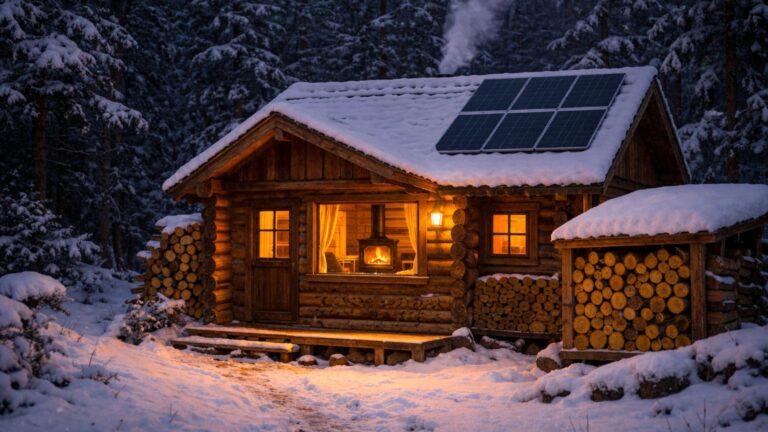
The dream of self-reliance often starts with a single image. A solar array glinting on a cabin roof, sunlight silently turning into freedom.
But ask anyone who’s lived through a week of heavy clouds, and they’ll tell you the truth: solar is only half the story.
Real off-grid mastery means energy sovereignty. A layered, resilient system that doesn’t care if the sun hides, the wind stills, or the temperature drops.
This is the art of diversification: building power systems that work together instead of failing alone.
Let’s go beyond solar and build something that runs itself, rain or shine.
The Myth of the “Solar-Only” Solution
Solar is the gateway drug to off-grid life. It’s quiet, affordable, and satisfying to watch those watts flow in. But here’s the catch:
even a 5 kW solar setup becomes useless after three days of storms, snow, or heavy forest shade.
The danger: overconfidence in a single energy source.
When your independence hinges on one weather pattern, you’re not off-grid. You’re just off-balance.
Energy sovereignty isn’t about going bigger. It’s about going broader.
Multiple power inputs, smart storage, and low-consumption living form the true foundation of freedom.
Layer One — Sunlight: Still the Backbone
Solar remains the backbone because it’s silent, predictable, and scalable.
Today’s panels last 25–30 years and keep producing even in partial shade.
Core strategy: design your array for your weakest season.
If you live in northern climates, size your system for December, not July. That often means 30–40% more panel capacity than you “need” in summer.
Battery pairing matters:
- LiFePO₄ for longevity and depth of discharge.
- AGM for simplicity in cold storage cabins.
- Saltwater or sodium-ion for eco resilience.
Smart picks:
- Panels: REC Alpha Pure, Qcells Duo, Canadian Solar HiKu.
- Controllers: Victron SmartSolar, Renogy Rover.
Oversize your wiring, protect with DC breakers, and give your panels a tilt that matches your latitude plus 15° for winter boost.
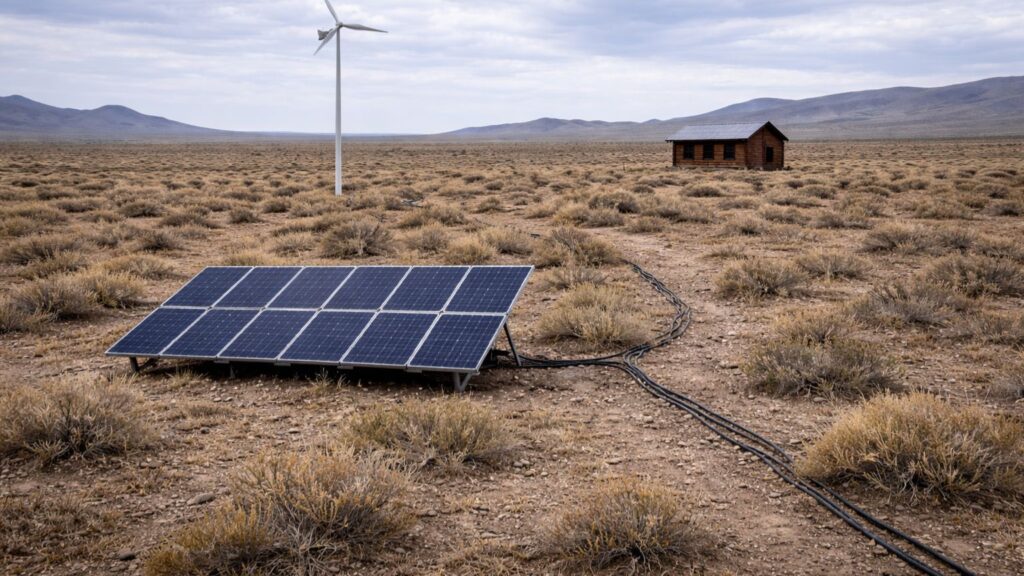
Layer Two — Wind Power: The Nighttime Equalizer
Wind fills the gaps solar leaves behind. It blows hardest in storms, at night, and during winter. Exactly when you need it most.
Advantages:
- Works while you sleep.
- Generates during overcast or stormy conditions.
- Can run directly into a battery bank or hybrid inverter.
Key design rules:
- Height matters. Doubling tower height often triples output.
- Keep clear airspace. 10× rotor diameter from obstructions.
- Expect maintenance: bearings, blades, and regulators wear faster than panels.
Solid turbines to consider:
- Primus AIR 40 — compact, marine-proven.
- Tumo-Int 400W — good for cabins.
- Nature Power 2000W — serious hybrid contender.
Add a wind diversion load to prevent overcharging on stormy nights, and log average wind speeds before you invest. No wind = no win.
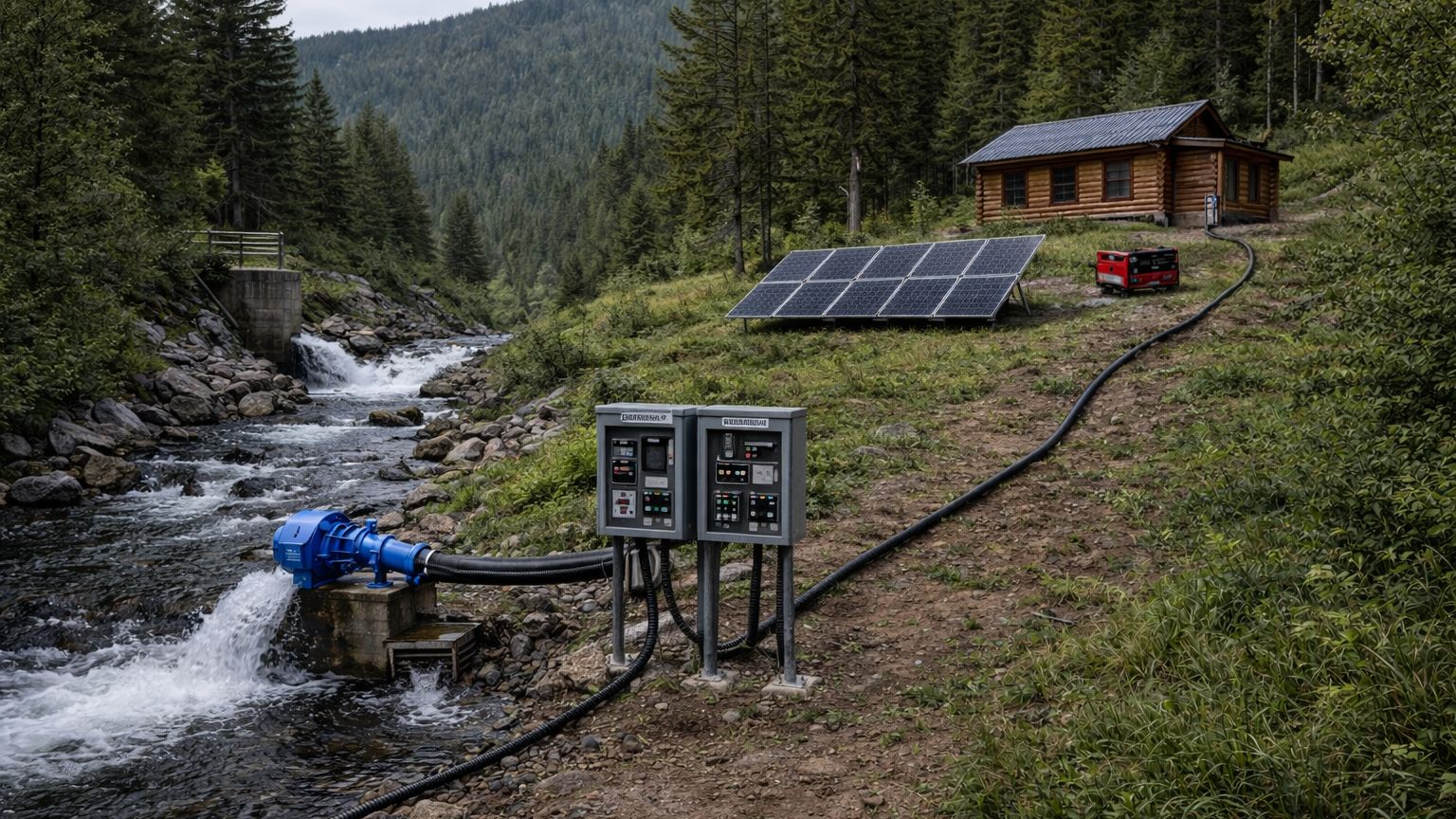
Layer Three — Micro-Hydro: The 24/7 Producer
If you have access to running water with decent fall (head), micro-hydro is the holy grail. Unlike solar or wind, it runs constantly.
Key metrics:
- Flow: how much water per second.
- Head: vertical drop (height).
- Pipe diameter: controls friction loss.
A steady 100 W micro-hydro turbine produces more daily energy than a 1 kW solar array in winter.
Top units:
- PowerSpout PLT14 (modular, robust).
- Scott Hydro Turbine (custom head builds).
- Stream Engine (long-proven reliability).
Protect your intake:
- Use a screened inlet to block debris.
- Drain pipe in freezing weather or use a bypass loop.
- Check bearings quarterly.
“Hydro is the hum you forget about. The one that keeps your fridge cold through every storm.”
Layer Four — Thermal Mass and Heat Recovery
Electric power isn’t your only energy form. Heat is energy, too. Thermal storage can replace thousands of watts of electrical load.
Examples:
- Rocket mass heaters: burn small sticks, release slow, steady warmth.
- Masonry stoves: retain heat for 12+ hours.
- Thermal batteries: phase-change salts or stone beds that store daytime heat for night release.
You can even capture waste heat from generators or cooktops with copper coil loops feeding into water tanks or radiant floors.
This is ancient wisdom meeting modern materials: simple, repairable, endlessly renewable.
Layer Five — The Generator Safety Net
No matter how advanced your system is, a backup generator closes the loop between comfort and catastrophe.
Fuel choices:
- Propane — clean, long shelf life, pairs well with dual-fuel units.
- Diesel — reliable in cold climates, ideal for heavy loads.
- Gasoline — fine short-term but degrades quickly.
Smart operation:
- Run only during bulk charging. Stop once your batteries reach ~80%.
- Use inverter/charger auto-start for hands-free backup.
- Store at least two weeks of stabilized fuel.
Recommended models:
- Champion 2500 Dual Fuel — light, reliable, budget-friendly.
- Honda EU2200i — legendary quiet efficiency.
- Bluetti AC500 — hybrid solar/generator smart switching.
A good generator isn’t defeat. It’s insurance. The goal is to use it rarely, but confidently.
Layer Six — Storage as Strategy
You don’t just store energy. You shape it.
The smartest off-gridders run multiple battery banks, each serving a different role.
Example strategy:
- Critical bank (LiFePO₄): runs fridge, comms, lighting.
- Comfort bank (AGM): runs A/C, tools, luxuries.
- Backup bank: older batteries kept charged for emergencies.
Different chemistries fail differently. Mixing them, when managed properly, gives you resilience no single pack can offer.
Batteries are your invisible power reservoir. Treat them as your off-grid heart.
Layer Seven — Passive Energy and Design Efficiency
Before you add generation, reduce need.
Energy you don’t have to make is energy you’ve already earned.
Passive design principles:
- Orientation: maximize south-facing glazing for winter solar gain.
- Thermal zoning: cluster high-use spaces near heat sources.
- Insulation: R-30 floors, R-40 walls, R-60 ceilings. Serious difference.
- Gravity systems: gravity-fed water and convection-based ventilation.
A well-designed cabin can maintain comfort on a tenth of the power of a standard house.
“You can’t out-solar bad insulation.”
Cold Climate Reality: Why Systems Fail in Winter
Winter is the ultimate stress test for any off-grid system.
Everything gets worse:
- Solar output drops
- Batteries lose efficiency
- Mechanical systems stiffen
- Fuel behaves differently
The Solar Problem
Short days + low sun angle + snow cover = massive production loss.
Even well-designed systems can drop to:
20–30% of summer output
Battery Performance Loss
Lithium batteries:
- Cannot charge below freezing without protection
Lead-acid:
- Lose capacity in cold
Result:
You have less stored energy AND less ability to recharge it.
Wind and Ice
Wind turbines help in winter — but:
- Ice buildup reduces efficiency
- Bearings stiffen
- Towers take more stress
Hydro Freezing Risk
Micro-hydro systems:
- Freeze at intake
- Freeze in pipe
- Lose flow entirely
Fuel and Generator Issues
Diesel gels
Gasoline degrades
Cold starts become harder
What Actually Works
Real winter-ready systems include:
- Oversized solar arrays
- Insulated battery enclosures
- Heated battery management (if lithium)
- Generator as primary winter fallback
- Reduced load expectations
The Mindset Shift
Winter isn’t just a season. It’s a different operating mode.
You:
- Use less
- Plan more
- Rely on backup systems
Design for winter first, and your system will feel effortless the rest of the year.
Design for summer, and winter will expose every weakness you have.
The Energy Descent Mindset
True sovereignty means redefining enough.
Living off-grid isn’t about endless abundance. It’s about rhythm.
You learn to cook when the sun’s up, charge tools in the afternoon, and let the dark be dark.
Energy descent isn’t a step backward. It’s evolution toward harmony.
Your system mirrors nature: balanced, cyclical, efficient.
You stop fighting the weather and start dancing with it.
Real-World Hybrid Examples
Example 1: Mountain Cabin
- 1 kW solar array, 400 W wind turbine, small hydro trickle.
- Year-round uptime with minimal battery cycling.
Example 2: Desert Homestead
- Solar roof + solar thermal water + high thermal mass walls.
- Near-zero night heating costs.
Example 3: Northern Farmstead
- Solar + wind + propane generator hybrid.
- Heat recaptured via masonry stove and water coils.
Each one demonstrates redundancy, synergy, and seasonal balance.
How to Phase a Hybrid System Without Overspending
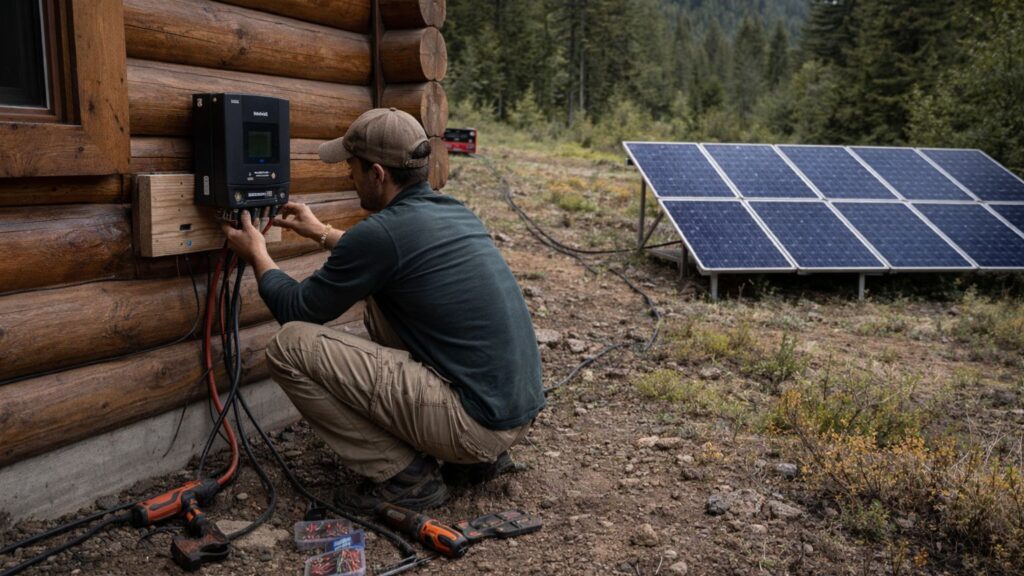
One of the biggest mistakes people make is trying to build a “perfect system” all at once.
That approach usually leads to:
- Overspending
- Overcomplication
- Underutilized components
A better strategy is phased deployment.
Phase 1 — Core Survival System
Start with:
- Solar array
- Battery bank
- Basic inverter
Goal:
Run essentials reliably:
- Fridge
- Lights
- Communications
Do NOT design for comfort yet.
Phase 2 — Redundancy Layer
Add:
- Generator
- Improved charge control
- Monitoring
Now your system can survive:
- Multi-day outages
- Seasonal dips
Phase 3 — Secondary Input
Add ONE additional energy source:
- Wind OR hydro
Not both.
Why:
- Learn one system properly
- Avoid compounding complexity
Phase 4 — Load Expansion
Now increase usage:
- Tools
- Appliances
- Comfort systems
Only after generation is stable.
Phase 5 — Optimization
Now refine:
- Add second battery bank
- Improve efficiency
- Automate switching
Key Principle:
Sequence matters more than components.
Most failures come from:
“Too much system, too early.”
A phased system:
- Teaches you your own energy habits
- Reveals weak points early
- Keeps costs aligned with reality
Build like a system designer — not a shopper.
Component Matching: Why Mixing Gear Can Break Your System
A common mistake in off-grid builds is assembling systems from mismatched components that technically “work,” but don’t work well together.
Hybrid systems are especially sensitive to this.
Voltage Mismatch Problems
Example:
- 24V panels feeding a 48V system improperly
- Controllers constantly compensating
Result:
- Efficiency loss
- Heat buildup
- Reduced lifespan
Charge Profile Conflicts
Different batteries require different charging profiles.
If your system mixes:
- Lithium
- AGM
- Older lead-acid
You can run into:
- Undercharging one bank
- Overcharging another
This leads to:
- Capacity loss
- Premature failure
Inverter and Battery Communication Gaps
Some modern systems rely on communication protocols (CAN, Bluetooth, etc.).
If your inverter and battery:
- Don’t “talk” properly
You lose:
- Accurate state-of-charge readings
- Smart charging control
- Safety protections
Cable Sizing and Resistance Issues
Even if everything else is correct:
Undersized cables:
- Create voltage drop
- Generate heat
- Reduce system efficiency
In hybrid systems, this gets worse because:
- Multiple inputs amplify losses
Cheap Component Trap
Mixing premium and budget gear often creates bottlenecks.
Example:
- High-end panels
- Cheap controller
Result:
- Your system performs at the level of the weakest component
The Fix: System Cohesion
Strong systems are:
- Designed as ecosystems
- Not assembled as collections
Best practice:
- Match voltage across all components
- Use compatible communication systems
- Standardize battery chemistry where possible
The Rule
Your system is only as strong as its weakest integration point.
Don’t just build a system that works. Build one that works together.
Planning Your Own Hybrid System
- Map your land: track sun path, wind direction, and water flow.
- Ask: “What still runs if the sun disappears for five days?”
- Simulate: use Victron Toolkit, HOMER, or SolarCalc to forecast load and generation.
- Design for failure: build backup for your backup.
A well-planned hybrid system is boring. And that’s the point.
It just works.
Failure Modes in Hybrid Energy Systems (What Actually Breaks First)
Most hybrid systems don’t fail catastrophically. They degrade quietly until something small cascades into something expensive.
The biggest misconception is that “more sources = more reliability.” In reality, more sources = more complexity, and complexity introduces new failure points.
Common real-world failure modes:
1. Controller Conflicts
When solar, wind, and generator charging all feed into the same battery bank, poorly configured charge controllers can fight each other.
Example:
- Solar is in absorption mode
- Generator kicks in and pushes voltage higher
- Wind controller diverts incorrectly
Result: overvoltage, battery stress, or shutdown loops.
Fix:
- Use coordinated systems (Victron ecosystem, hybrid inverter setups)
- Or isolate inputs with proper charge priority logic
2. Battery Imbalance Across Banks
Running multiple battery banks is powerful, but dangerous if unmanaged.
Common issue:
- One bank cycles heavily
- Another sits idle
Over time:
- Capacity mismatch develops
- Transfer loads become unstable
Fix:
- Rotate usage
- Monitor each bank independently
- Never parallel mismatched chemistries directly
3. Phantom Loads Killing Efficiency
In hybrid systems, idle consumption adds up fast.
Examples:
- Inverter standby draw
- Monitoring systems
- Controllers
- Always-on DC loads
You can lose:
5–15% of daily production to “nothing.”
Fix:
- Measure idle draw
- Use low-power modes
- Shut down non-essential systems
4. Weather Synchronization Failures
Worst-case scenario:
- No sun
- No wind
- Frozen hydro intake
This happens more often than people expect.
Fix:
- Always design for “triple failure windows”
- Maintain generator readiness
- Store extra energy buffer in winter
5. Wiring and Connection Degradation
Hybrid systems mean:
- More connections
- More terminals
- More vibration points
Failure signs:
- Heat discoloration
- Voltage drop
- Intermittent outages
Fix:
- Annual torque checks
- Anti-corrosion grease
- Oversized cables
Hybrid systems don’t fail because of big design mistakes. They fail because of small overlooked details repeated across multiple subsystems.
Build clean. Monitor everything. Expect drift.
Load Management Strategies That Actually Work Off-Grid
Most off-grid systems don’t fail because of poor generation. They fail because of unmanaged consumption.
People focus heavily on panels, turbines, and batteries, but the real leverage comes from controlling when and how power is used.
Time-Based Load Shifting
The simplest and most effective strategy is aligning usage with production.
Example:
- Run power tools during peak solar hours (10 AM–3 PM)
- Charge devices mid-day instead of overnight
- Avoid heavy loads at night unless necessary
This reduces:
- Battery cycling
- Depth of discharge
- Generator runtime
Priority Load Structuring
Not all loads are equal.
Break your system into tiers:
Tier 1 — Critical
- Fridge
- Communications
- Lighting
Tier 2 — Important
- Water pumps
- Fans
- Work equipment
Tier 3 — Comfort
- Air conditioning
- Entertainment systems
- Non-essential appliances
Wire or program your system so:
- Tier 1 never shuts off
- Tier 3 gets cut first under low battery conditions
Smart Inverter Programming
Modern hybrid inverters allow:
- Load shedding
- Auto shutdown thresholds
- Generator trigger points
Key settings to dial in:
- Low-voltage cutoff
- Generator auto-start voltage
- Max discharge limits
A poorly configured inverter can drain your system faster than bad weather.
DC vs AC Efficiency
Many systems waste energy converting between DC and AC unnecessarily.
Where possible:
- Use DC appliances (lighting, fridges, fans)
- Reduce inverter runtime
Every conversion step costs energy. Usually 5–15%.
Hidden Load Killers
Watch for:
- Old appliances with high idle draw
- Cheap power bricks
- Always-on electronics
These “small” loads quietly drain your system over time.
The Reality
A well-managed load profile can:
- Reduce system size requirements
- Extend battery lifespan
- Eliminate unnecessary generator use
You don’t need more power. You need better timing.
Off-grid success isn’t just about generation.
It’s about discipline in consumption.
Maintenance and Monitoring
A multi-source system needs cross-checking, not constant tinkering.
Routine schedule:
- Weekly: visual check for leaks, corrosion, bird nests, frost.
- Monthly: clean turbine blades, flush hydro intake, inspect cables.
- Quarterly: log each source’s kWh production to spot imbalance early.
Automate what you can with smart shunts, Wi-Fi monitors, and inverter relays. But still do physical inspections. Tech doesn’t replace touch.
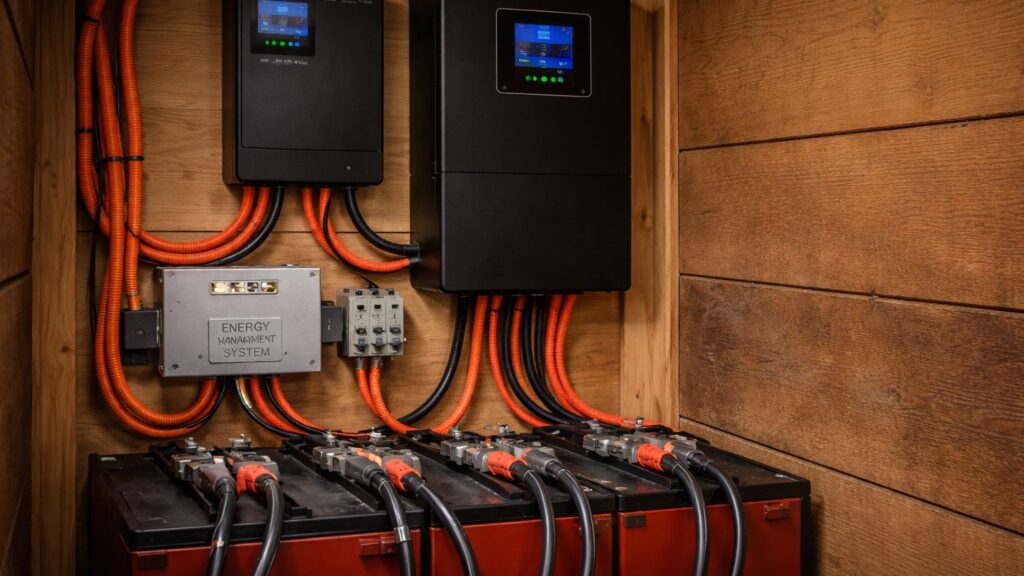
The True Goal — Forget It’s Even There
The highest level of off-grid mastery isn’t obsessive management.
It’s forgetting that your system even exists because it never fails.
Energy sovereignty isn’t about chasing perfection. It’s about designing for peace of mind.
When your systems hum quietly while you focus on life, you’ve reached it.
Build redundancy. Embrace simplicity. Achieve silence.